

The release of the blendOS 4 distribution has been announced, utilizing container isolation to ensure coexistence within a single system of packages from various Linux distributions. In addition to packages from the Arch Linux distribution, which is part of the base environment, and universal packages in Flatpak format, there is the option to install packages from Fedora 39, Debian 13 (testing branch), CentOS Stream, and Ubuntu 22.04 (packages are installed in containers based on these distributions). Additionally, blendOS provides an environment for installing and running Android applications from the Google Play and F-Droid catalogs. Users can choose from desktop environments including GNOME, KDE, Xfce, MATE, Budgie, Cinnamon, and LXQt. The size of the installation image is 2.2 GB.
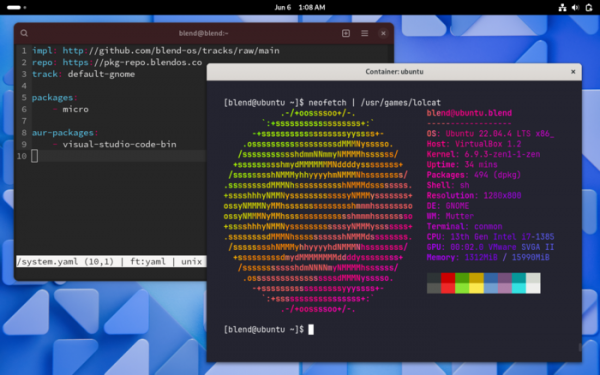
The base system environment remains unchanged during operation (immutable) and is updated in an atomic manner using interchangeable root partitions. The source of updates comes from newer ISO images, the contents of which are synchronized with the base environment via zsync (the average size of data downloaded during updates is between 10 and 100 MB). When a new ISO image is available, a second root filesystem is created based on it, which will become the working root filesystem upon the next reboot, while the old one remains for the next update installation.
For the installation of the distribution, a custom installer backend is used with an interface based on Jade-GUI from Crystal Linux. The creation of scripts for replicating identical installations on different computers is supported — desktop settings, the list of deployed containers, and the list of packages installed within them can be saved to a YAML file, which can be imported into another system.
The new release is notable for its transition to a declarative description of the components, stored in a single file "/system.yaml". The user can specify in this file the necessary packages for installation on top of the base system, desktop environments, Linux kernel versions, and drivers available in the Arch Linux repository. At the same time, the atomic nature of the base system is preserved, while all additional packages expand it.
I separata containrar, som aktiveras via systemets konfigurationsprogram eller kommandoradsverktyg, kan paket installeras från Fedora-, Debian-, CentOS Stream- och Ubuntu-repositorier. Försök att öppna paket i formaten DEB, RPM och APK leder också till att en container automatiskt skapas med den nödvändiga distributionen för det paketet. Vid installation av samma applikationer i olika containrar fattas beslutet om vilken version av applikationen som ska köras baserat på den angivna prioriteten.
Applikationer från containrar integreras med huvudsystemet genom ett verktyg som liknar Distrobox (den första versionen av blendOS var en wrapper kring Distrobox, men den har sedan dess ersatts med en egen version av verktyget, som också använder Podman-plattformen för containerhantering). Verktyget monterar användarens hemkatalog i containrarna och konfigurerar åtkomst till servern X11 och Wayland för att köra grafiska applikationer från containern, organiserar ljudutgång och genomför integration på D-Bus och udev-nivå.
Stödet för Android har implementerats med hjälp av paketet WayDroid, vilket gör det möjligt att skapa en isolerad miljö för att laddas med en fullständig systembild av Android-plattformen i en typisk Linux-distro. Körning av Android-applikationer stöds endast i grafiska miljöer baserade på Wayland (GNOME och KDE Plasma).
Källa: opennet.ru
