

Let's rejoice comrades!
10 years ago we were glad that optical communication lines crossed the Tatar Strait, three years ago we were delighted that we finished laying optics to Magadan, and a couple of years ago to Kamchatka.
And then came the turn of the South Kuriles.
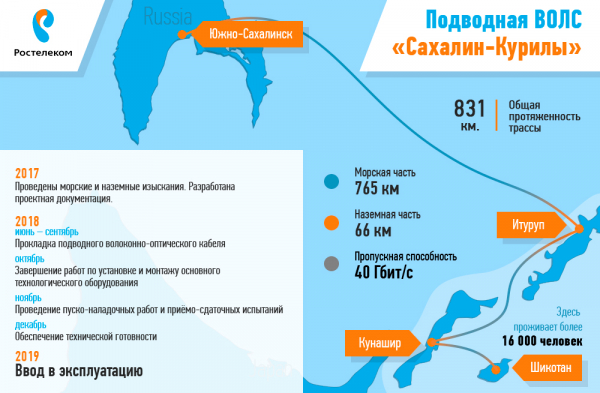
This autumn, optics came to three Kuril Islands. Iturup, Kunashir and Shikotan.
I have done my best to follow this case as usual, and I will tell you that everything is already , tested and couple of weeks ago
At the invitation of Rostelecom, I managed to visit the ship that was laying the cable.
The customer, as the state represented by Rostelecom, acted as the executor, as the last time, Huawei became the company.
But the cable-laying vessel was already different.
Naturally, in the process of laying the cable, some . But nothing seems to have gone further than notes of protest. Although the devil knows what the situation there will come to. But this is a matter of politics, we probably will not say anything about it.
1998 release.
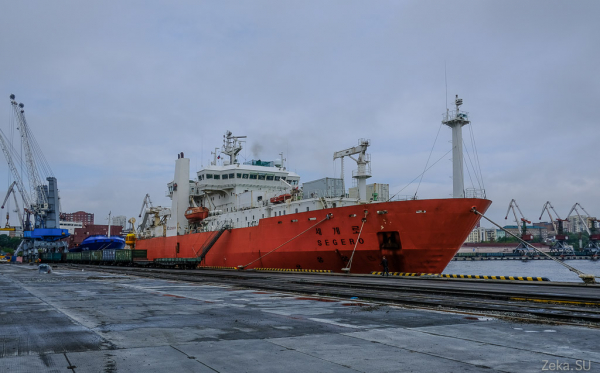
Vessel specification on the site
Who are interested in other cable-laying ships - Here's a great selection for you to admire
In 2017, the same team that built the line to Magadan and Kamchatka conducted reconnaissance work in the Sea of Okhotsk on our hydrographic vessels, and in May 2018, the ship arrived in Vladivostok, took the team and technical specialists and went to the work area for direct laying.
You have a unique opportunity to walk around the cable-laying ship with me and see what's going on.
Alas, no one else will tell you the same story as last time about another Cable Layer.
++++++++++++++++++++++++++++++++++++++++++++++++++++++++++++ ++++++++++++++++++++++++++++++++++++++
If you do not know or have forgotten how the laying of underwater communication lines is carried out, then I will remind you of the stages of work on laying submarine communication lines:
1 Research and design
At this stage, the bottom of the sea is explored, or ready-made materials from previous studies are taken. Depending on the bottom topography, a laying route is built. Naturally, current communications at the bottom are also taken into account. But the good thing is that the Sea of Okhotsk is not rich in underwater pipelines and underwater optical highways, well, except perhaps the secret communication cables of the Pacific Fleet to which .
A hydrographic vessel is sent to the place of work and a study of the day, relief and determination of the points of exit of the cable to the surface on the shore is carried out.
2 Cable fabrication and loading
The cable is made at once as a single coil, so that under ideal conditions it can be laid from beginning to end, and loaded onto the ship. At the production stage, erbium doped fiber amplifiers (EDFA) are immediately built into the cable - a fiber-optic amplifier based on optical fiber doped with erbium ions.
Due to the fact that Russia does not have such civilian ships, the manufacture of the cable and its laying were entrusted to Huawei.
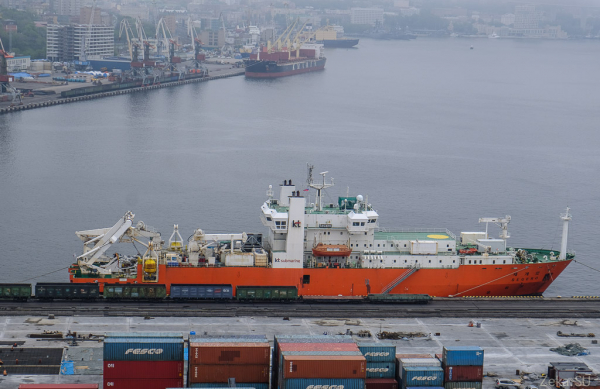
Huawei does not have its own fleet and for this reason they hired a subcontractor kt submarine, a Korean company that specializes in underwater work
3 Gasket
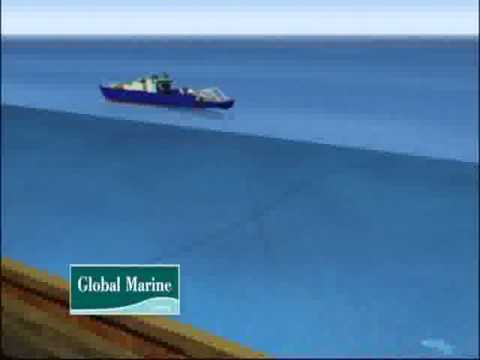
Everything is simple here. At the bottom, from the ship, the plow is lowered and the small forward is turned on. He digs a trench, a cable is buried in it.
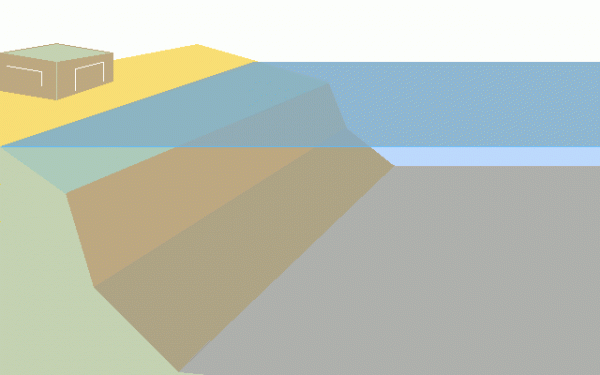
The only difference with the picture is that under the ship the depth is a couple of kilometers.
Here is another informative video
4 Land connection
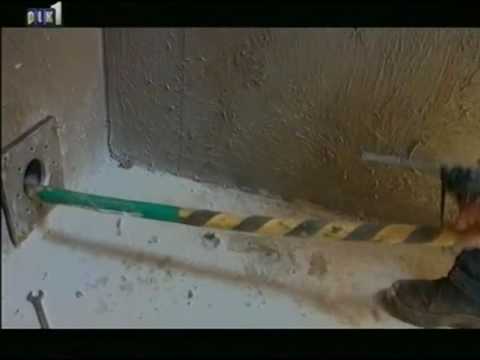
If everything went well and the cable was pulled from coast to coast, then it is connected to the coast station. To do this, at the connection point, the cable is thoroughly buried in the bottom so that it is not washed out by the sea, they are covered with stones. Connect the land end with the sea end.
This is what it looks like up close
5 Testing and commissioning
After the end of the work, I stick the wires, measure the losses, start the connection. If everything works, connect consumers. Usually they start at the minimum speed, but there are usually additional cores in the cable, through which in the future, when replacing equipment, large volumes of traffic can be launched. Well, again, the reserve, all of a sudden something breaks.
In the description of the process, any coordination of money and work is omitted, but in our case this is no longer very important.
+++++++++++++++++++++++++++++++++++++++++++++++++ +++++++++++++++++++++++++++++++++++++++
Segero cable layer
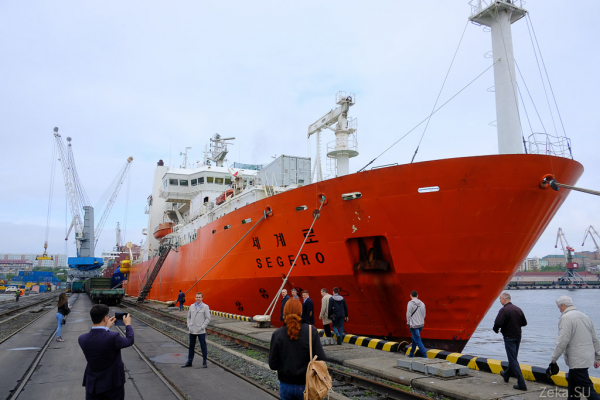
1 And now you and I will now step on board Segero’s ship and walk a little.
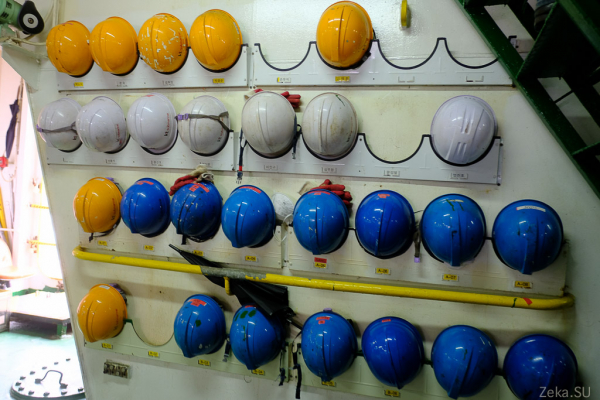
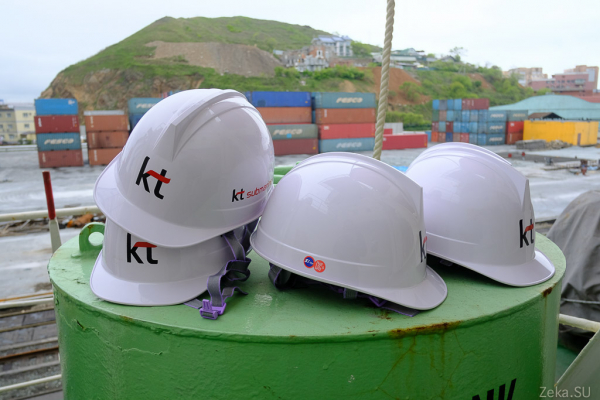
2 The first thing we have to do is, yes, that's right, we will put on protective equipment so as not to hit our heads where it is not necessary.
3 Last time I did not think about how the cables are loaded onto the ship. It turns out there are special "filling necks". I honestly thought just through the open door in the board.
The main distinguishing modules of the cable-laying vessel are
- Cable deck. All cable work is done on it. Cutting, repairing, transferring the cable to the outside, and so on. On the cable deck, it is worth highlighting the wet storage of amplifiers separately. (submarine signal amplifiers must be stored in a humid environment). "Clean room" - required for cable welding work. X-ray room - to check the quality of connections.
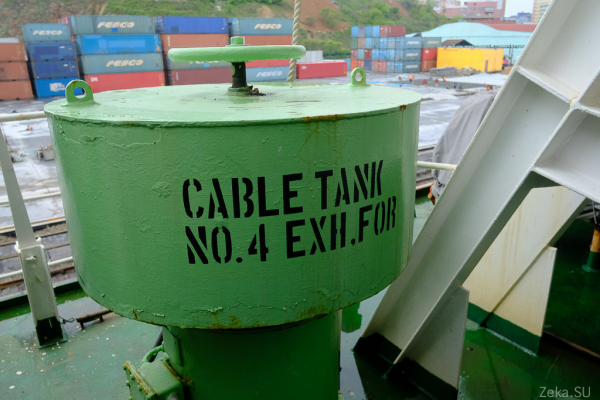
- cable tanks. Tanks in the form of barrels where cable stocks are stored.
- Aft deck with cranes and laying tools. There are usually subsea laying equipment and cranes to operate this heavy equipment. Also control panels.
- Own underwater plow equipment and additional underwater robots.
- Additional forage cabin. Since it is often required to position the ship very accurately at sea during work, then the cabin is usually double, front and rear. So that the helmsman can control the process from all sides.
Everything else is the same as other ships, engine, cabins, galley, dining room. The only but, for convenience, on such ships there are a bunch of different thrusters and automation for millimeter accuracy in keeping the ship in place.
Let's go in order
Cable Deck
4 These mechanisms are conveyors for transferring the cable from the tanks to the stern
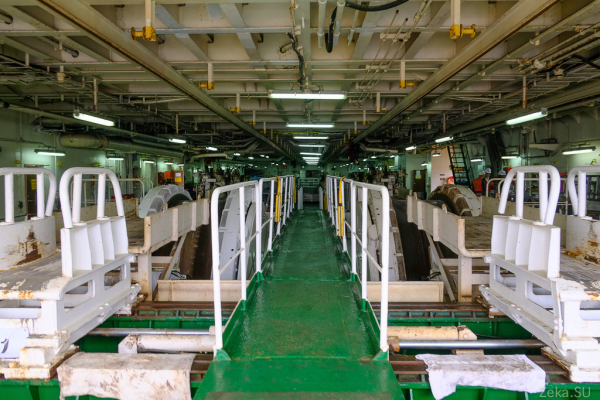
5 Cable rollers
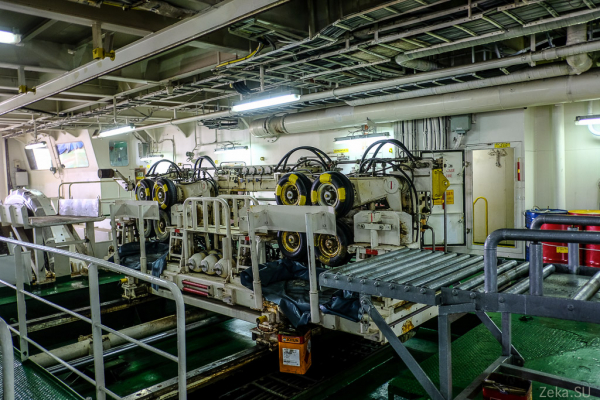
6
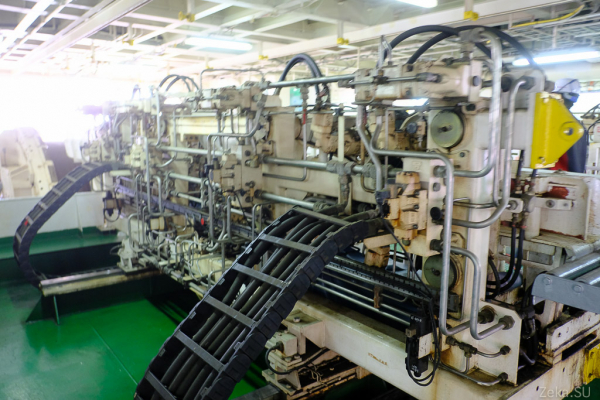
7 At the same time, two cables from 2 tanks can be fed at once
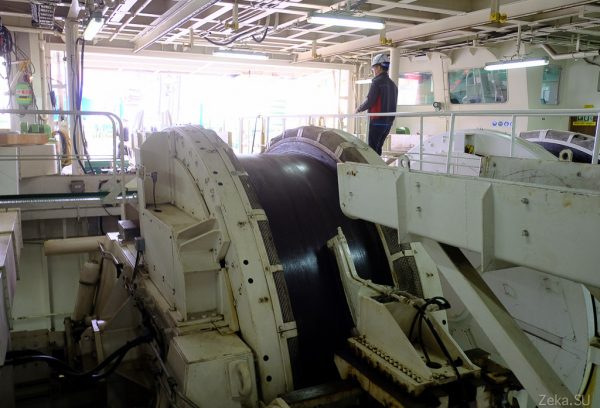
8
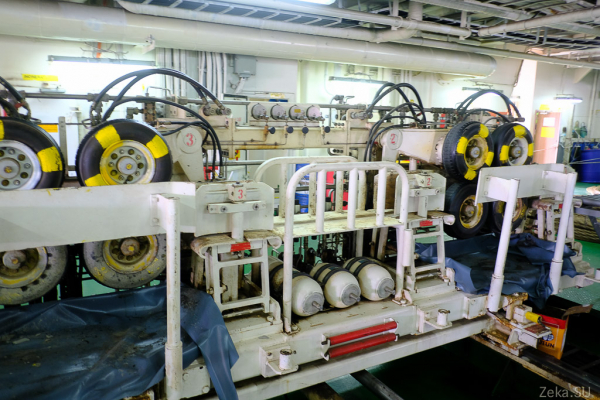
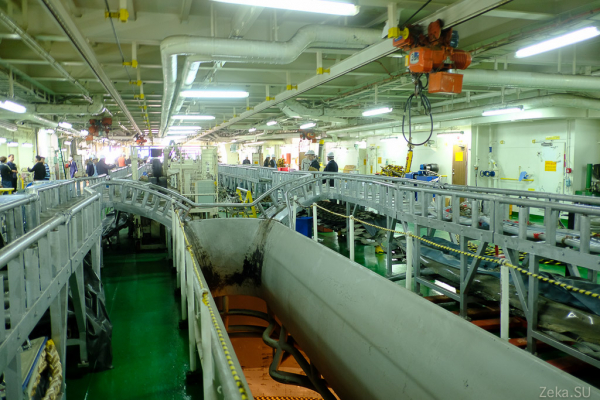
9 I don't know what to call it, but it's like cable channels. Cables run through them.
10 Signal amplifiers are stored on the deck itself
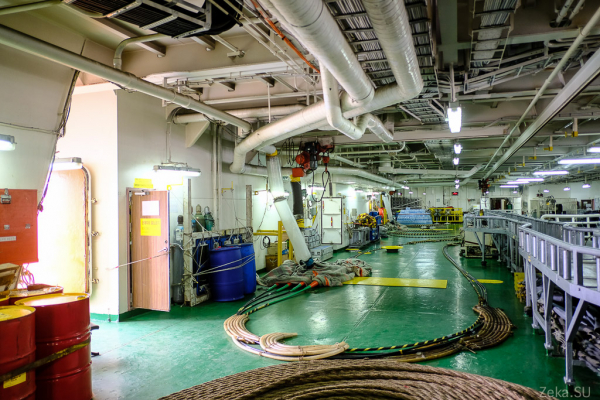
11 Alas, there is apparently no wet camera on board. The storage scheme is implemented according to the "Wet rag" method
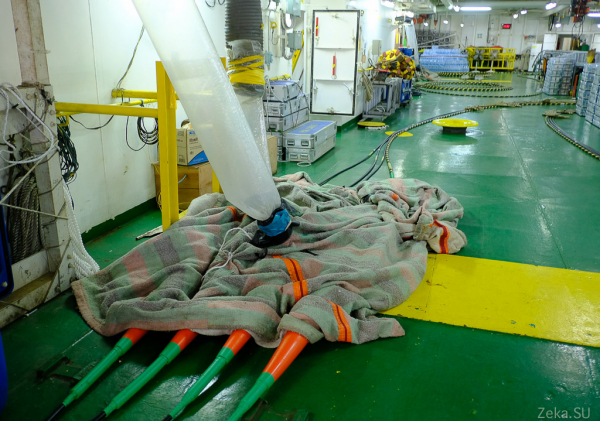
12
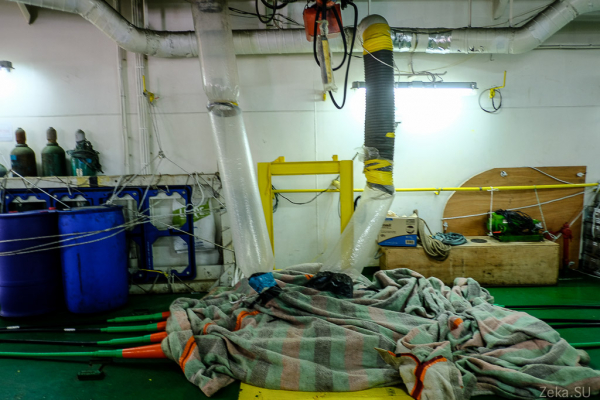
This is a real disappointment compared to other cable-laying I have visited. You can visit and compare
How Signal Amplifiers Work
Amplifiers are most often made by doping the fiber with the rare earth element erbium.
An additional pumping laser beam of high power, but different from the frequency of the laser transmitting information, is injected into the fiber and causes the erbium atoms in the amplifier to go into an excited unstable state. When a laser radiation photon with useful information, weakened by a long path along the fiber, collides with this atom, it receives energy from this excited atom, and is re-emitted with renewed vigor and flies further, more precisely, it is re-emitted in the form of 2 quanta and there are more useful photons.
This is all if you explain on the fingers. it will be so.
Tennis balls are thrown into the pipe, on which information is recorded, and they fly along the pipe from point A to point B. Labor is long, and when they experience air resistance, they slow down and may not reach the end of the pipe.
But next to it, air is pumped through a parallel pipe at high speed, and it makes the wheel blades of the type like in a water mill, or a paddle steamer, located somewhere in the middle of the pipe, spin quickly.
Having reached this wheel, tennis balls get hit by this wheel on the ass, like a tennis racket, and fly further with renewed vigor ... another 80 km =)
For those who are interested read , so or
sorry for the confusion, but I'm not very strong in these matters.
But in more detail
13 Also on this deck, additional equipment for laying is stored. Couplings, adapters and so on. In short, a bunch of stuff
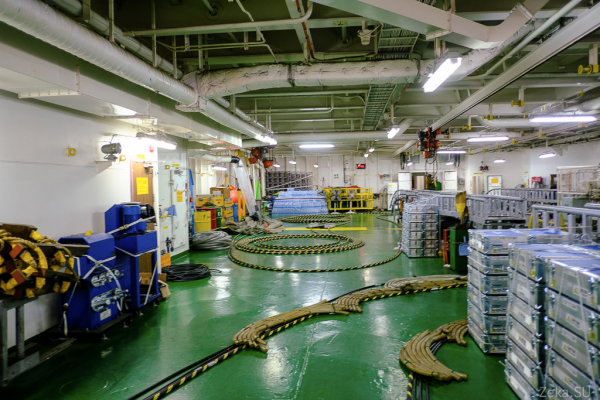
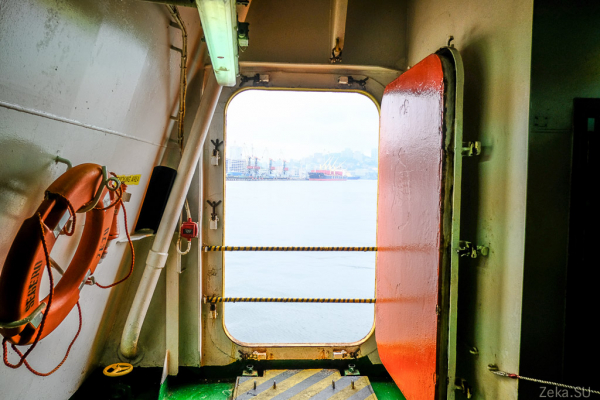
14 Here you can go to sea =)
15 Here are the suspicious boxes that interested me
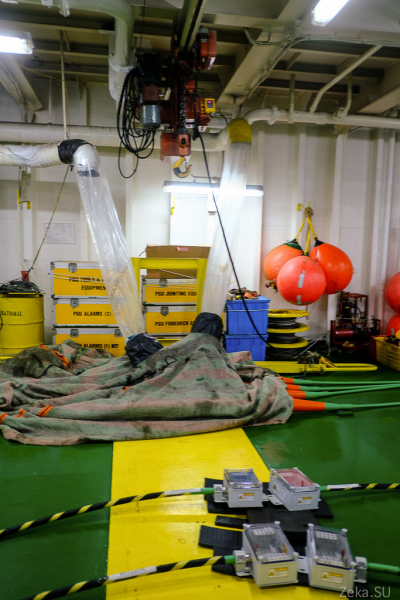
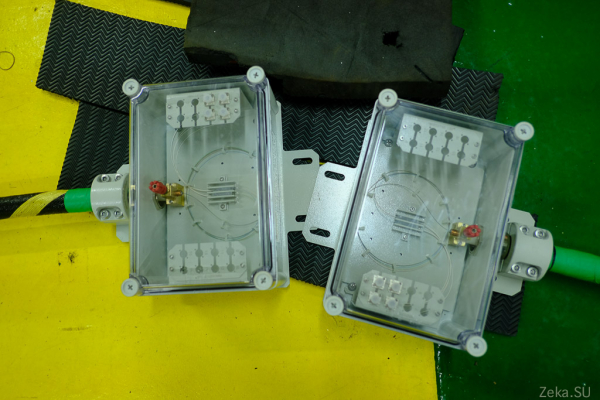
16 This is just an optical coupler for installation in a shore wiring closet. This is the very end of the cable. Terminal equipment will already be connected to it. In the coupling, it is just clear that 4 cores are divorced.
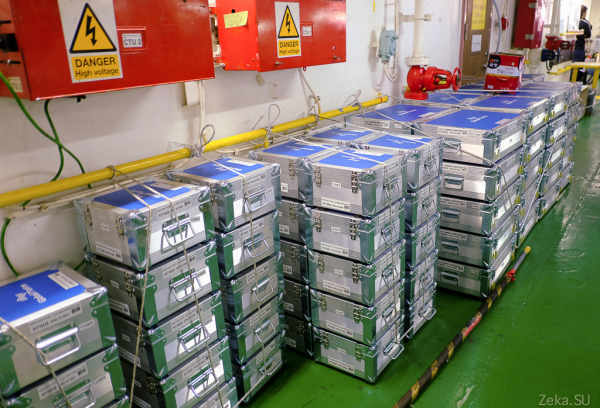
17 Alas, I don’t know what it is, but also probably spare parts and other parts
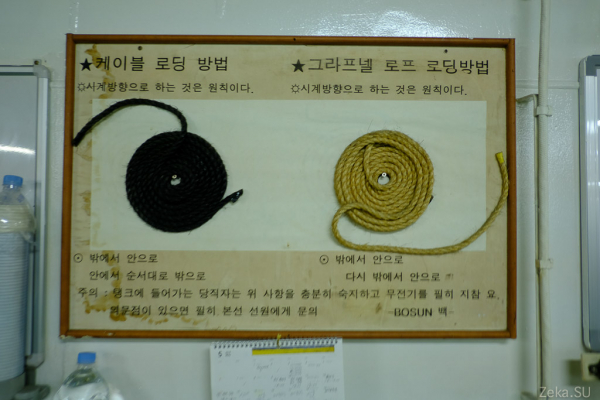
18 Installation visual aid
Naturally, there are also two cable storage tanks on the cable deck.
19 They contain 850 km of cable + stock.
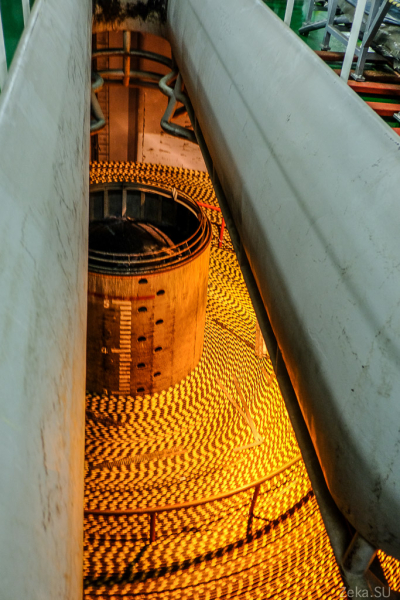
20 Second vault
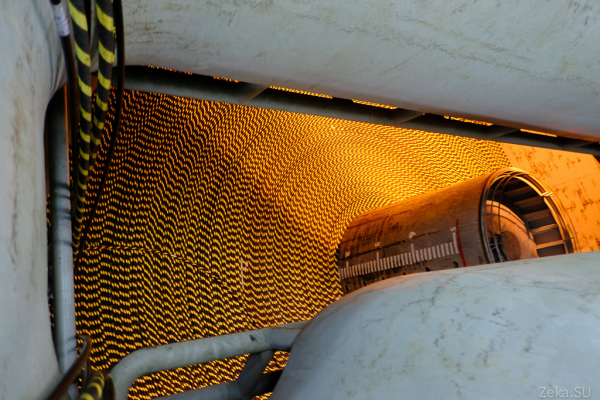
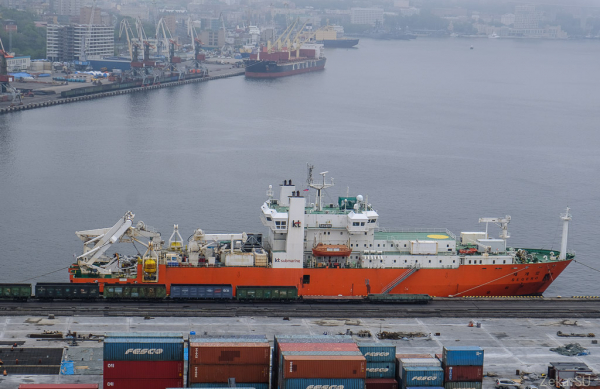
21 tank walls are rounded so that the cable slides and does not fray
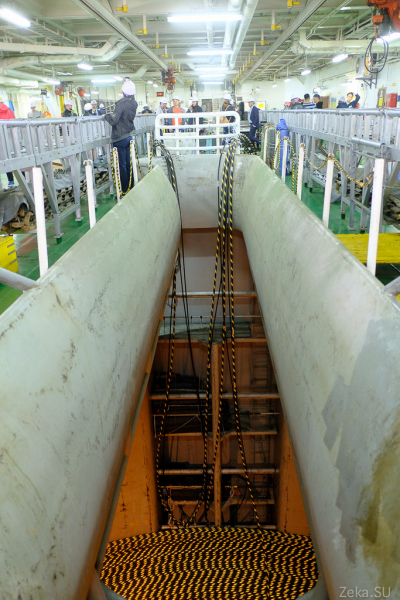
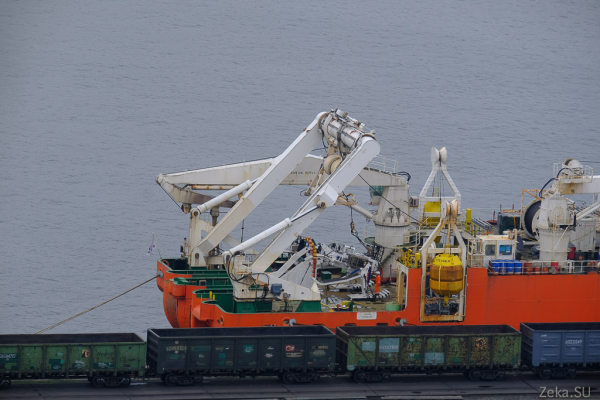
Now let's look at the "clean room". There, work is carried out on cutting cables, welding optics and installing couplings, amplifiers, and so on.
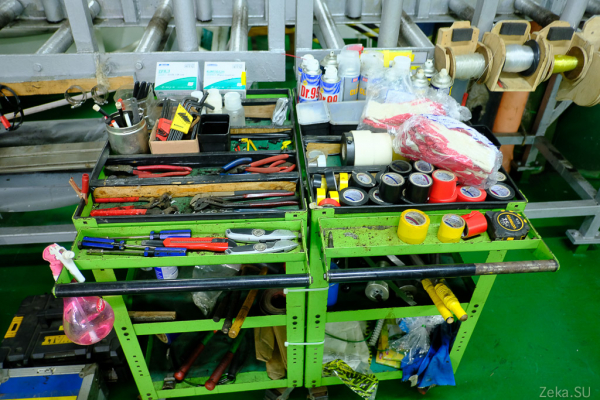
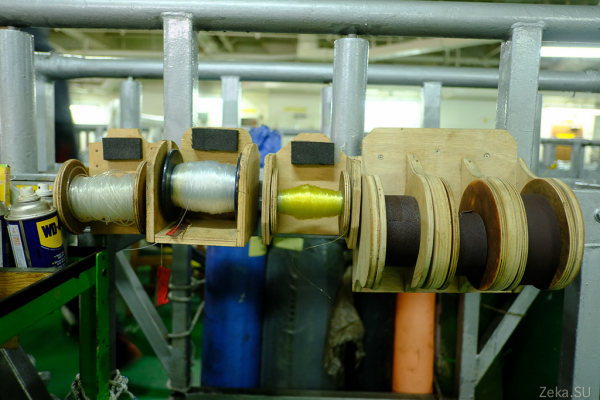
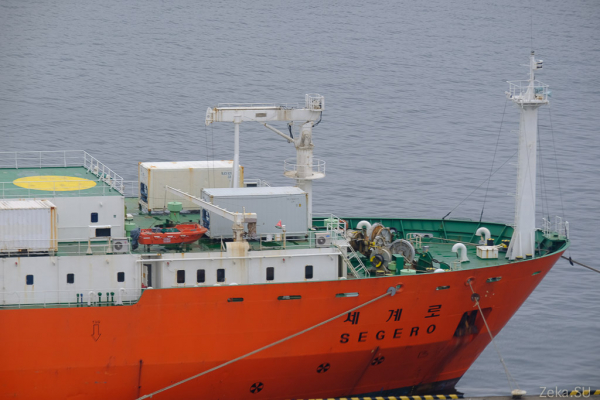
22 Workbench. Pay attention to homemade bobbins for materials
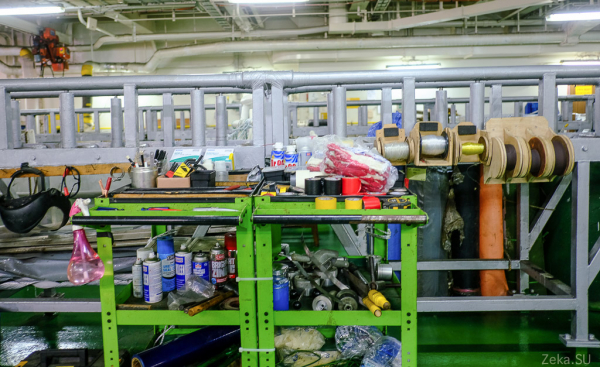
Tools and lots of duct tape.
23 Welder
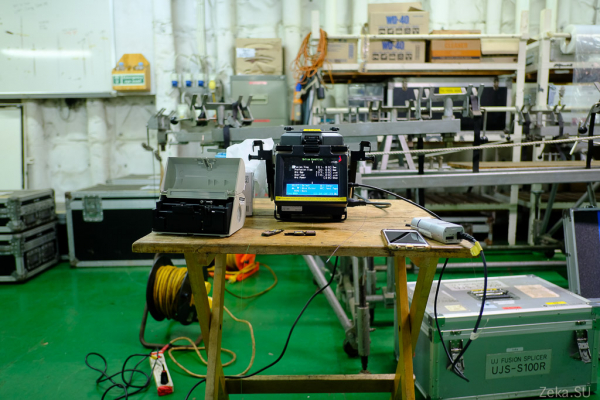
You can see how it works or
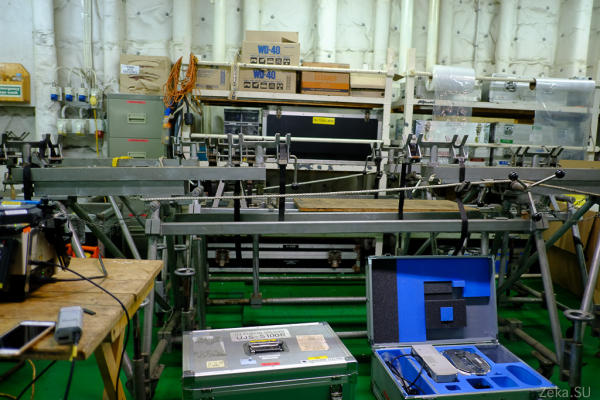
24 frame for mounting the coupling. This is a fairly large and heavy structure.
25 Alas, I don’t know what it is, but I’ll assume that the terminal equipment for the ground station
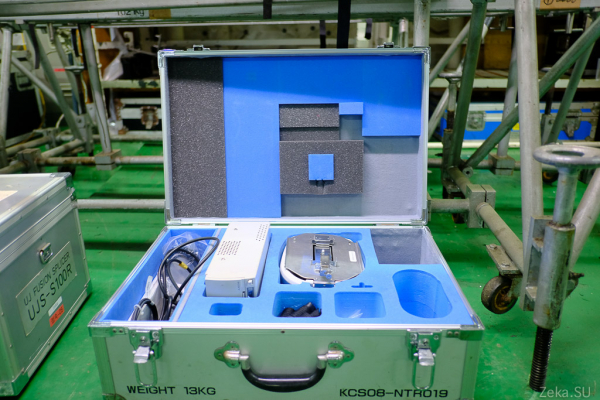
26 X-ray equipment for testing manufactured underwater sleeves. You understand, it’s better to check 30 times than to mess around with getting the cable and making a new clutch for a month
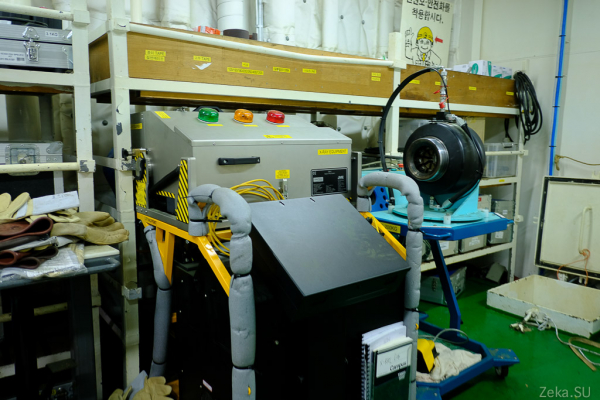
Now we will see how the pros work and how durable this submarine cable is.
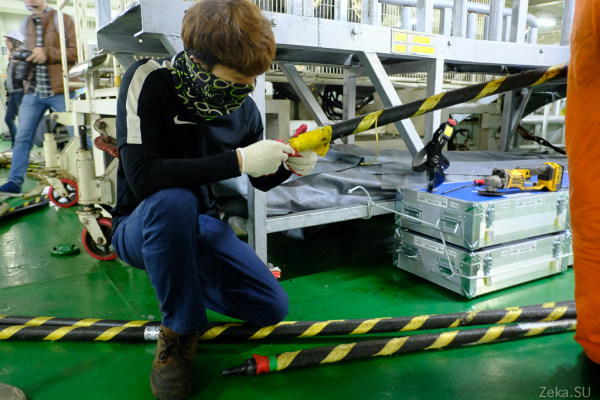
Workers cut the end of the cable to install a sleeve on it
27
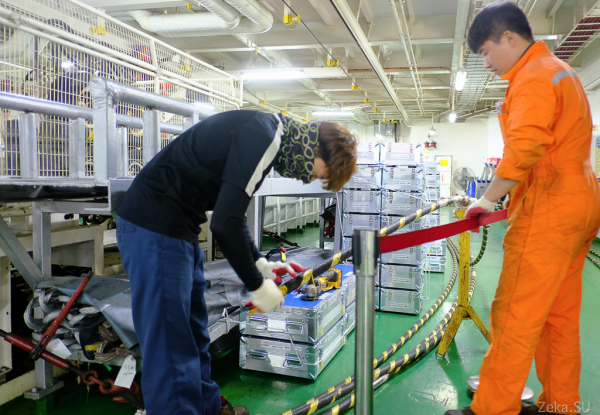
28 First you need to unweave the plastic multi-layer insulation
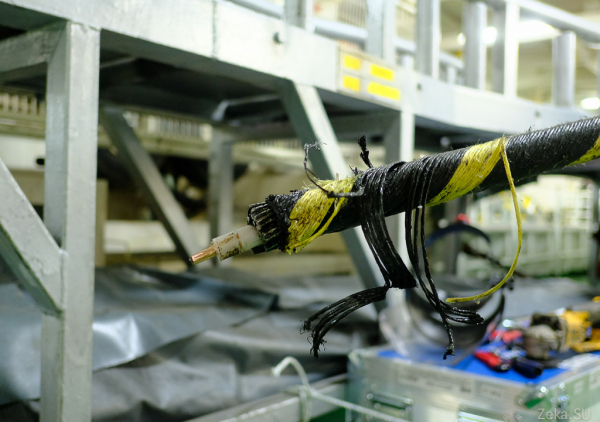
29 Cable arrangement. The top layer is plastic waterproofing. Next - power bearing steel cables. Under them is a layer of polyethylene insulation. Inside is a copper flexible tube. And it already contains the optical fibers themselves.
30 These bobbins haunted me. There is a skin for stripping the cable, and saws in the form of strings. It is convenient to cut plastic shells with such a string.
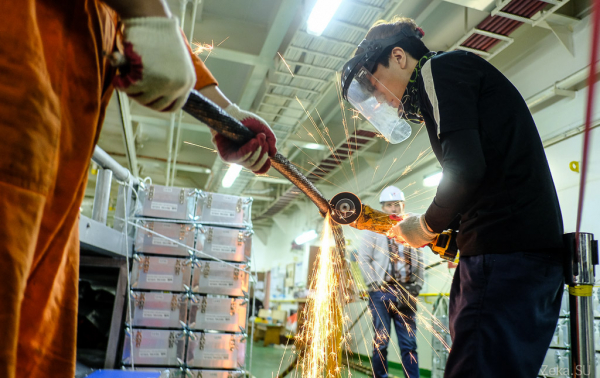
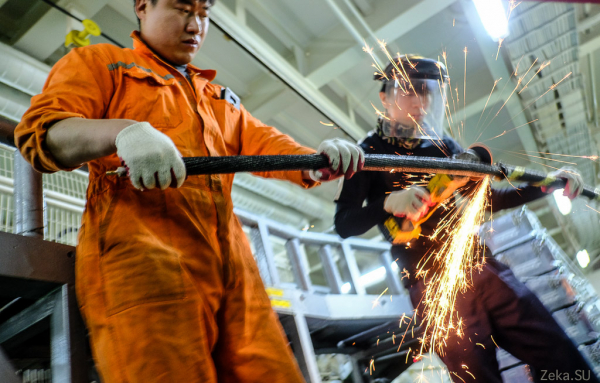
31 But in order to open the power steel frame, you have to use heavier artillery. A turbine and a few minutes of hard work
32 What is surprising about local workers is some disdain for TB. I hope nothing bad happened to them.
Well, a few technical details.
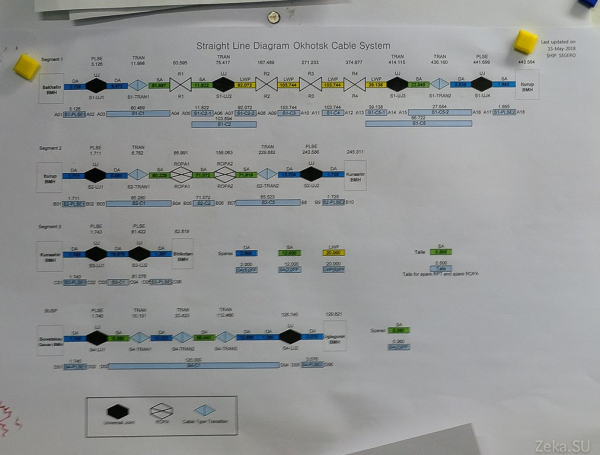
It seems to lay the wire - nothing complicated. I found a picture of how much equipment you need to install on the cable before laying. Naturally, most of all you need to install on the longest cable - Sakhalin - Iturup (top line). Then the cable goes to Kunashir, and then to Shikotan.
By the way, an additional project of this ship was the laying of a new communication line connecting Sakhalin with the mainland. The cable was laid across the Tatar Strait from Vanino to Uglegorsk. But there the communication line is small compared to the rest
We are done with the cable deck. Let's go aft and see the underwater equipment.
aft deck
The only deep-sea unit on this ship is a plow.
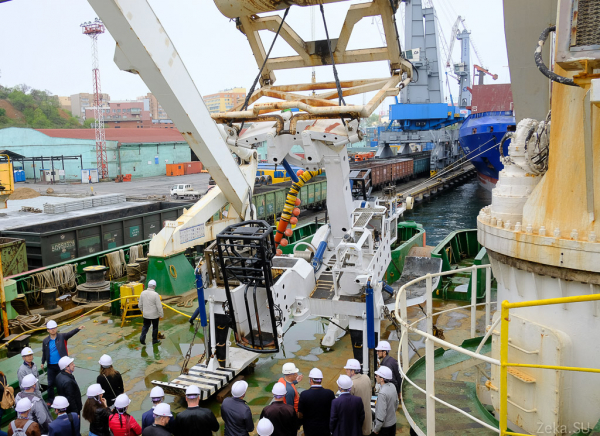
The plow is lowered on a cable to the bottom and trailed behind a moving ship like a regular plow across the field behind a horse. In the process of moving on command from above, the plow deepens its working canine into the bottom and digs a trench there to a depth of up to a meter. A cable channel passes through the fang and our cable immediately finds itself in a trench. Which can immediately be littered with soil.
Of course, this scheme may not work on rocky areas in the coastal strip, but in the ocean itself at the bottom it is usually quiet and the bottom is a deposition of soft sedimentary rocks or even silt. In such soils, the plow can dig to the maximum depth of the knife. If the cable is left lying on top, it can be damaged. For example, if one of the fishermen or scientists will trawl the living creatures from the bottom, or the shark will get too nervous. There are many examples. In shallow water where there is active navigation, the cable has to be additionally filled up with a rock for safety. Suddenly, the negligent captain will anchor near him and then pull out all 850 km of cable with his anchor.
Great video showing the plow in action

And one more video that scares all owners of submarine cables.
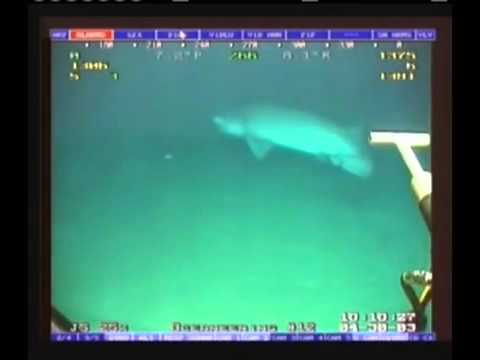
Plow
The plow weighs almost 30 tons and can work at depths up to 1500 meters.
More detailed specifications can be seen on the owner's website
33 The front of the plow has two skis. They stand on the ground and he rides on these skis behind the ship on a leash
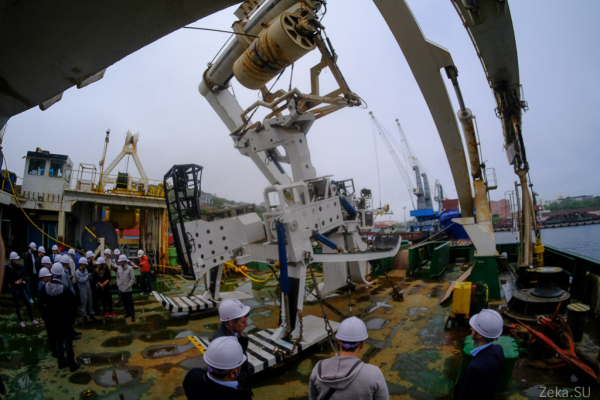
34 At its back is a fang. The canine is deepened into the ground and plows a trench of a given depth there. On the rear edge of the canine, a cable is inserted into the trench under water through a special “tongue”
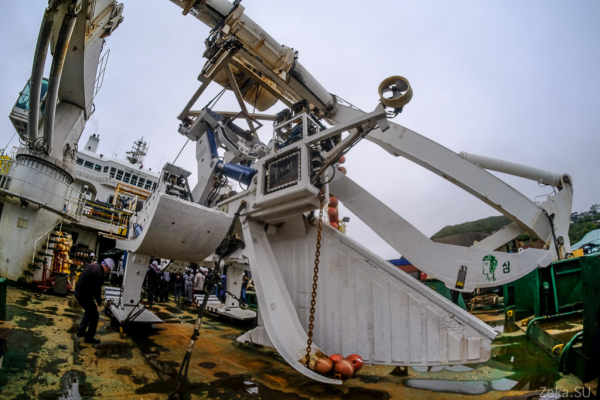
Cameras, lighting and sensors are installed above the canine to monitor the work process. The picture is transmitted to the operators on the deck.
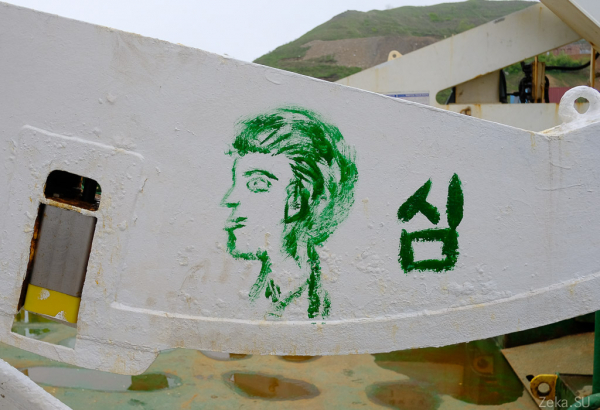
35 What is the purpose of the little green man is not clear. But I will assume that the plow has its own name in the crew list and everyone addresses it by name
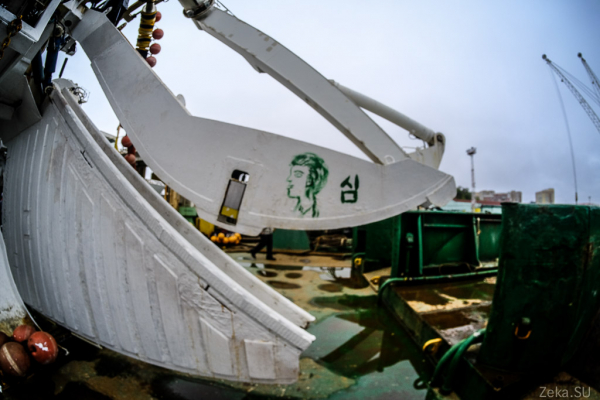
36 "Tongue" which is responsible for feeding the cable into the trench. Can be lowered and raised by adjusting the laying depth or cable tension
37 Close up
38 Front view
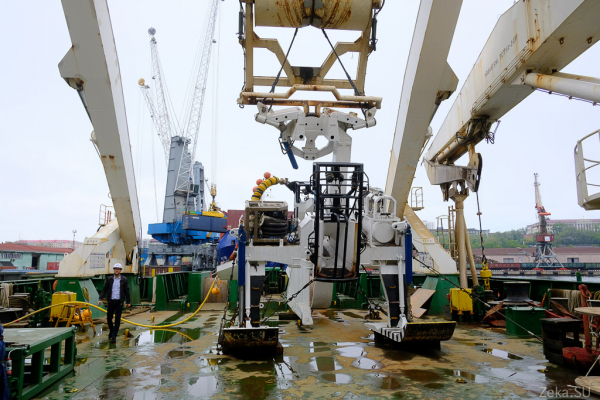
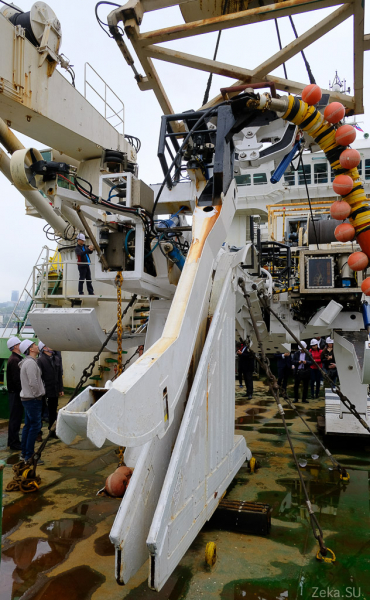
39 The plow is a complicated thing. You see a bunch of control hydraulics for lowering the canine and the rear pair of skis.

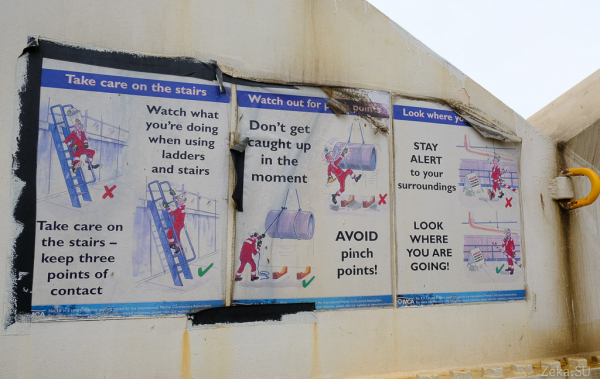
40 Let's go upstairs. admire from above. Before that, you need to familiarize yourself with TB
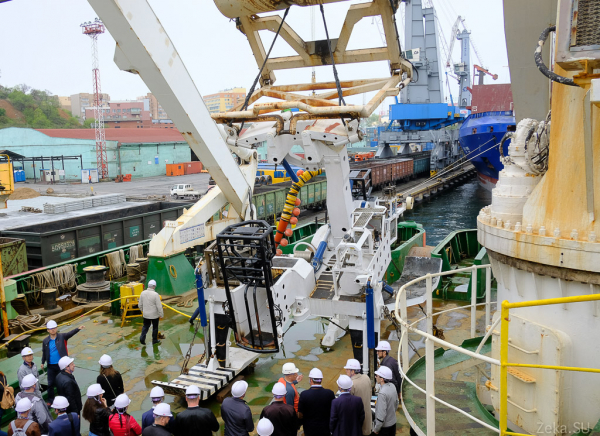
41 Plow view from above. Those in white helmets are not with me.
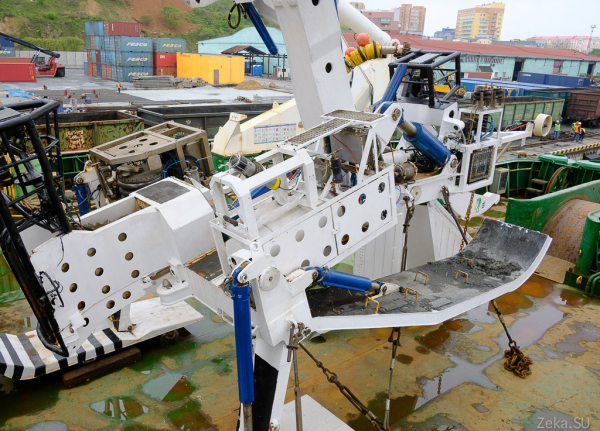
42 Judging by the fresh paint, the plow has recently been put in order. I am sure that after work it is dirty and rusty. There is some dirt left on the ski.
43 Above the plow there is a “portal” crane which throws the plow overboard. Alas, here he did not fit into the frame
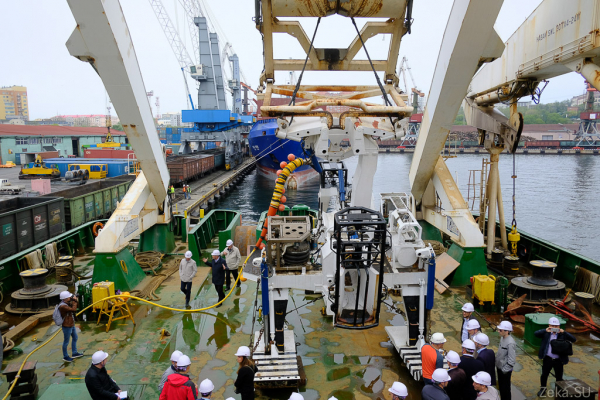
44 But it's clearer this way.
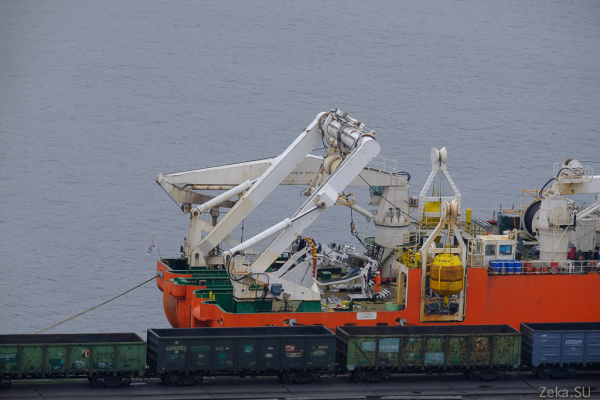
45 Additional crane
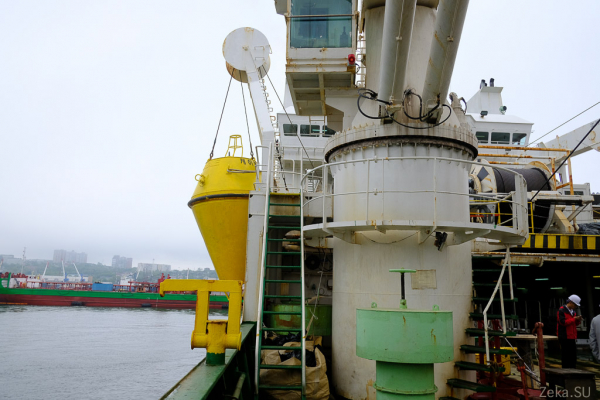
46
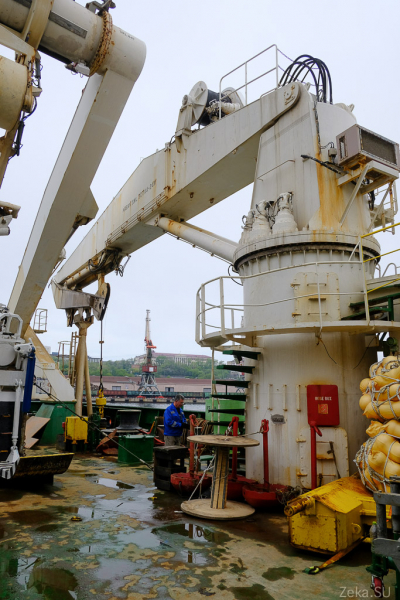
An additional crane is required to work with things other than the plow. Picking up a cable left for a while from work.
Just imagine, you are laying a cable, and a storm threatens you. What to do? Wind up 1000 km of cable?
No, everything is simple. We cut off the cable at the place where we finished. We tie a float or 10 float to it and leave it here. We ourselves collect all the belongings and sail away to a protected port. At the end of the storm, we sail to the place, we catch the end of the cable on the floats with a winch and drag it to the cable deck. There we cut, attach our end and continue the gasket. That's all.
48 And we have stocks of all kinds of floats. Although these are more likely to bring the cable to the shore.
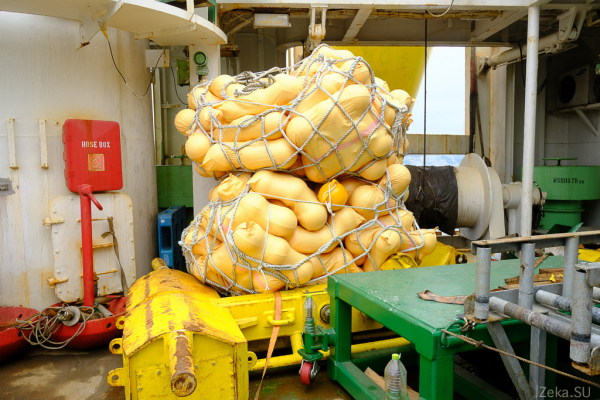
49 Spare anchors to secure the floats in place
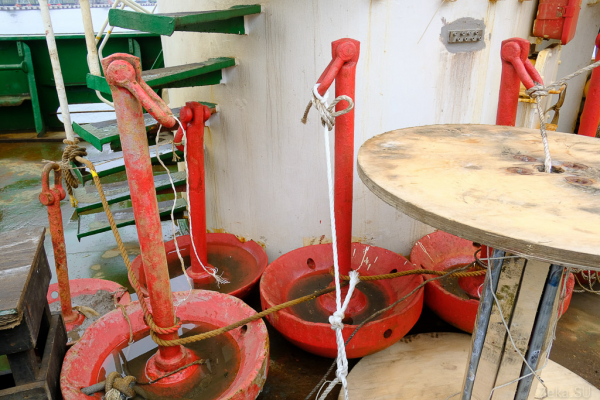
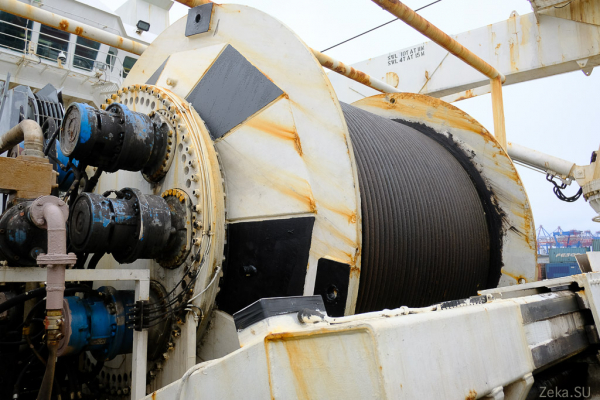
50 18 Okay, we digress. Here is the carrying cable for lowering the plow under water
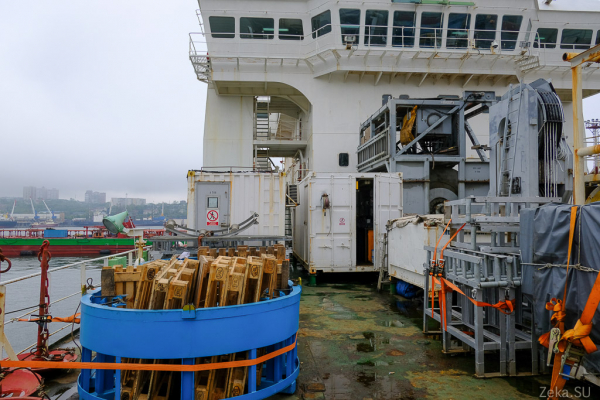
51 On the upper deck there are containers for storing small things
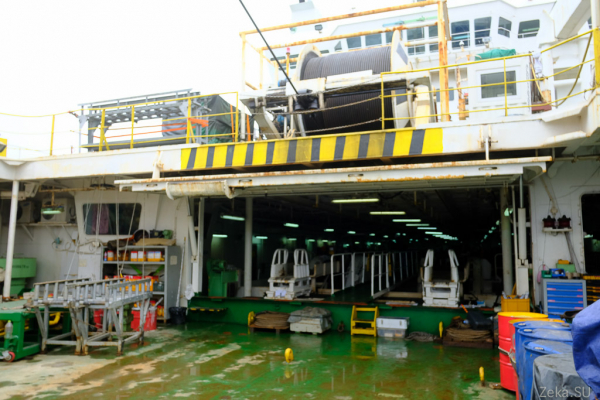
52 The entrance to the cable deck is hermetically sealed in case of a storm
53
And this is a “drain” for a cable that will go to depth
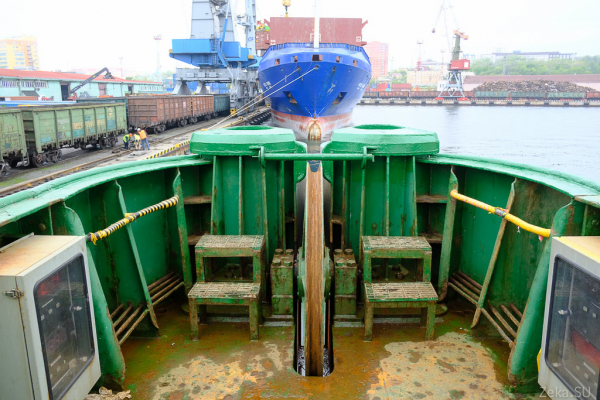
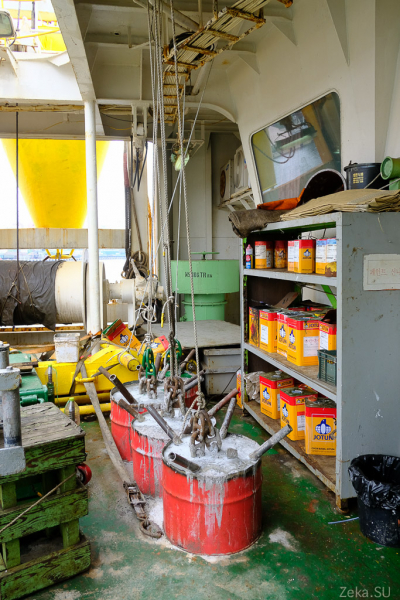
54 Let's finish our inspection of the aft deck and note that the local employees are very creative.
Here is a set of homemade and inexpensive anchors. I assume they are disposable.
Then we will go from the heart of the ship, to its control room ...
Cabin
This is where all control comes from.
55 Starboard
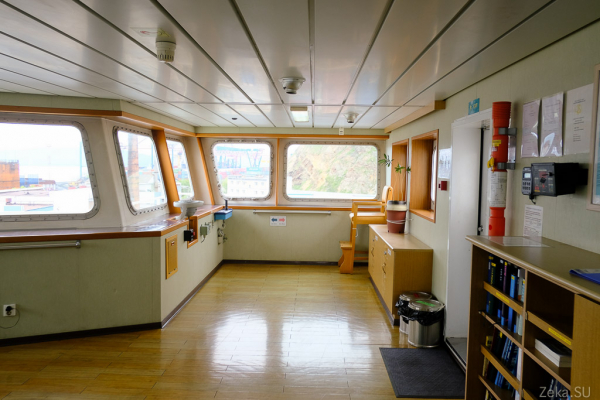
56 Port side
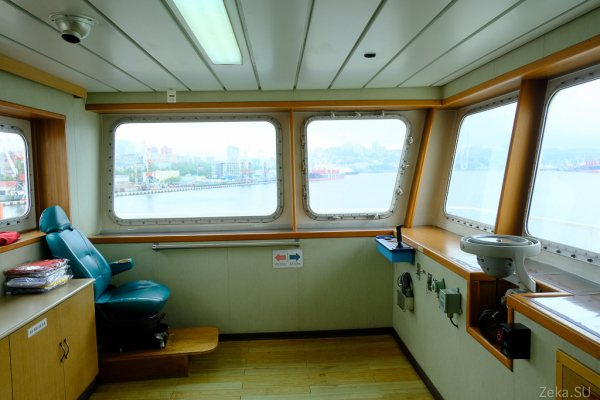
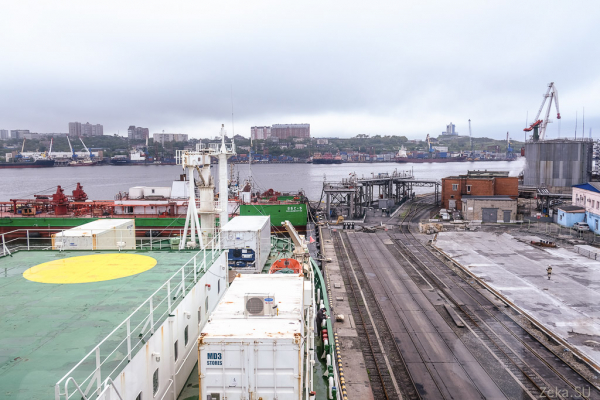
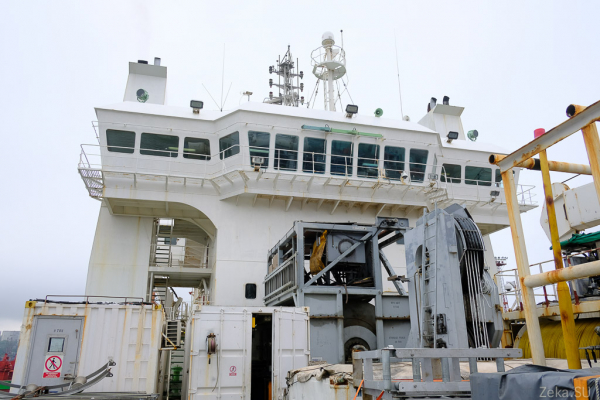
57 Prow of the ship. Helipad. Underneath is the crew canteen.
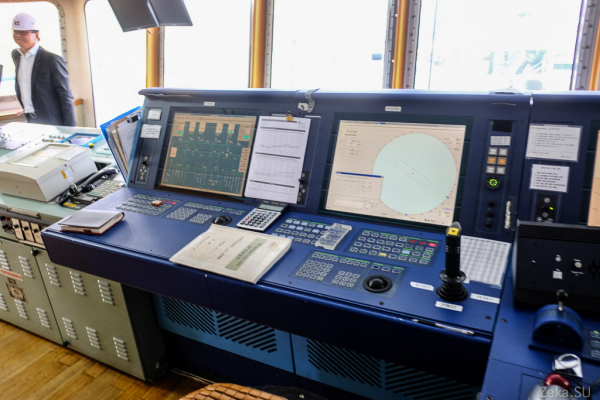
58 Remote
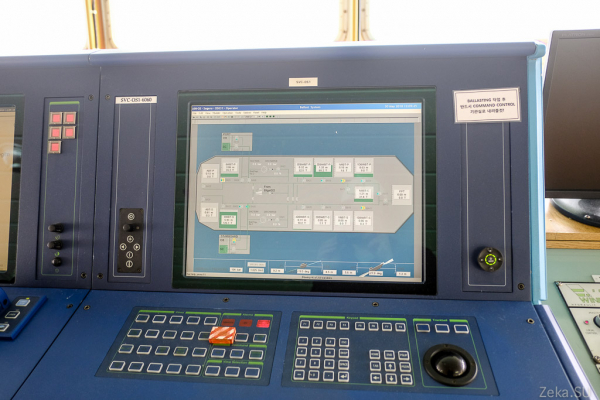
59 It's in order. Everything is much better than on our Stone Age ships.
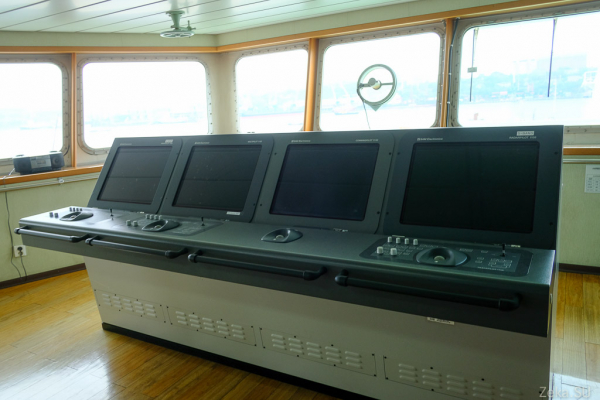
60 Navigator's place
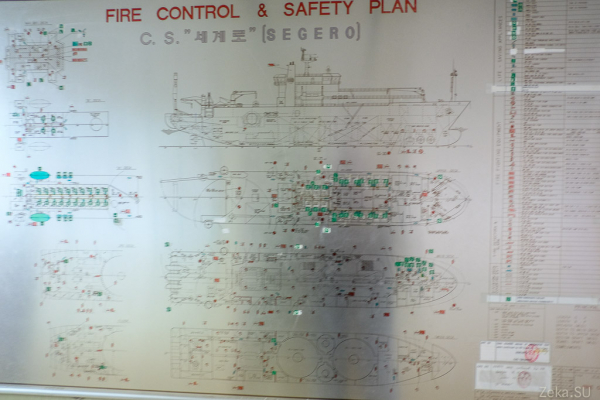
61 Scheme of the vessel. By the way, I lied to you. There are not 2 cable tanks on the ship, but 4. In the lower diagram, two additional smaller volumes are visible
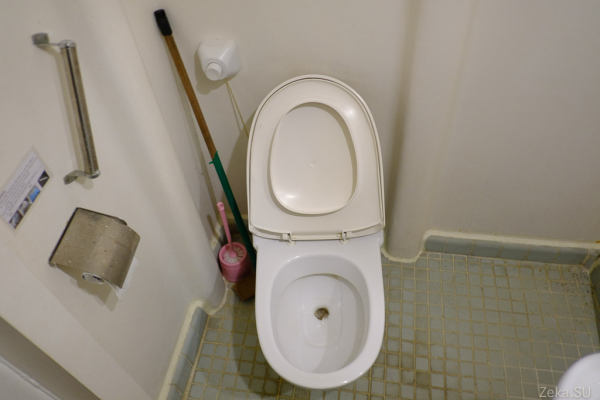
62 In the middle of the felling there is the most important place, without which it would be possible to rake in problems. Excellent toilet. I went and checked. Everything is clean
63
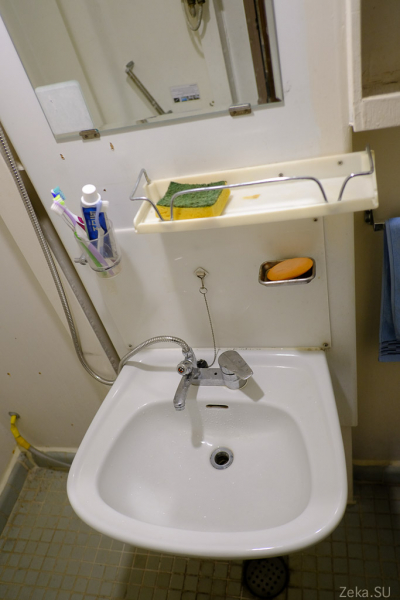
64 I was told in confidence that, despite a certain mess, the toilets on Segero are many times cleaner than on CableInnovator. Do you know this indicator?
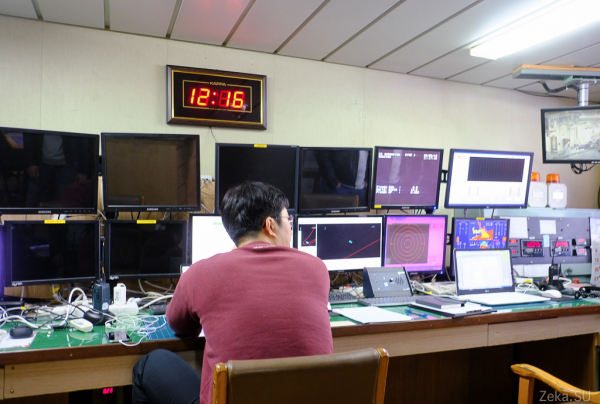
65 Separate control room for all deep water operations. The heart of everything.
Here sit the operators who manage all the technological processes. plow operation, cable feed
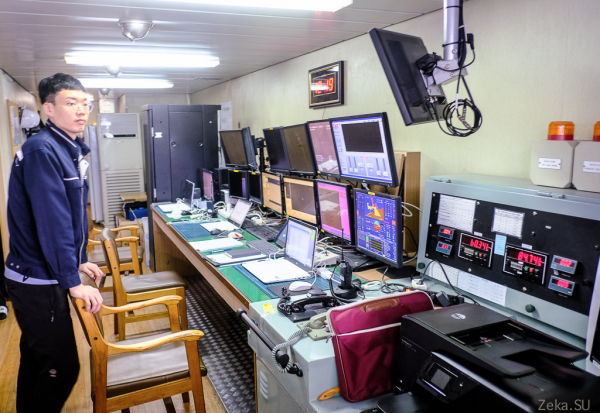
66 Radars, positioning
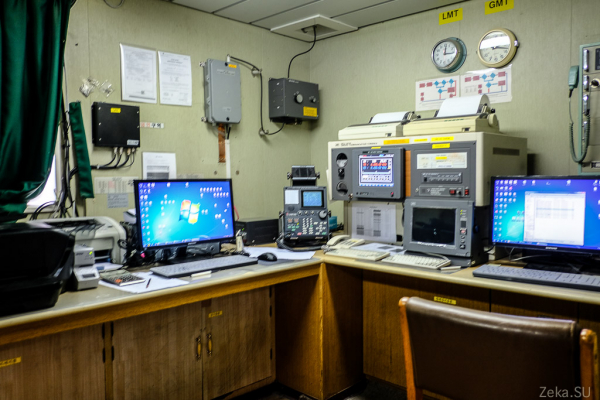
67 Communication well and everything you need in one place
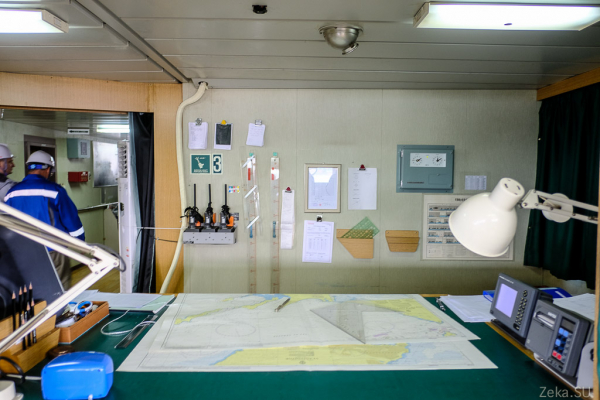
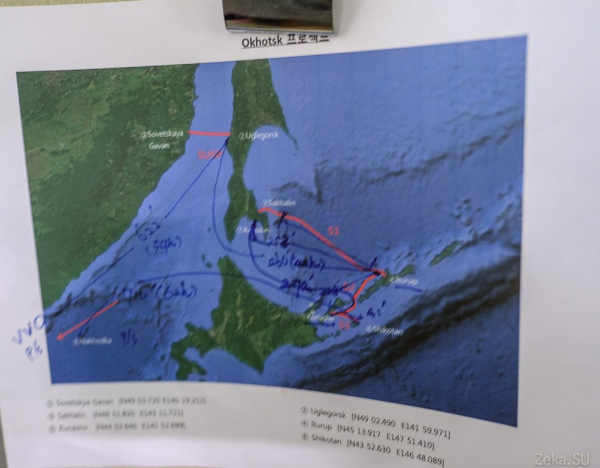
68 Another secret map. Work plans. Where and where are we sailing? Where are we laying
69 The purpose of this equipment, alas, was not disclosed. Probably a trade secret

70 Aft control room, outside view
71 Remote. As I understand it, a lot of things are duplicated from the front cabin
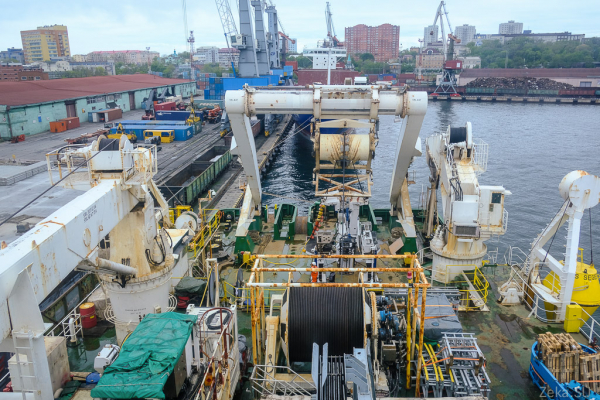
72 Aft deck view
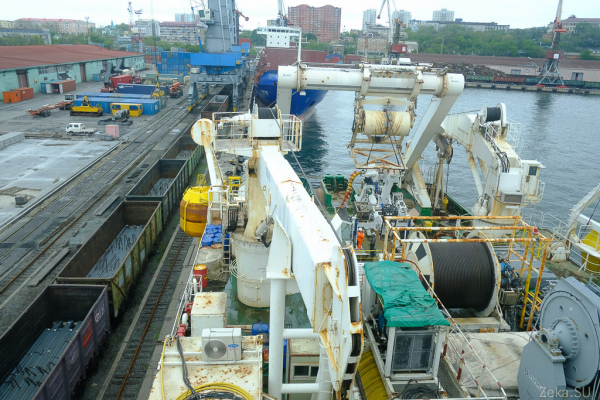
73 The plow crane is visible, and auxiliary cranes.
Well, for the sake of order, let's look into the cabins of the company-dining room for the crew. Alas, it is small and will not immediately displace all 60 crew members.
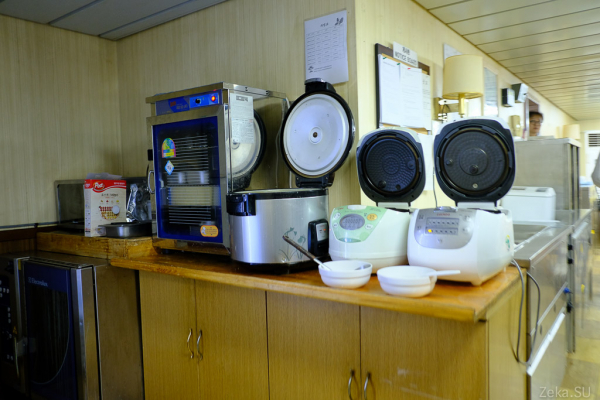
74 They didn’t let me into the galley, but it’s immediately obvious that we have only Asians here. As many as 3 rice cookers
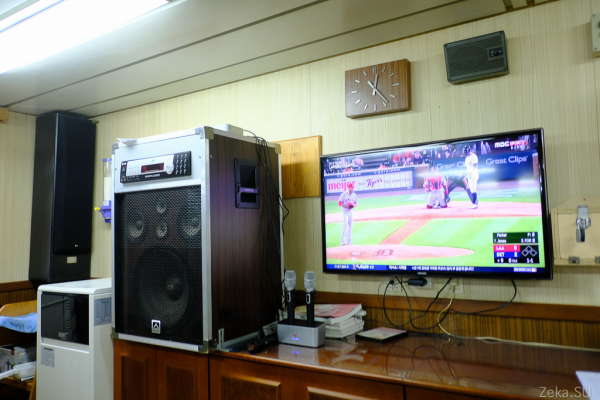
75 From entertainment there is video and karaoke
Well, now leave the hospitable ship and look at it from afar.
Thanks for the hospitality everyone.
76
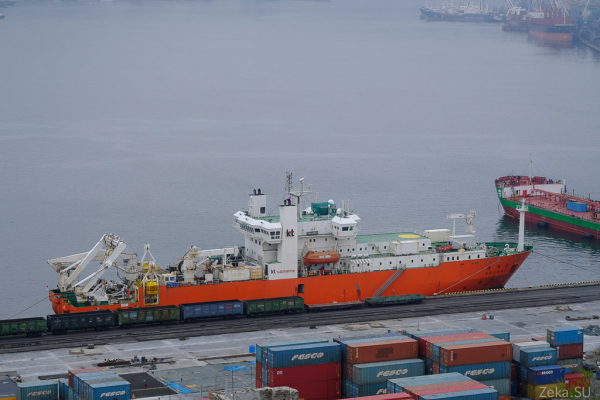
Appearance
77 Parked in a trading port
78 Feed equipment
79 There is practically nothing on the nose
80
And a short video filmed in Japan about the operation of this vessel.
Course of work
Work on laying the line from Vanino to Sakhalin was carried out in the summer of 2018, and then the ship went to Korsakov, refueled and went to the work site in the Sea of Okhotsk.
By October, the laying work had already been completed and commissioning had begun.
Coastal stations were connected to communication centers in Kurilsk, Yuzhno-Kurilsk, Krabzavodsky. And updated communication lines have been laid to the nearest settlements: Hot Beach, Reidovo, Malokurilskoye. Alas, the rest of the settlements have not yet been connected due to their remoteness. But it's just a matter of technique. It is necessary to lay terrestrial optical cables and that's it. They promise that in 2019 Mendeleevo and Yasnoye Airport will be connected to the fast Internet.
Alas, I do not have data on the road map. But since 2019, Rostelecom is starting a project to connect the last mile of fast Internet in villages with up to 100 residents. (before it was up to 200) This is the project Eliminating the Digital Divide and it is possible that within the framework of this project the others will be connected.
In February, a group of high-ranking officials went to Shikotan and solemnly opened the Internet connection in state institutions. School, house of culture, rural administrations.
Alas, I did not find photos from the event on the Internet. Here is the only one. From the club of the village of Krabzavodskoye - Shikotan
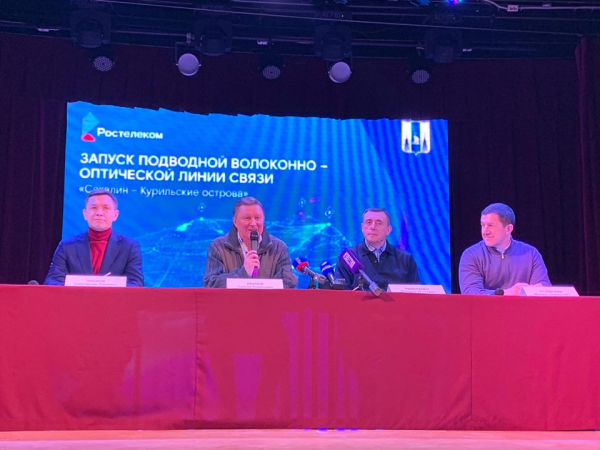
Well, there is a report of the 1st channel. They show a little the ship itself and even the rack in the communication node. The rest is all official stuff.
That's all. We would like to thank Rostelecom for the honor of visiting such an interesting vessel.
Source: habr.com
