

Together with Elena Gerasimova, head of the "" faculty at Netology, we continue to explore how Data Scientists and Data Engineers interact and how they differ.
In the first part, we discussed .
In this article, we will talk about the knowledge and skills specialists should possess, which qualifications employers value, how interviews are conducted, and also how much data engineers and data scientists earn.
What Data Scientists and Engineers Should Know
Relevant education for both specialists is Computer Science.
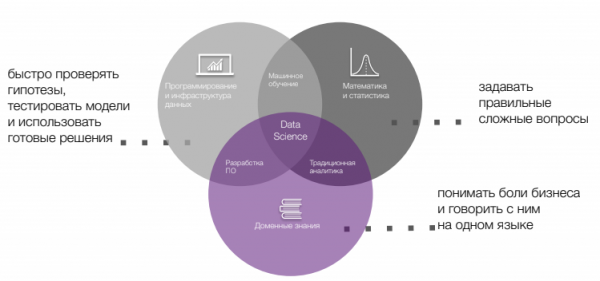
Any data specialist — whether a data scientist or an analyst — must be able to demonstrate the validity of their conclusions. This requires knowledge of statistics and basic mathematics related to statistics..
Machine learning and data analysis tools are indispensable in today's world. When familiar tools are unavailable, one should have the skills for quickly learning new tools, creating simple scripts for task automation..
It is important to note that a data specialist must effectively communicate the results of their analysis. This can be aided by data visualization or the results of conducted research and hypothesis testing. Specialists should be able to create charts and graphs, utilize visualization tools, and understand and explain data from dashboards.
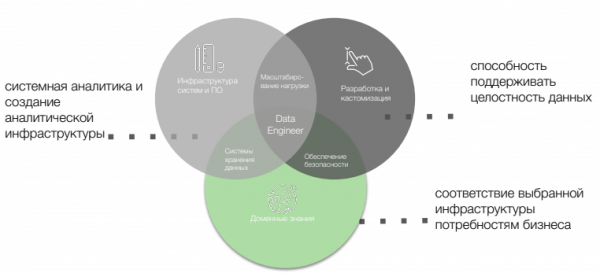
For data engineers, three areas emerge as priorities.
Algorithms and data structures. It is important to become proficient in coding and using basic structures and algorithms:
- analyzing algorithm complexity,
- the ability to write clear, maintainable code,
- batch processing,
- real-time processing.
Databases and data warehouses, Business Intelligence:
- storage and processing of data,
- designing cohesive systems,
- Data Ingestion,
- distributed file systems.
Hadoop and Big Data. The volume of data is continually increasing, and within 3-5 years, these technologies will become essential for every engineer. Additionally,
- Data Lakes,
- working with cloud providers.
Machine Learning will be widely used, and it is important to understand which business challenges it can help address. While it is not necessary to create models (data scientists will manage that), it is essential to understand their application and the relevant requirements.
How much do engineers and data scientists earn?
The income of data processing engineers
In international practice the starting salary is usually around $100,000 per year and significantly increases with experience, according to Glassdoor. Additionally, companies often provide stock options and annual bonuses of 5-15%.
In Russia at the start of their careers, salaries are usually no less than 50,000 rubles in the regions and 80,000 in Moscow. At this stage, no experience is required other than completed training.
After 1-2 years of work — the range is 90-100 thousand rubles.
The range increases to 120-160 thousand rubles after 2-5 years. Factors such as specialization in previous companies, project size, work with big data, and others come into play.
After 5 years of work, it becomes easier to look for vacancies in related departments or to apply for specialized positions such as:
- Architect or lead developer in a bank or telecom — around 250 thousand.
- Pre-Sales at the vendor of the technology you have worked with the most — 200 thousand plus potential bonus (1-1.5 million rubles).
- Experts in implementing Enterprise business applications, such as SAP — up to 350 thousand.
Income of data scientists
by the analytics company 'Normal Research' and the recruiting agency New.HR shows that Data Science specialists earn, on average, a higher salary than analysts in other specialties.
In Russia, the starting salary of a data scientist with less than a year of experience is from 113 thousand rubles.
Participation in training programs is now also considered as work experience.
After 1-2 years, such a specialist can earn up to 160 thousand.
For employees with 4-5 years of experience, the range increases to 310 thousand.
How interviews are conducted
In the West, graduates of professional training programs typically attend their first interview an average of 5 weeks after completing their training. About 85% find jobs within 3 months.
The interview process for data engineer and data scientist positions is practically identical. It usually consists of five stages.
Summary. Candidates with non-profile previous experience (e.g., from marketing) need to prepare a detailed cover letter for each company or have recommendations from a representative of that company.
Technical screeningTypically conducted over the phone. It consists of one or two complex questions and the same number of simple questions regarding the candidate's current employer.
HR InterviewIt can take place over the phone. At this stage, the candidate is assessed for general adequacy and communication skills.
Technical InterviewMost often held in-person. The level of positions within the company may vary, and job titles can differ. Therefore, at this stage, technical knowledge is specifically evaluated.
Interview with the Technical Director / Chief ArchitectEngineer and scientist are strategic positions and, for many companies, relatively new. It is important that the potential colleague is liked by the manager and shares similar views.
What will help scientists and engineers in their career growth
A considerable number of new data management tools have emerged. Few people are equally proficient in all of them.
Many companies are not ready to hire employees without work experience. However, candidates with a minimal foundation and a basic knowledge of popular tools can gain the necessary experience if they pursue self-education and development.
Valuable qualities for a Data Engineer and Data Scientist
Desire and ability to learnIt is not necessary to rush for experience or to change jobs solely for a new tool, but one must be ready to switch to a new area.
Aspiration for automating routine processesThis is important not only for productivity but also for maintaining high data quality and speed of delivery to the consumer.
Attention to detail and understanding 'what is under the hood' of processesThe specialist who has deep knowledge and awareness of processes will solve the task more quickly.
Besides excellent knowledge of algorithms, data structures, and pipelines, one needs to learn to think in terms of products — to see architecture and business solutions as a unified picture.
For example, it is useful to take any well-known service and design a database for it. Then consider how to develop ETL and DW that will populate it with data, what the consumers will be, and what is important for them to know about the data, as well as how customers interact with applications: for job searching and dating, car rentals, podcast applications, educational platforms.
The roles of analyst, data scientist, and engineer are very similar, so transitioning from one area to another can occur more quickly than from other fields.
In any case, those with any IT background will find it easier than those without it. On average, motivated adults retrain and change jobs every 1.5–2 years. It is easier for those who learn in a group with a mentor, compared to those who rely only on open sources.
From the editorial team of Netology
If you're considering a career as a Data Engineer or Data Scientist, we invite you to explore our course programs:
- The profession of “».
- The profession of “».
- Course “».
Source: habr.com
