


Hello everyone. In this article, we publish the opinion of our partner — the system integrator — Ulagos. It will discuss how Aerodisk is perceived by clients, how any Russian solution is generally viewed, and what happens during implementation and how support operates.
The following narrative will be from the first-person perspective.
Hello, let me introduce myself first. My name is Sergey Tanaev, I am the CEO of Ulagos, a system integrator that focuses on selling and implementing IT solutions. As you can imagine, I communicate with clients not just a lot, but a whole lot. Both formally and informally. Therefore, I can confidently convey their opinions to the Habra audience.
What’s on our minds?
We all love comparisons. For example, we often like to compare IT solutions to cars. People say there’s a cool car.

There’s a vendor with a three-letter name – green, like this BMW – a cool car!
Then there’s another three-letter vendor, blue. That’s Audi.

And here’s another representative of the elite — Mercedes Maybach.

In principle, clients say: "Wow! Cool! Tech! Expensive, fast, reliable!" People feel great about this. They ask each other:
"What system do you have? I have the three-letter green one."
"And I have the blue three-letter one, totally satisfied!"
And then I come in and say: "Guys, take a look at the Russian storage solution AERODISK!"
In 100% of cases, the reaction is the same. Just like this.

Because when we think about Russian technology while discussing cars, we picture something like this.

It’s definitely a beat-up junker without a hood, without doors, and someone is surely sitting inside and definitely drunk. Why is there even someone inside? Very simple: because without him, this junk won’t move. Maybe another guy is needed — to push from behind.
That’s the sad picture in the minds of 100% of my clients.
They can be understood. First of all, Aerodisk has been on the market for a short time. Secondly, for decades, we’ve all been taught in every way possible that any Russian technology is bad.
My task is to convince you with facts that, in reality, Russian technology is like this:

or like this:
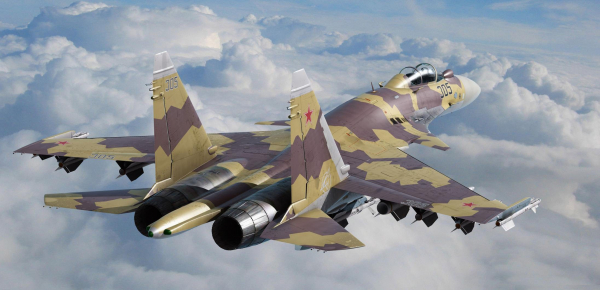
A real comparison
Now let's move on to the facts. When objectively comparing storage systems, we typically use simple criteria.
- Reliability
- Performance
- Cost of expansion
- Quality of support
- Price
Let's start with point 1.
Reliability
I usually ask my clients who use A-brands:
"How would you assess the reliability of your storage system?"
The usual response is:
"Everything is great, no complaints, I sleep well, eat, go to work, and so on. Assessment is five plus!"
Then I ask the second question:
"Okay, but have you ever experienced data loss, even once? For example, during a firmware update or any other reason?"
In almost 100% of cases, I can honestly say, clients sigh and respond:
"Yes, it has happened!"
Now let's go back a little...

An interesting picture emerges. On one hand, there's a firm belief that A-brands are always reliable. On the other hand, with A-brands we lose data just like ordinary mortals.
But let's return to Aerodisk.
I have been selling and implementing AERODISK storage systems since the fall of 2017. As you can imagine, I have managed to implement a lot of projects for data storage of varying complexity. Many systems have been operational for over a year now. Periodically, clients buy additional disks or shelves as their needs grow. I maintain good relationships with each of my clients.
And here’s a fact. There have been no data losses with Aerodisk systems among my clients. Yes, there have been hardware failures, administrator errors, and other abnormal situations. But data has always remained intact. The system is designed in such a way that it is extremely difficult to lose data. You really have to make an effort to do so.
Firstly, just like with A-brands, Aerodisk has a ton of built-in data protection measures: snapshots, autosnapshots, RAID with triple parity, clones, and replication.
Secondly, there are additional means that are not visible to the naked eye, but they save you in critical situations. Lockdown mode (or foolproof protection). If critical components are damaged due to a hardware failure or improper use, the system shuts down and does not allow operations that could ultimately destroy the storage system until normal conditions are restored.
There is also a BBU module, which allows the storage system to operate autonomously for several minutes in case of a power outage. What does this look like in practice?
I have one client. It's a factory in Yekaterinburg. The electricity there is extremely unreliable. It frequently goes out for a few minutes, then comes back. This can happen several times a day.
Recently, they brought the AERODISK storage system for testing. They plugged it into a regular outlet bypassing the UPS, swept the dust off the table where they then placed the storage system, and configured it. The BBU module was disabled during the test period to avoid damaging the equipment.
I went off to take care of my errands after that. Then I got a call from the client saying:
‘Serega, everything's gone. We lost power, then it came back, we're connecting to the storage system, and everything's red!’
I explained to the client that this is normal behavior for a storage system without a BBU module or UPS. This is a protection system. It detected that both controllers lost power, which is clearly abnormal, and to prevent damage, it blocked any potential for failure.
Imagine if your enterprise experienced power outages five times a day while a rebuild (i.e., rebuilding the RAID group) was happening on the storage system at that moment. It’s obvious that at some point, data would be lost; it’s just a matter of time. Therefore, in such cases, the storage system enters a protection mode, from which it can be exited with a regular reboot. Ultimately, this was done, and the testing continued, now with a proper UPS and BBU.
There have been many situations with my clients. One had a UPS burn out, filling the entire room with smoke, while others experienced disk failures due to hardware malfunctions, but no data was lost.
Of course, someone will now tell me: ‘There are too few installations to boast about having no failures that irretrievably lost data,’ and they would be right.
It is clear that the question of the number of installations here is extremely important. It’s also obvious that the issue of data loss on the AERODISK storage system is a matter of time. Therefore, it is fair to equate the reliability of top brands and AERODISK. Like A-brands, AERODISK employs a multi-level data protection system against any unforeseen circumstances.
All these systems are quite reliable, although no one can guarantee data safety 100%, simply because it is physically impossible.
Performance
Everything is fairly transparent here. Earlier, when AERODISK only had RDG (RAID Distributed Group - a type of disk group), performance tests did not always yield results. This is due to the nature of RDG's implementation. There is a lot of intelligence involved, but it comes at the cost of reduced performance.
With the introduction of DDP (Dynamic Disk Pool – the second way of organizing groups in AERODISK), the situation dramatically changed; AERODISK started outpacing everything in its class on flash and hybrid configurations. The results can be found in but I will summarize them briefly here:
The entry-level AERODISK ENGINE N2, FC16Gb, featuring 24 SSD disks of 800G.
- Standard test with 4k FullRandom blocks – 400,000 IOPS, latency 2 ms.
- Test with large blocks of 128k – 6 gigabytes per second read stream; 5.5 gigabytes per second write stream.
In both cases, the load on the storage system's processors is about 50%, meaning this is not the limit.
What do these numbers tell us? Is it a lot or a little? Let’s compare. I test many different storage systems as part of my work. Naturally, I cannot publish direct competitor results on Habr for AERODISK, they would sue me for that. However, I can say this: vendors with three-letter names – both blue and green – can also achieve these kinds of results.
But there is one problem.
These results in A-brands are only possible for mid-range and high-end models (Mid-Range and Enterprise Mid-Range), while entry-level models perform significantly worse, by three to four times. To avoid being unsubstantiated, I will provide an example from the materials of one of the A-brands, where this is stated absolutely officially.
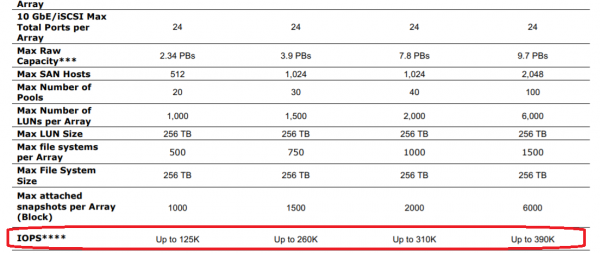
This is a description of an A-brand with three letters. You can find it on the Internet. On the left – the entry-level model, on the right – the highest one. Thus, the entry-level AERODISK delivers performance equivalent to a top-tier system from a competitor A-brand.
I have not yet seen the test results for the ENGINE N4 storage system (Enterprise Mid-range), but I suspect that a new record will soon be set for mid-range and high-end storage systems. We'll just have to wait.
Output: Aerodisk's performance is at least on par with A-brands, and thanks to a more attractive pricing policy, it gains an advantage in the price/performance ratio. or if you prefer IOPS/per ruble.
Cost of expansion
This is a crucial point that customers often forget. It frequently happens that we buy a storage system in its initial configuration at a super price, genuinely for a pittance. Excited about the successful purchase, we put the storage system into operation and start storing data on it. After two or three months, however, the space on the storage system runs out, and we go to the manufacturer for new disks or shelves. And here we encounter a surprise.
It suddenly turns out that the fantastic discount applied only to the initial configuration, and expanding the storage system must be done at full price. In the end, there's no choice; we can't just buy a new storage system, can we? We're forced to spend a fortune on expansion. But that's not all.
At some point, we will hit the maximum specifications of this storage system because the controller's processor can't keep up, and we'll indeed have to purchase a new storage system.
Of course, a reasonable question arises: why wasn't the proper sizing done and the capacity calculated?
The question is indeed reasonable, and all vendors (including Aerodisk) keep saying:
Sizing, sizing, and once again sizing! For a minimum of three years!
But in reality, three purely psychological factors come into play.
- The desire (or necessity) to save money. It was calculated just enough, and then some was cut off; it should be enough.
- Vendor marketing, which promises tremendous space savings through compression and deduplication.
- Unaccounted workloads that arise right after implementation. To be precise, they existed, but it wasn't planned to host them on the new storage system. In fact, a new, fast, and convenient storage system was installed, and it immediately turned out that there are millions of internal IT services that need to be migrated there to increase loyalty among internal IT users and businesses as a whole.
As a result, after three months, we need to expand the system... at a different cost.
The situation described above is classic for A-brands. How does it play out with AERODISK?
The AERODISK Engine is essentially a constructor. If at any point you hit a wall with the controller processor, you can replace it with a more powerful one instead of upgrading the entire storage system to a more advanced model. The same goes for RAM and input-output adapters. Naturally, the vendor will handle the selection and replacement of components since they provide a warranty on their equipment.
What about the disks? This is where it gets interesting. We all know that A-brands don’t allow third-party disks. For instance, you can’t buy an HGST disk and plug it into an A-brand storage system. It simply won’t work. Why?
In the past, vendors themselves launched legends, like:
- Disks in storage systems are produced by the storage manufacturers themselves. This is not true. They are made by the same companies, WD, Samsung, Micron, Intel, etc. Just due to service and marketing, these disks are 4-8 times more expensive than their counterparts from the original manufacturers.
- Disks in the storage systems are specially flashed by the storage manufacturer to enhance reliability and/or performance. This is also untrue. Disks are flashed (more accurately, the sector size is changed to a custom one) to protect the vendor. On one hand, to ensure that no third-party disks operate in their storage systems, and on the other, to prevent their "flashed" disks from working elsewhere.
AERODISK has a very interesting policy in this regard.
Just like A-brands, AERODISK offers its own disks, which are essentially the same as those from the open market, but they are more expensive (though only 1.5-2 times more, not 4-8 times) because they come with a warranty from AERODISK (quick disk replacement).
However, there is one VERY IMPORTANT difference.
Attention! You can use your own disks. Yes, your own.
That is, you can go to Yandex Marketplace, buy some HGST disks, plug them into the storage system, and they will work. Naturally, there will be no warranty from AERODISK on these disks (but the warranty on the storage system itself will remain intact), and you will have to manage disk replacement yourself.
Of course, it’s important to understand that the developers of the storage systems are also people and need to eat, so using third-party disks will require a separate license (which isn't very expensive, by the way).
As a result, In terms of expansion cost, AERODISK is more flexible than most top competitors.
Missed the sizing? No problem! There’s always an option to expand the system for not too much money. The ability to freely upgrade hardware, use expensive drives from the storage developer without stress, or save costs by using your own drives – all of this is quite pleasing. Unlike the A-brands, Aerodisk provides choice, and having such a choice is always a good thing in my opinion.
Quality of support
We are already accustomed to support from top brands. Support from a leading vendor always brings peace of mind to the IT director. There are service centers in every city, plenty of trained specialists across the country, a lot of technical materials available online, and everything can always be 'googled'.
It seems that everything is perfect. But the devil, as they say, is in the details. Let’s try to understand how the support for A-brand systems is usually organized.
You call (or write) to the call center/service desk, where a polite person from the first line of support asks you 5-10 standard questions about your problem and registers a ticket. Then (immediately or after a short while), this polite, but not very competent person honestly tries to find a quick solution to your problem. If the issue is about replacing a faulty disk, that is, of course, resolved quickly, but if it's something more complicated, that’s where the problems start.
Your request is escalated to the second line of support to guru engineers who know significantly more, and the chance that they will solve your problem is much higher. But here’s the catch: guru engineers are a busy bunch, and you may have to wait several days for a guru to descend from the heavens and start addressing your problem.
I am not joking, and many clients can confirm this. For cool, expensive, and well-known A-brands, transferring a ticket between the first and second lines almost always means several days of waiting. And what if the second line can't handle it and you need developers from the third line for assistance?

And how does Aerodisk support work? It’s all absolutely the same: several lines of support, a ticketing system, and so on. Aerodisk has a regional presence in Russia and the CIS at roughly the same level (there are offices in all major cities), although, of course, the presence is not as extensive.
Qualified specialists and materials are scarce on the Internet, but their numbers are growing rapidly. SLA is roughly the same across the board, with several levels ranging from the most basic to mission-critical.
It might seem that we can conclude the comparison of support quality here. Overall, it's a draw, with a slight edge towards the top vendors.
However, Aerodisk's support has one very interesting feature. I would even call it a killer feature. Regardless of the level of support you purchase, you have a dedicated qualified engineer.
Moreover, you personally know your dedicated engineer; you are familiar with him. You have his mobile phone number and can easily message him via WhatsApp or Telegram. He is aware of your infrastructure and understands it well. He can resolve your issues easily because he knows you and your setup.
If he cannot solve the problem, he himself (take note, himself!) will call the developers, and they will help him resolve your issue.
You might say that if this is done with all clients, the engineer will eventually be overwhelmed. I can assure you – they won't be overwhelmed, as the number of such engineers increases with the growing client base. The point is that Aerodisk does not rely on a large number of low-skilled personnel, as is typically the case with A-brands. Instead, the focus is on a small number of highly competent and educated individuals.
This approach has its downsides, such as the never-ending search for personnel, but it works and works well. And I think that's enough about that.
As a result, The presence of a dedicated guru engineer as a mandatory element of services makes Aerodisk's support significantly more attractive and valuable in the eyes of the client compared to top vendors.
Price
And now for the most interesting part.
When I present clients with the AERODISK storage systems, clients usually say to me: 'Listen, Sergey, this is Russian, it should cost a bit more than nothing!!'
So I usually respond with:
- AERODISK is not QNAP.
- AERODISK is not SYNOLOGY.
- AERODISK is not SUPERMICRO.
It is a normal Enterprise storage system, with excellent performance and outstanding support, and which is naturally worth its price. Just like a good car.
Aerodisk is not more expensive than a well-known top vendor with three letters, but it's not significantly cheaper either. However, wait, there’s an option to use your own disks.
If you use your own disks, it can be much cheaper than the top vendors. Therefore, if you need to beat someone on price, Aerodisk makes it easy to do so..
In summary
I am by no means trying to idealize Aerodisk. It's clear that, like any solution, it has its drawbacks.
The limited number of installations (currently in the hundreds) does not allow us to draw a final conclusion about reliability, although at the moment, the SAN systems are working excellently in current projects, with Aerodisk's reliability on par with the best foreign solutions and not inferior to them at all.
Technical support is also not as extensively organized, although the resources are currently sufficient; at least none of my clients have complained, quite the contrary – they praise the original approach with a dedicated engineer, the super-fast response from all support lines, and the truly loyal attitude towards the client.
Aerodisk systems clearly outperform A-brands in terms of price-performance ratio. For less money, you can get more performance. And that’s a fact you can’t ignore.
Additionally, AERODISK SAN systems are technically more flexible (hardware upgrades, using your own disks), which makes it easy to solve scaling issues at a reasonable cost.
Unfortunately, decades of disparaging Russian technology have taken their toll. The cliché "Russian technology is bad" is firmly planted in all our minds, and we will be struggling to shake this off for a long time, disparaging our own while not noticing the obvious flaws in foreign technology.
With this article, I wanted to highlight the real advantages of a very worthy Russian product, which, in my opinion, truly resolves and outweighs any potential drawbacks.
Initially, I planned to also discuss the implementation and operational experience of Aerodisk with one of my commercial (important to note, this is not a government) clients, but then the article would have been quite lengthy, so expect a continuation in a week.
Thank you, please leave comments and share your experiences.
P.S. By the way, you can watch the video of my recent Aerodisk presentation and a VERY lively discussion with real clients on the Aerodisk YouTube channel.
There you will find many confirmations of the theses described in this article from the mouths of real clients. The discussion turned out to be extremely entertaining; I recommend watching it.
Source: habr.com
