

Other articles in the series:
- History of the relay
- History of electronic computers
- History of the transistor
- Internet history
The second project to create an electronic computer, which appeared as a result of the war, like the "Colossus", required a lot of minds and hands for fruitful implementation. But, like the Colossus, it would never have come into being if a single person hadn't been obsessed with electronics. In this case, his name was .
Mauchly's story intertwines in mysterious and suspicious ways with that of John Atanasoff. As you remember, we left Atanasov and his assistant Claude Berry in 1942. They quit working on the electronic computer and turned to other military projects. Mouchli had a lot in common with Atanasov: they were both professors of physics at obscure institutes that lacked prestige and authority in broad academic circles. Mauchly languished in isolation as a teacher at the tiny Ursinus College in suburban Philadelphia, which did not have even the modest prestige of the state of Iowa, where Atanasoff worked. None of them did anything to get the attention of their more elitist counterparts at, say, the University of Chicago. However, both were taken by an eccentric idea: to build a computing machine from electronic components, the same parts from which radios and telephone amplifiers were made.
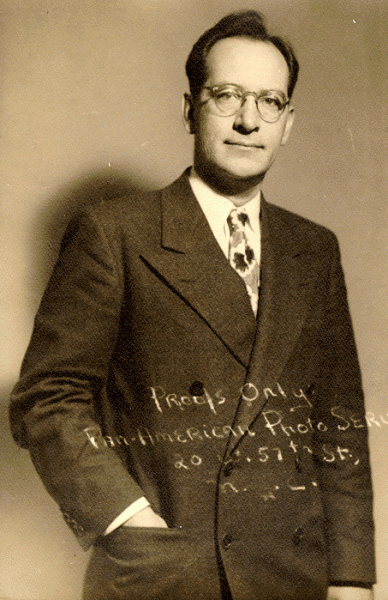
John Mauchly
Predicting the weather
For some time, these two men established a certain connection. They met in the late 1940s at the American Association for the Advancement Science (AAAS) conference in Philadelphia. There, Mouchli gave a presentation on his research on cyclical patterns in weather data using an electronic harmonic analyzer that he developed himself. It was an analog computer (that is, representing values not in digital form, but in the form of physical quantities, in this case, current - the more current, the greater the value), similar in operation to the mechanical tide predictor developed by William Thomson (later became Lord Kelvin) in the 1870s.
Atanasoff, who was sitting in the hall, knew that he had found a comrade on a lonely journey to the country of electronic computing, and without delay approached Mouchli after his report to tell him about the machine he had built in Ames. But to understand how Mauchly even got on stage with his presentation of an electronic weather computer, you need to go back to his roots.
Mouchli was born in 1907 to the physicist Sebastian Mouchli. Like many of his contemporaries, as a boy he became interested in radio and vacuum tubes, and vacillated between careers in electronics engineering and physics before deciding to concentrate on meteorology at Johns Hopkins University. Unfortunately, after graduating, he fell straight into the clutches of the Great Depression, and was thankful for getting a job at Ursinus in 1934 as the sole member of the physics department.
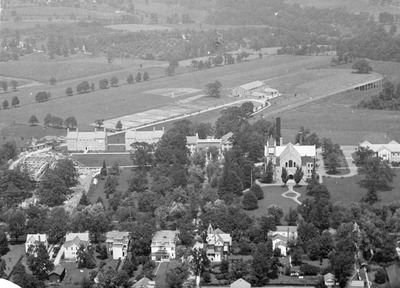
Ursinus College in 1930
In Ursinus, he embarked on a dream project - to unravel the hidden cycles of the global natural machine, and learn to predict the weather not for days, but for months and years ahead. He was convinced that the Sun governs weather patterns that last for several years, associated with solar activity and sunspots. He wanted to extract these patterns from the huge amount of data accumulated by the American Meteorological Bureau with the help of students and a set of desktop calculators purchased for pennies from bankrupt banks.
It soon became clear that there was too much data. Machines couldn't compute fast enough, and human error began to show up as the machine's intermediate results were constantly being copied onto paper. Mauchly began to think of another way. He knew about the vacuum tube counters pioneered by Charles Wynn-Williams, which his fellow physicists used to count subatomic particles. Given that electronic devices could obviously record and accumulate numbers, Mouchly wondered why they couldn't do more complex calculations. For several years, in his spare time, he played with electronic components: switches, counters, substitution cipher machines that used a mixture of electronic and mechanical components, and a harmonic analyzer that he used for a weather prediction project that extracted data similar to weeks-long patterns of rainfall fluctuations. . It was this discovery that led Mouchli to the AAAS in 1940, and then Atanasoff to Mouchli.
Visit
The key event in the relationship between Mouchly and Atanasoff occurred six months later, in the early summer of 1941. In Philadelphia, Atanasoff told Mouchly about the electronic computer he had built in Iowa, and mentioned how cheaply it had cost him. In their subsequent correspondence, he continued to make intriguing allusions about how he built his computer, costing no more than $2 per bit. Mauchly became interested and was quite surprised by this achievement. By that time, he had serious plans to build an electronic calculator, but without the support of the college, he would have to pay for all the equipment out of his own pocket. One lamp usually cost $4, and a minimum of two lamps was required to store one binary digit. How, he thought, did Atanasov manage to save money so well?
After six months, he finally had time to travel west to satisfy his curiosity. After one and a half thousand kilometers in the car, in June 1941 Mauchly and his son came to visit Atanasov in Ames. Mauchli later said that he left disappointed. Atanasoff's cheap data storage was not electronic at all, but held by electrostatic charges on a mechanical drum. Because of this and other mechanical parts, as we have already seen, he could not perform calculations at speeds even close to those that Mauchly dreamed of. He later called it "a mechanical knick-knack using several vacuum tubes". However, shortly after the visit, he wrote a letter praising Atanasov's machine, where he wrote that it was "electronic in essence, and solved in just a few minutes any system of linear equations that included no more than thirty variables." He argued that it could be faster and cheaper than mechanical Bush.
Thirty years later, Mouchly and Atanasoff's relationship would become key in the Honeywell v. Sperry Rand litigation, as a result of which patent applications for the electronic computer created by Mouchly were cancelled. Without saying anything about the merits of the patent itself, despite the fact that Atanasoff was a more experienced engineer, and given Mauchly's suspicious backdated opinion of Atanasoff's computer, there is no reason to suspect that Mauchly learned or copied anything important from Atanasoff's work. But more importantly, the ENIAC circuit has nothing to do with the Atanasoff-Berry computer. The most that can be said is that Atanasoff spurred Mauchly's confidence by proving the possibility that an electronic computer could work.
Moore School and Aberdeen
And at this time, Mauchly found himself in the same place from which he began. There was no magic trick for cheap electronic storage, and while he remained in Ursinus, he had no means of making the electronic dream come true. And then he got lucky. That same summer of 1941, he took a summer course in electronics at the Moore School of Engineering at the University of Pennsylvania. By that time, France was already occupied, Britain was under siege, submarines plowed the Atlantic, and America's relations with aggressive expansionist Japan were rapidly deteriorating [and Nazi Germany attacked the USSR / approx. transl.]. Despite the isolationist sentiment among the population, American intervention seemed possible, and probably inevitable, to elite groups from places like the University of Pennsylvania. The Moore School offered a refresher course for engineers and scientists to speed up preparation for possible military work, especially on the topic of radar technology (radar has features similar to electronic computing: it used vacuum tubes to create and count the number of high-frequency pulses and the time intervals between them; however, Mouchli subsequently denied that there was any serious influence of radar on the development of ENIAC).
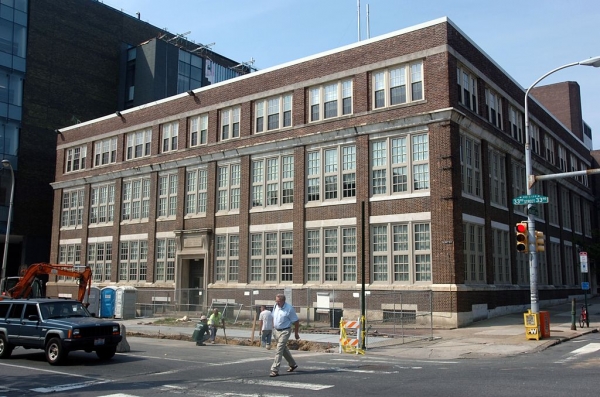
Moore School of Engineering
The course had two main consequences for Mouchly: first, it connected him with John Presper Eckert, nicknamed Pres, from a local family of real estate magnates, and a young electronics wizard who spent all his days in the laboratory of a television pioneer. . Eckert would later share the patent (which would then be invalidated) for ENIAC with Mauchly. Second, it secured Mouchly a place at the Moore School, ending his long academic isolation in the swamp of Ursinus College. This, apparently, was not due to any special merit of Mouchly, but simply because the school was desperate for people to replace scientists who had gone to work on military orders.
But by 1942, much of the Moore school was itself working on a military project: calculating ballistic trajectories through mechanical and manual work. This project organically grew out of the existing connection between the school and the Aberdeen Proving Ground, located 130 km further along the coast, in Maryland.
The range was established during World War I to test artillery, replacing the previous range at Sandy Hook, New Jersey. In addition to direct firing, his task was to count the firing tables used by artillery in battle. Air resistance made it impossible to calculate where a projectile would land by simply solving a quadratic equation. Nevertheless, high accuracy was extremely important for artillery fire, since it was the first shots that ended in the greatest defeat of the enemy forces - after them the enemy quickly disappeared underground.
To achieve this accuracy, modern armies compiled detailed tables that told shooters how far their projectile would land after being fired at a certain angle. The compilers used the initial velocity and position of the projectile to calculate its position and velocity after a short interval of time, and then repeated the same calculations for the next interval, and so on, hundreds and thousands of times. For each combination of gun and projectile, such calculations had to be carried out for all possible angles of fire, taking into account various atmospheric conditions. The counting load was so great that in Aberdeen they completed the calculations of all tables, which had begun at the end of the First World War, only by 1936.
Clearly, Aberdeen needed a better solution. In 1933, he entered into an agreement with the Moore School: the army would pay for the construction of two differential analyzers, analog computers, created according to a scheme from MIT under the direction of . One will be sent to Aberdeen, and the other will remain at the disposal of the Moore School and be used at the discretion of the professorship. The analyzer could build a trajectory in fifteen minutes that would take a person several days to calculate, although the accuracy of computer calculations was slightly lower.
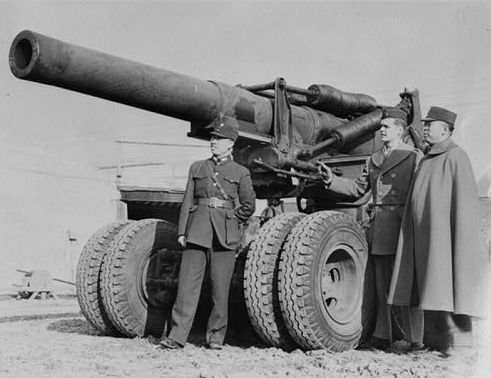
Howitzer demonstration at Aberdeen, c. 1942
However, in 1940, the research unit, now called the Ballistic Research Laboratory (BRL), requested its machine, which was at Moore's school, and began calculating artillery tables for the impending war. The counting group of the school was also brought in to support the machine with the help of human calculators. By 1942, 100 female calculators at the school were working six days a week, grinding up calculations for the war - among them was Mouchley's wife, Mary, who worked on Aberdeen's firing tables. Mauchly was made head of another group of calculators working on calculations for radar antennas.
From the day he arrived at Moore's school, Mouchly promoted his idea of an electronic computer throughout the faculty. He already had considerable support in the form of Presper Eckert and , senior faculty member. Mauchly provided the idea, Eckert the engineering approach, Brainerd the credibility and legitimacy. In the spring of 1943, the trio decided that the time had come to publicize Mouchli's long overdue idea to army officials. But the mysteries of the climate, which he had long been trying to solve, had to wait. The new computer was supposed to serve the needs of the new owner: to track not the eternal sinusoids of global temperature cycles, but the ballistic trajectories of artillery shells.
ENIAC
In April 1943, Mauchly, Eckert, and Brainerd drafted a Report on an Electronic Differential Analyzer. This attracted another ally to their ranks, , mathematician and army officer who served as an intermediary between Aberdeen and the Moore School. With Goldstein's help, the group pitched the idea to a committee at BRL, and received a military grant, with Brainerd as the project's scientific director. They had to complete the machine by September 1944 with a budget of $150. The team called the project ENIAC: Electronic Numerical Integrator, Analyzer and Computer (Electronic Numerical Integrator and Computer).
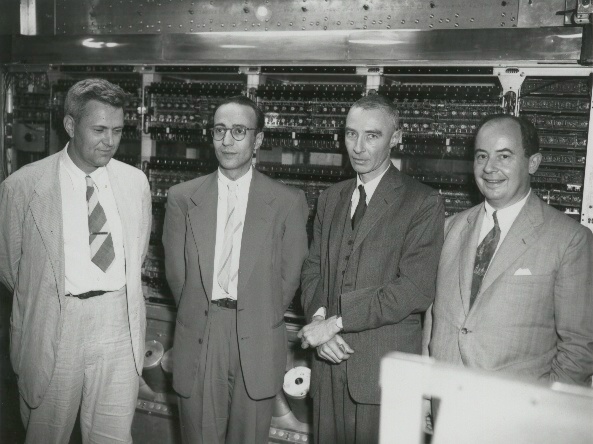
Left to right: Julian Bigelow, Herman Goldstein, Robert Oppenheimer, John von Neumann. Photo taken at Princeton Institute for Advanced Study after the war, with a later model computer.
As in the case of the Colossus in Britain, reputable engineering authorities in the United States, for example, the National Defense Research Committee (NDRC), were skeptical about the ENIAC project. The Moore School did not have the reputation of an elite educational institution, but it offered to create something unheard of. Even industrial giants like RCA struggled to create relatively simple electronic counting circuits, let alone a customizable electronic computer. George Stibitz, the relay computer architect at Bell Labs, then working on the NDRC project, thought that the ENIAC would take too long to be useful in the war.
In this he was right. The creation of ENIAC will take twice as long and three times as much money as originally planned. It sapped the bulk of the human resources of the Moore school. The development alone required the involvement of seven more people, in addition to the initial group of Mouchli, Eckert and Brainerd. Like the Colossus, ENIAC brought in a host of human calculators to help set up their electronic replacement. Among them were Herman Goldstein's wife, Adele, and Jean Jennings (later Bartik), who later had important work in the development of computers. The letters NI in ENIAC's name suggested that the Moore school was giving the army a digital, electronic version of a differential analyzer that would solve path integrals faster and more accurately than its analog mechanical predecessor. But as a result, they got something much more.
Some of the design ideas could have been borrowed from a 1940 proposal made by Irven Travis. It was Travis who participated in the signing of the contract for the use of the analyzer by the Moore school in 1933, and in 1940 he proposed an improved version of the analyzer, although not electronic, but working on a digital principle. He was supposed to use mechanical meters instead of analog wheels. By 1943, he had left the Moore School and took a post in command of the Navy in Washington.
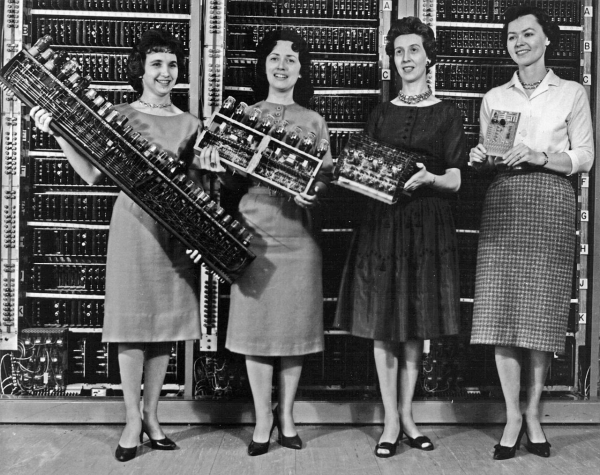
The basis of the ENIAC capabilities, again, like the Colossus, was the variety of functional modules. Most often, accumulators were used for addition and counting. Their circuit was taken from the Wynn-Williams electronic counters used by physicists, and they literally did addition by counting, the way preschool children count on their fingers. Other functional modules included multipliers, function generators that looked up data in tables, which replaced the calculation of more complex functions such as sine and cosine. Each module had its own software settings, with the help of which a small sequence of operations was set. Like the Colossus, programming was done using a combination of a switchboard and telephone-switch-like panels with jacks.
ENIAC had several electromechanical parts, notably a relay register that served as a buffer between the electronic accumulators and the IBM punch machines used for input and output. This architecture was very reminiscent of the Colossus. Sam Williams of Bell Labs, who collaborated with George Stibitz on Bell's relay computers, also built a register for ENIAC.
The key difference from the "Colossus" made the ENIAC a more flexible machine: the ability to program the main settings. The master programmable device sent pulses to the function modules, causing pre-set sequences to start, and received response pulses when the work was completed. It then moved on to the next operation in the main control sequence, and produced the desired calculations as a function of many smaller sequences. The main programmable device could make decisions using a stepper motor: a ring counter that determined which of the six output lines to redirect the pulse. In this way, the device could execute up to six different functional sequences depending on the current state of the stepper motor. This flexibility will allow ENIAC to tackle tasks far removed from its original ballistics expertise.
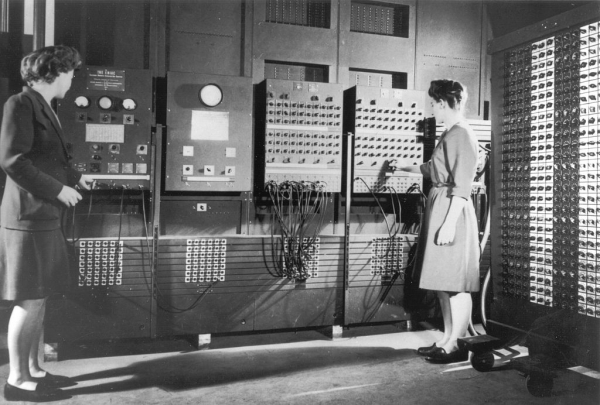
Configuring ENIAC with Switches and Switches
Eckert was responsible for making all the electronics in this monster buzz and buzz, and he himself came up with the same basic tricks that Flowers had in Bletchley: the lamps should work at currents much lower than the regular ones, and the machine does not need to be turned off. But due to the huge number of lamps used, another trick was required: plug-in modules, each of which mounted several dozen lamps, could be easily removed and replaced in case of failure. Then the service personnel without haste found and replaced the failed lamp, and ENIAC was immediately ready for work. And even with all these precautions, given the sheer number of lamps in the ENIAC, he couldn't run the problem all weekend or all night like the relay computers did. At some point, the lamp burned out.
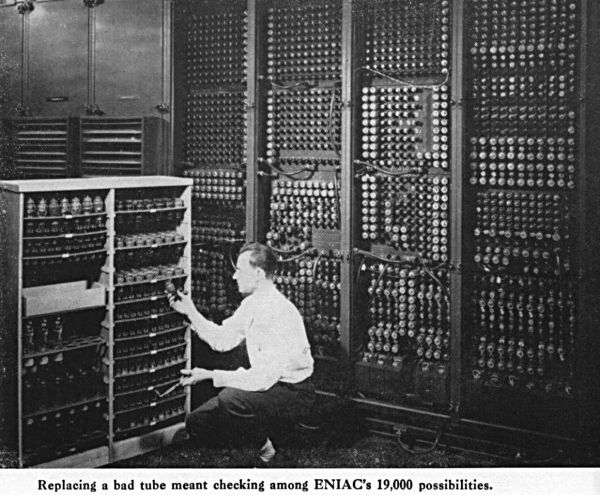
Example of many lamps in ENIAC
Reviews of ENIAC often mention its huge size. Rows of racks of lamps—18 in all—with switches and switchboards would take up a typical country house and front lawn to boot. Its size was due not only to its components (the lamps were relatively large), but also to its strange architecture. And although all mid-century computers seem large by today's standards, the next generation of electronic computers was much smaller than ENIAC, and had more capabilities when using one-tenth of the electronic components.
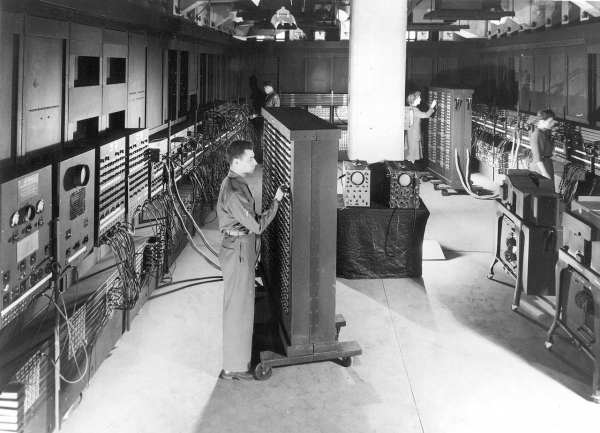
Panorama of ENIAC at Moore's School
The grotesque size of the ENIAC stemmed from two major design decisions. The first sought to increase potential speed at the expense of cost and complexity. After that, almost all computers stored numbers in registers, and processed them in separate arithmetic units, again storing the results in a register. ENIAC did not separate storage and processing modules. Each number storage module was also a processing module capable of adding and subtracting, which required many more lamps. It could be seen as a heavily accelerated version of the Moore school's Human Computing Department, as "its computational architecture resembled twenty human calculators running ten-digit desktop calculators, passing the results back and forth." In theory, this allowed ENIAC to carry out parallel computing on several batteries, but this possibility was little used, and in 1948 it was completely eliminated.
The second design decision is harder to justify. Unlike ABC or Bell relay machines, ENIAC did not store numbers in binary form. He translated decimal mechanical calculations directly into electronic form, with ten triggers for each digit - if the first one was on, it was zero, the second one was 1, the third one was 2, and so on. This was a huge waste of expensive electronic components (for example, to represent the number 1000 in binary, 10 flip-flops are required, one per binary digit (1111101000); and in the ENIAC circuit, this required 40 flip-flops, ten per decimal digit), which, apparently, was organized only out of fear of the possible difficulties of converting between binary and decimal systems. However, the Atanasoff-Berry computer, the Colossus, and the relay machines of Bell and Zuse used the binary system, and their developers had no difficulty in converting between bases.
No one will repeat such design decisions. In this sense, ENIAC was like ABC - a unique curiosity, not a template for all modern computers. However, his advantage was that he proved, beyond any doubt, the performance of electronic computers, performing useful work, and solving real problems with surprising speed for others.
Rehabilitation
By November 1945 ENIAC was fully operational. It did not boast the same reliability as its electromechanical relatives, but it was reliable enough to use its speed advantage several hundred times. The calculation of a ballistic trajectory, which took fifteen minutes for a differential analyzer, could be done by ENIAC in twenty seconds - faster than the projectile itself flies. And unlike an analyzer, he could do it with the same precision as a human calculator using a mechanical calculator.
However, as Stibitz had predicted, ENIAC came too late to help in the war, and tabulation was no longer needed as urgently. But there was a secret weapons project at Los Alamos in New Mexico that continued after the war. It also required a lot of calculations. One of the physicists of the Manhattan Project, Edward Teller, back in 1942 caught fire with the idea of a "superweapon": much more destructive than what was later dropped on Japan, with the energy of the explosion coming from atomic fusion, and not from nuclear fission. Teller thought he could start a fusion chain reaction in a mixture of deuterium (ordinary hydrogen with an extra neutron) and tritium (ordinary hydrogen with two extra neutrons). But for this it was necessary to get by with a low content of tritium, since it was extremely rare.
Therefore, a scientist from Los Alamos brought to the Moore school calculations for testing superweapons, in which it was necessary to calculate differential equations that simulated the ignition of a mixture of deuterium and tritium for various concentrations of tritium. No one at Moore's school had permission to know what these calculations were for, but they dutifully entered all the data and equations brought by the scientists. The details of the calculations remain secret to this day (as well as the entire program to build a superweapon, today better known as the hydrogen bomb), although we know that Teller considered the result of the calculations received in February 1946 as confirmation of the viability of his idea.
That same month, Moore's school released ENIAC to the public. During the opening ceremony in front of the assembled bigwigs and the press, the operators pretended to turn on the machine (although it was always on, of course), performed several ceremonial calculations on it, calculating the ballistic trajectory to demonstrate the unprecedented speed of electronic components. After that, the workers distributed punched cards from these calculations to all those present.
ENIAC continued to solve several more real problems throughout 1946: a set of calculations for the flow of fluids (for example, for the flow of an airplane wing) for the British physicist Douglas Hartree, another set of calculations for simulating a nuclear weapon implosion, trajectory calculations for a new ninety-millimeter cannon at Aberdeen . Then he fell silent for a year and a half. At the end of 1946, under an agreement between the Moore school and the army, BRL packed the car and transported it to the training ground. It suffered from reliability problems there, and the BRL team could not get it to work well enough for it to do any useful work, until a major upgrade ended in March 1948. We'll talk about the upgrade that completely updated ENIAC. more in the next part.
But it didn't matter anymore. Nobody cared about ENIAC. There was already a race to create its successor.
What else to read:
• Paul Ceruzzi, Reckoners (1983)
• Thomas High, et. al., Eniac in Action (2016)
• David Ritchie, The Computer Pioneers (1986)
Source: habr.com
