

Not long ago, I faced the need to choose a virtual PBX. There were some changes in my company's business: new services were introduced, including those aimed not only at the B2B segment but also at B2C. With the arrival of private clients, it turned out that many people still prefer to communicate by phone.
I don't have a very large startup, but I have clients all over the world, so I needed a solution suitable for such a situation. I also wanted to initially collaborate with Russian-speaking developers.
Important clarification: I had no knowledge of telephony, so I had to Google everything from scratch, which may lead to inaccuracies in the text. Please correct/supplement the material in the comments – it will only improve it.
So, let's go!
Who participated in the comparison
A couple of days of reading reviews and overviews helped me form a shortlist of systems for further analysis. It included:
The main point at this stage was the large number of mentions, reviews, and articles about these products – I didn't want to connect a recently emerged raw system to develop a new business direction.
Comparison
Since we were just starting any interaction with potential customers by phone, a highly 'complicated' PBX functionality was not needed. Much more important were ease of use, flexibility, and of course, price.
Here are the points I paid attention to during the analysis:
Integrations
A PBX itself is not as interesting as its combination with other important business systems – for example, CRM, project management tools, and communication means. Therefore, we analyzed the available capabilities of the products we chose from.
Yandex.Telephony has two well-established integrations – with Bitrix24 and amoCRM. The API is designated as a beta version. The feature is available in trial mode and in the tariff for 1299 rubles per month.
Mango Office has a much broader list of ready-made integrations. They are even divided by categories, for instance, there are lists of integrations with resources for specific industries (medicine, tourism, etc.). This may be useful for someone, but in our specific case, 99% of these integrations will not be applicable.
In the case of Zadarma, a plus is its more versatile list of system connections. It includes not only CRMs (both Russian and foreign), but also messengers – as a result, you can send notifications, for example, about missed calls directly to your Telegram.
Sipuni is only integrated with amoCRM, which we do not use. I prefer Zoho. Telfin has only 4 of its own ready-made integrations. Megafon has slightly more (5), and they all focus on working with various CRMs.
Cost
Once again, I'll repeat the introduction: telephony was needed for a new direction in the business, which is currently experimental, so we did not want to spend a lot of money on call reception infrastructure.
The basic version of the Mango Office PBX costs 685 rubles per month. For this money, you get three included users in the tariff, 3 numbers with 10 channels each. However, additional features cost extra – connecting the very basic version of call tracking will cost another 3050 rub/month.
The billing of Yandex.Telephony is based on a package approach. The basic tariff "Start" is free, and you only pay for calls and numbers (one simple number is free, then it's 180 rubles, and the subscription fee for the 8-800 number is 999 rub/month). But there are packages, for example, one unites all web widgets, like website calls, callback requests, etc. – its price is 499 rubles. If you need a fancy number, you will have to pay extra for that as well.
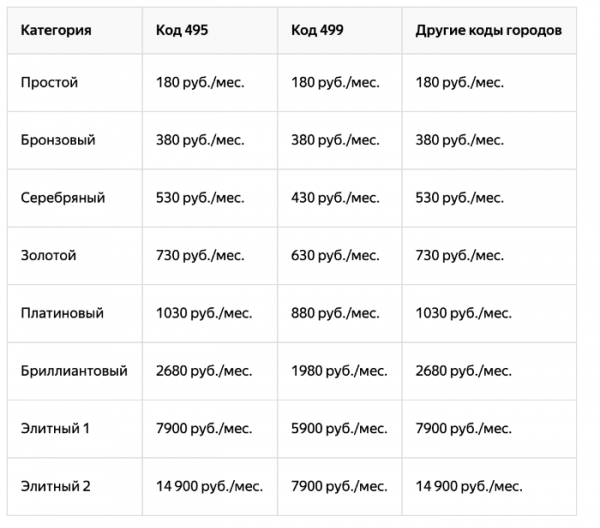
The cost of "fancy" numbers in the Yandex service
Zadarma is a free PBX; charges are made for increased storage of recordings and minutes. The numbers themselves are quite inexpensive – the connection fee is a couple of dollars, and the subscription fee for most not-so-exotic countries is $5-$10 (for some reason, a Belarusian number will cost $45 for connection and $15 monthly).
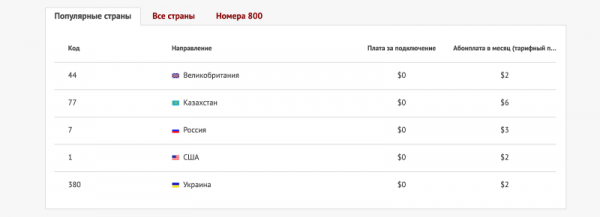
A list of popular countries for ordering numbers in the Zadarma system
The pricing of Telfin seemed quite confusing to me. The lack of a single page with tariffs is concerning – information has to be gathered from different parts of the site – as well as the word "from" in many prices (like services from 299 rub per month). A Moscow number with the code 495 costs more – 1490 against 990 rubles for the code 499.
In the Sipuni service, connecting one number will cost 1000 rubles plus a monthly fee of 266. The basic integration with CRM will additionally cost 286 rubles.
The subscription fee for using the Megafon PBX is 1000 rubles per month (regardless of whether it's 1 employee or 7), and recording and storing calls will cost the same amount, with integration to CRM priced at an additional 500 rubles.
Functionality: international calls, callback, and call tracking
We needed to receive calls from clients from different countries — at least from the USA, Russia, and Europe. It was also important to use the call tracking feature – we were launching several advertising campaigns and needed to understand where the call came from. The presence of additional features like callback widgets was also considered a plus – we don't need it right now, but we wanted to have the potential for future development.
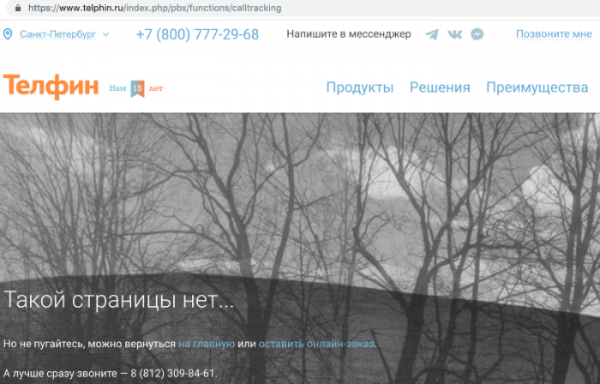
I found foreign numbers only in Zadarma. As for call tracking, it is not available in the PBX from Yandex and Megafon, and the Telphin website has a dedicated section for this feature, , but for some reason, there is no actual page.
All analyzed systems have – at least declared – the ability to use a callback widget. Information about this feature is available on all product sites. Only on the Megafon site is there a mention of the possibility to set up a widget for requesting a callback, but finding it turned out to be difficult.
What we have in the end
System
Foreign numbers
Free access
Number of integrations
Call tracking
Callback widget
Mango Office
No
Yes
(only through a manager – you need to
submit a request and wait for a call)
Many industry services
Yes
(3050/month for the basic version)
Yes
Zadarma
Yes
Yes (the PBX is free; payment is only for numbers)
Popular CRMs
(including Zoho),
task managers,
messengers + API
Yes
(for free, with payment only for numbers)
Yes
Telefin
No
14 days
4
No
Yes
(450 rub/month)
Yandex.Telephony
No
14 days
Bitrix24 + AmoCRM
No
Yes
Megafon PBX
No
14 days
5
No
Yes
Sipuni
No
14 days
1 (only AmoCRM)
Yes
Yes
That's it. I hope this material will be useful to those who, like me, are encountering the task of choosing a PBX for their startup for the first time. Thank you all for your attention!
Source: habr.com
