

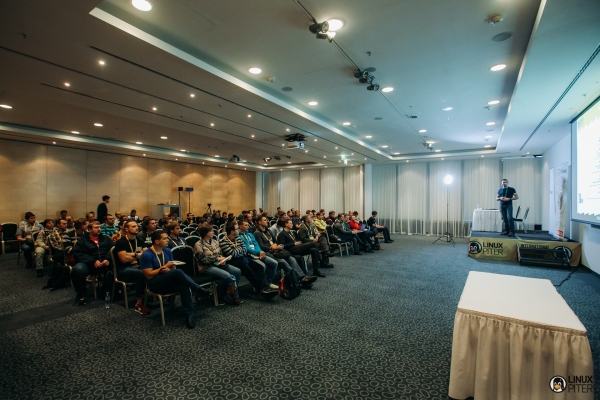
We have been visiting for a long time and regularly Linux conferences all over the world. We found it surprising that Russia, a country with such high technological potential, didn't have a single similar event. That's why we contacted IT-Events a few years ago and proposed creating a larger Linux-conference. That's how it came about Linux Piter is a large-scale thematic conference that will be held in the northern capital on October 4 and 5 for the fifth time in a row.
This is a grand event in the world Linux, which you definitely won't want to miss. Why? We'll discuss that below.

This year, we'll discuss servers and storage, cloud infrastructure and virtualization, networks and performance, embedded and mobile, and much more. We'll connect, connect, and grow the community together. Linux-enthusiasts. Conference speakers include kernel developers, recognized experts in networking, storage systems, security, virtualization, embedded and server systems, DevOps engineers, and many others.
We have prepared many new interesting topics and, as always, invited the best international experts. Below we will talk about some of them. Of course, each visitor will have the opportunity to get acquainted with the speakers and ask them all their questions.
Once upon an API…
Michael Kerrisk, man7.org, Germany
Michael will talk about how one harmless and almost no one needs a system call can provide jobs for prominent programmers from a dozen large international companies for many years.
By the way, Michael wrote a widely known book on systems programming in Linux (and Unix) "The Linux Programming Interface." So if you have a copy of this book, bring it to the conference to get the author's autograph.
Modern USB gadget with custom USB functions & its integration with systemd
Andrzej Pietrasiewicz, Collabora, Poland
Andrey is a regular conference speaker. Linux Foundation. His report will focus on how a device controlled by Linux make a USB gadget that can be connected to another computer (say, on Windows) and use it using only standard drivers. For example, a video camera can be seen as a storage for video files. All the magic happens on the fly, using existing tools and systemd.
Towards Linux kernel security: the journey of the past 10 years
Elena Reshetova, Intel, Finland
How the approach to kernel security has changed over the past 10 years LinuxNew advances, long-standing unresolved issues, future directions for kernel security, and the holes today's hackers are trying to exploit—learn about this and much more in Elena's presentation.
Hardening an application-specific Linux
Tycho Andersen, Cisco Systems, USA
Taiko (someone pronounces his name as Tikho, but we in Russia call him Tikhon) will come to Linux Piter is back for the third time. This year, he'll present a report on modern approaches to improving the security of specialized Linux-based systems. For example, a weather station management system can be stripped of many unnecessary and insecure components, enabling enhanced security mechanisms. He'll also demonstrate how to properly "prepare" TPM.
USB arsenal for masses
Krzysztof Opasiak, Samsung R&D Institute, Poland
Kristof is a talented PhD student at the Warsaw Institute of Technology and an open source developer at Samsung R&D Institute Poland. He will talk about methods and tools for analyzing and reengineering USB traffic.
Multi-core application development with Zephyr RTOS
Alexey Brodkin, Synopsys, Russia
You could also meet Alexey at previous conferences. This year he will tell you how to use multi-core processors in embedded systems, since they are so cheap today. As an example, he uses Zephyr and the boards it supports. At the same time, you will learn what can already be used, and what is under development.
Running MySQL on Kubernetes
Mykola Marzhan, Percona, Ukraine
Nikolay is a member of the program committee Linux Piter since 2016. Incidentally, even program committee members go through all the paper selection stages just like everyone else. If their paper doesn't meet our strict criteria, they won't be selected to speak at the conference. Nikolai will discuss the existing open source solutions for running MySQL on Kubernetes and analyze the current state of these projects.
Linux Multifaceted: How to work on any distribution
Sergey Shtepa, Veeam Software Group, Czech Republic
Sergey works in the System Components division and is developing the change block tracking component for Veeam Agent for Windows and the indexing component for Veeam Backup Enterprise Manager. It will show you how to build your software for any Linux version and what alternatives there are to ifdef.
Linux networking stack in enterprise storage
Dmitry Krivenok, Dell Technologies, Russia
Dmitry is a member of the program committee Linux Piter has been working on creating unique conference content since its inception. In his talk, he will share his experience working with the network subsystem. Linux in data storage systems, non-standard problems and ways to solve them.
MUSER: Mediated Userspace Device
Felipe Franciosi, Nutanix, UK
Felipe will tell you how to programmatically depict a PCI device - and in userspace! It will come out like a living thing, and you won’t have to urgently make a prototype to start developing software.
Evolution of identity and authentication in Red Hat Enteprise Linux 8 and Fedora distributions
Alexander Bokovoy, Red Hat, Finland
Alexander is one of the most respected speakers of our conference. His presentation will focus on the evolution of the user identification and authentication subsystem and its interfaces in RHEL 8.
Secure execution of applications on modern Linux-based smartphone: Secureboot, ARM TrustZone, Linux IMA
Konstantin Karasev, Dmitry Gerasimov, Open Mobile Platform, Russia
Konstantin will talk about secure kernel boot tools. Linux and applications, as well as their use in the Aurora mobile OS.
Self-modifying code in Linux kernel – what, where, and how
Evgeniy Paltsev, Synopsys. Russia
Evgeny will share his experience of using the interesting concept of "finishing with a file after assembly" using the kernel as an example Linux.
ACPI from scratch: U-Boot implementation
Andy Shevchenko, Intel, Finland
Andy will talk about using the power management interface (ACPI), as well as how the device discovery algorithm is implemented in the U-Boot bootloader.
Comparison of eBPF, XDP and DPDK for packet inspection
Marian Marinov, SiteGround, Bulgaria
Marian works with Linux for almost 20 years. He's a big FOSS fan, so you can meet him at FOSS conferences around the world. He'll talk about a high-performance virtual machine on Linux, which cleans traffic to combat DoS and DDoS attacks. Marian will bring several cool open-source games to our conference, which will be available in a special gaming zone. Modern open-source game engines are a far cry from what they used to be. Come and see for yourself.
Zoned Block Device ecosystem: no longer exotic
Dmitry Fomichev, Western Digital, USA
Dmitry will discuss a new class of storage devices – zoned block devices – and their support in the kernel. Linux.
Linux Perf advancements for compute intensive and server systems
Alexey Budankov, Intel, Russia
Andrey will demonstrate special magic for measuring the performance of SMP and NUMA systems and talk about recent improvements in Linux Perf for high-performance server platforms.
And that is not all!
For descriptions of other reports, see the website. .
About preparation for the conference
By the way, you're probably wondering what Dell has to do with this? Dell Technologies is the driving force behind it and a key partner. Linux Piter. We don't just sponsor the conference; our staff members serve on the program committee and participate in inviting speakers, selecting the most relevant, challenging, and interesting presentation topics.
The program committee of the conference includes 12 experts. The committee chairman is Alexander Hakobyan, technical manager of Dell Technologies.
International team: Intel CTO Andrey Laperrier, BSTU Associate Professor Dmitry Kostyuk, Percona CTO Nikolay Marzhan.
Russian team: Kirill Krinkin, Candidate of Technical Sciences, Head of Department at LETI, Vasily Tolstoy and Dmitry Krivenok, Leading Programmers of Dell Technologies, Pavel Emelyanov, Virtuozzo Architect, Marina Lesnykh, Leading Marketing Manager of Dell Technologies, Denis Kalanov, CEO of IT-Events, Diana Lyubavskaya, Event Managers and Irina Saribekova.
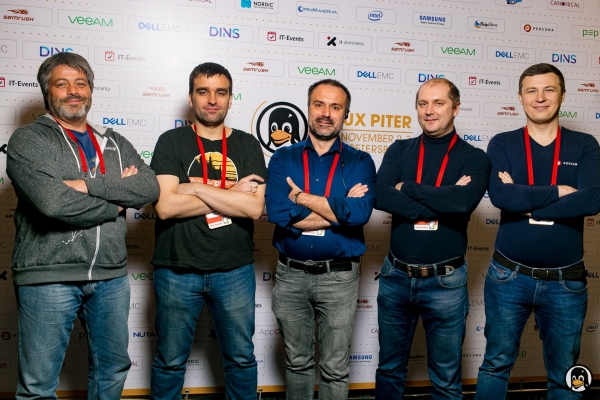
The program committee is responsible for filling the conference with useful and relevant reports. We ourselves invite experts of interest to us and the community, and also choose the most worthy of the topics submitted for consideration.
Then work with the selected reports begins:
- At the first stage, the problems and interest of the community in the stated topic are generally assessed.
- If the topic of the report is relevant, a more detailed description is requested.
- The next stage is remote listening (by this time the report should be 80% ready).
- Further, if necessary, changes are made, and a second audition takes place.
If the topic is interesting and the speaker knows how to reveal it beautifully, the report will definitely get into the program. We help some speakers to open up (we hold several rehearsals and give recommendations), because not all engineers were born great speakers.
And only after that you hear the final version of the report at the conference.
Recording and presentations of reports of past years:

How to get to the conference?
Everything is extremely easy: you just need to buy a ticket . If you are unable to come to the conference or get access to the online broadcast, do not worry. Sooner or later (although we will not hide it sooner rather than later), most of the reports will appear on .
We hope we've piqued your interest. See you there. Linux St. Petersburg 2019! We think it will be truly interesting and useful.
Source: habr.com
