

At the event in September 2018, it was , that new exams of the AZ-*** series have been introduced, while the 70-53* series has faded into obscurity.
The description was already provided in my . But since then, much has changed, and this article incorporates changes from December 2018 and March 2019 that were not reflected in the previous article.
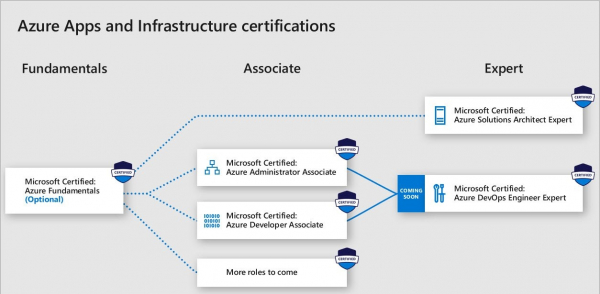
Additionally, new certifications and exams in the field of data handling have appeared In this
, there will be a list of resources for preparation for the Azure Dev/Infra/Architecture exam. For those who are not interested in the reasons for the changes, feel free to skip this section.
I will try to outline the key points:There was no foundational exam for Azure
- (especially noticeable for non-technical roles). Previously, you had to pass a fairly difficult exam on infrastructure/development/architecture right away. Now imagine that you have been working in Sales for about 5 years, not coding, and not setting up servers. To obtain some valid certification, you need to delve much deeper than your role requires and spend much more time, which is not rational. (I am not considering the certificates issued at one-day or even shorter workshops by Microsoft, as this is more about attendance than knowledge.)
- You can't update the exam every 3-4 years and pretend that those who passed in 2015 and those who passed in 2018 have the same knowledge of a rapidly changing platform.
- There was an attempt to replace exam 70-535 with 70-534 for architecture, but this was insufficient.
- You can't pack all questions
- on infrastructure into one exam, all on development into another, and all on architecture into a third. There are 100+ services in Azure. It is obvious that exams needed to be divided. However, Microsoft has moved away from this point by March 2019. In December 2018, az-200/az-201 were combined into one az-203. Then
- in March 2019, az-100/az-101 were merged into az-103 Business
- (as well as developers, admins, and architects) does not change as rapidly as trends do. does not change as quickly as trends do (along with Azure services and Microsoft's ambitions). Microsoft can add services every day to keep up with new trends (Blockchain/IoT/Cognitive Services and AI, Quantum computing, etc.), but you don't use them in your projects and don't plan to use them, as these services are not needed in your project or needed but in another team. As a result — the relevance of the certification began to decline with each new question about new topics. This is true not only for traditional companies with rather slow implementation of innovations, but also for super-innovative startups, for which not everything is necessary either.
- Of course, there were also mentions that Microsoft wanted to create certifications that would correspond to real roles (positions that HR are looking to fill). But initially, a 2+2+2+1 certification for Azure was announced, which probably resembled types of Azure specialists, but after the compression, when it became 1+1+2+1, this argument became less clear.
The explanations were logical, but the community still has reasons for outrage.
The community's opinion on the problems can also be omitted if desiredHere are the ones I saw:
- Between 70-535 (which replaced 70-534 at the end of 2017) and new architecture exams (az-30*) less than a year passed. Probably, with the replacement of 70-534 (for 70-535), it was no longer possible to delay, as it lagged behind reality by about 2 years, but the problems were the same for all 3 exams, and only one was replaced.
- Someone has already started preparing for the 70-53* exams, and they were 'delighted' to learn that the exams were outdated, they needed to restructure their preparation and take new exams. (In theory, the exams are similar, but the testing process differs due to the presence of practical lab work with the real Azure portal during the exam, official courses weren't initially available)
- Transitional exams — good, but transitional exams are paid (az-*02). It turns out that someone could pass 70-532 and spend $165 (in the US, $80 in Russia), and a month later learn that they need to prepare more money.
Before this point, there was nothing unusual, as this had happened before. But there were also unique reasons for dissatisfaction.
- Even Beta versions of the exams (az-20*, az-30*) are paid (They say beta exams were once free, and people were willing to risk waiting several months to find out if they passed, while also helping to improve the exam.)
- There were voices about: "A right away could do it properly? Вот в AWS таких проблем не было». На это мне возразить нечего.
Probably, if both the transition exams and beta were free (for those who had previously taken them), no one would have complained much.
But in March 2019, Microsoft dropped a bombshell on the community with the news that. This ignited frustration among almost everyone.
What fundamentally changed?
- The complete replacement of existing exams with new ones is certainly a significant change, but it didn't impress me.
- For architects, there are 2 exams instead of one — this doesn't really change much, as you still have to pass both to get the architect certificate. There are just more exams now.
- There is now an exam for Azure DevOps (formerly VSTS, formerly VSO).
- The biggest innovation was the addition of a practical component, where you are given access to a real Azure portal, a genuine subscription, an account to work with, and several tasks to complete. This is fantastic because exams began to assess practical skills.
- From personal experience, if you have work experience with Azure, then the lab portion makes passing easier, not harder, as you may not recall the correct answer immediately, but in the practical part, by looking at the Azure environment setup, you’ll find it.
Azure for beginners, or AZ-900
was announced much later than the others, but I believe this was the first thing that needed to be done. AZ-900 consolidates all the basic questions about Azure without linking them to specific technical roles (developer/architect/it pro). Examples: what are CAPEX/OPEX, public/private/hybrid cloud, how billing works, who owns the data, being able to explain a few dozen basic services in a couple of words, and the difference between public data centers and Azure data centers in Germany/China/US GOV, etc. And in the end, you can even obtain a basic certificate.
Finally, there is now an exam for people who are not yet ready to take something serious or really don't need to, but still require proof of competence that they are familiar with the topic. In my humble opinion, This exam must be taken by all managers and salespeople involved in Azure-related projects.It's a way to ensure that people understand what they are doing. Technical roles should also consider this exam. At the very beginning of their certification journey, as the exam covers questions about several dozen basic services (what they are and why), and also provides general overviews of the platform that are usually overlooked.
Once you pass the exam, you can think about whether to continue 'taking' exams or not, as each exam requires significant effort for preparation.
Infrastructure (itpro/or trendy devops)
Initially, there were 2 exams (az-100/az-101), but in March 2019 there was a metamorphosis with the exams similar to the one in the development exam, where — .
The community did not like this at all (read the comments in the announcement in English).As az-100/az-101 were created (and were in release state) in September 2018, and by March 2019, it was announced that they would be deprecated starting May 2019. People invested time and money.
The best comment was 'Who’s managing that stuff? The same guy from the Windows Phone department?' ©
It's clear that the certificate, unlike the exam, hasn’t become outdated and that those who passed az-101 were promised a voucher for the test. But the situation with the exam being pulled back just 7 months after its release is unpleasant.
Since 70-533, (after merging az-100/az-101 into az-103), not much has changed globally, although there was a reason for a new exam since the 70-533 exam was already 3-4 years old, and a new exam was necessary, as knowledge in 2015 and in late 2018 is undoubtedly different.
- From Almost all questions were taken regarding how and what can be done in Azure (creating machines, access to resources, subscriptions, resource groups, working with Azure Active Directory objects, networks, etc.). However, several topics were removed: 'Azure AD Identity Protection and Enterprise State Roaming; configure self-service password reset; implement conditional access policies; manage multiple directories; perform an access review.'
- From Only work with 'Implement Azure load balancer,' 'Monitor and troubleshoot virtual networking,' 'Integrate on-premises network with Azure virtual network,' 'Managed role-based access control (RBAC),' 'Implement multi-factor authentication (MFA),' and a little expansion of the section 'Implement and manage hybrid identities' were included.
Development
Initially, in September 2018, 2 exams were announced: an exam on and an exam on However, on December 29 (two days before the exams were released from Beta), Microsoft made a New Year's gift: all three exams AZ-200/AZ-201/AZ-202 were moved from the state beta to the state retired. Instead, a new exam was published which took into account the community's wishes (article in ).
The community was not pleased with this move.The full version can be read right in the comments under .
For the few who took the exam between September and December, this was a big blow. In the end:
- For those who took AZ-200, results were recalculated, and some were eligible for the certificate. It is said that those who only took AZ-201 did not score enough for the certificate.
- AZ-202 was also recalculated cleverly along with the 70-532 exam after discontented comments under the announcement. Here Microsoft did not deceive us, and some people received the Associate Developer certificate.
In the AZ-203 exam, questions are asked about Web Apps, SQL Database, Functions, AKS, CosmosDB, Logic Apps, Event Grid, API Management ". I believe this is the right set of services reflecting the current state of Azure.
What AZ-203 lost compared to AZ-200/AZ-201It's a pity that questions about Cognitive Services, Bots, and IoT were removed regarding AZ-201, but probably there was too much content for one exam, and they decided to sacrifice these topics as the least frequently encountered, yet very trendy.
In AZ-203, 3 out of 8 issues that I noted for AZ-200/AZ-201 were retained.
- Why did Batch Services make it into the exam? Is it impossible to live without a number cruncher? (WebJobs/Functions are enough if you don't need to perform compute-intensive operations).
- Why is Mobile Apps from Microsoft in 2019 also unclear to me. Microsoft lost the battle for its mobile platform, and when you don't have your own mobile platform, services to support it aren't in demand. But they are included in the core exam.
- I really like the setup instructions for Notification Hub for Android, which sound like this: "Before creating a Notification Hub for Android, create Firebase (which can send notifications to Android/iOS for free)."
- — this is a question about Asp.Net Core and stands out from the general trend, since it is implemented differently in Node, but one must know the code (Microsoft has been striving to make its services cross-platform in recent years) and it is not directly related to Azure.
What exists now is far better/fresher than what was in the 70-532 exam from 2015 to 2018. (And if it weren't for the betrayal of those who passed AZ-200/201/202, everything would have been quite good.)
Architecture
There are 2 exams, and a certificate of Solution Architect is issued for passing both. In my opinion, taking one without the other is quite strange since it involves 2 perspectives on the same thing.
- In the case of we approach from specific services (azure active directory, azure storage, virtual machines)
- And in the case of we approach from key logical blocks (authorization, storage, compute).
I wouldn't say there's a one-to-one correspondence between them. For example, in 301, the term compute may refer to azure batch, aks, and vmss in the corresponding section. Meanwhile, in 300, there is a clear separation into 3 different parts (parallel processing, containers, vms).
I see no point in translating the list of services that one needs to know since it’s not only about knowing the services but also understanding how they are interconnected and when to use what. Additionally, because the list is very long, and even the complete version isn’t available on the exam description pages since an Architect must know the subject widely (whereas a developer needs to delve deep).
Once again, I recommend taking both exams and preparing for them simultaneously..
DevOps in Azure on Azure services
is oriented towards a very wide range of questions. The exam requires understanding processes and methodologies (working with work items, planning, etc.) on one hand, and knowing how to manage project dependencies, how to build code, publish, how to use external tools for code analysis, how to get user feedback through tools, etc. on the other.
Personal opinionPersonally, I would make the exam similar to AZ-30* (splitting it into 2 parts: processes & practices/craft part of devops work) since this is like the difference between a scrum master and devops engineers. But the authors know better.
To obtain the certificate , you must first obtain a certificate either in , or in .
- If you want certification specifically in Azure/Cloud, then everything is fine for you. I would recommend first taking AZ-203, as it provides an overview of some Azure services, and then in AZ-400 you have a whole section on Azure Kubernetes Services, Azure Container Registry, ARM, Azure CLI in the context of publishing.
- But if you want totake the exam but not publish in Azure,, then you’ll still need to familiarize yourself with Azure.You have no choice anyway, as on December 31, 2018, Microsoft and now it's either the Cloud version or nothing.


Exams for Data Platform
All the above-mentioned exams were just the first step in the changes.
- In December, there was an announcement , stating that all exams involving extensive data work would be retired in six months, on June 30, 2019.
- And by the end of January 2019 .
These exams were created in the era of ‘Cloud First, Mobile First’, but that era ended in the fall of 2017. Now, a new time has come at Microsoft: ««.
Microsoft is revising its approach to data storage and processing, along with various Artificial Intelligence-based services, which also impacts the exams.
- For example, since 2016 (maybe even since 2017), there has been the role of Cloud Solution Architect — a person responsible for increasing Azure adoption among customers. This role had 2 directions (which appeared and then merged again): App Platform and Infrastructure (we are not considering O365 now, as I am not an expert in that). In 2018, they started hiring DSAs — Data Solution Architects.These are the same as CSAs, but they focus on projects related to storing/processing large volumes of data and various cognitive services, bots, and machine learning.
- Moreover, one reason for canceling az-200/az-201 and replacing them with az-203 was that questions on bots and cognitive services belong more to the ‘Data & AI’ domain rather than to development, and thus they were removed from the developer exams.
As a result, we got 4 exams in beta stage (if we look at what happened with az-10*/az-20*, I wouldn't rush to take them).
I cannot call myself a major specialist in data analysis and especially in artificial intelligence, but my understanding of the difference in exams is as follows:
- DP-100 Data Science Solutions — the description of this exam does not contain questions about Azure. It's rather a general, methodological exam.
- DP-200/DP-201 — they are about storing and processing data specifically in Azure (Azure Data Solution). They include both general questions and specific ones for SQL Azure, CosmosDB, SQL DWH, etc.
- AI-100 — this is fairly straightforward, since AI is not about storage or large volumes, but about analysis methods based on machine learning (not just collecting a bunch of sources, performing cleaning, aggregation, and dumping into a DWH).
But that’s just my understanding as someone who is interested but not deeply involved in the topic.
Source: habr.com
