

Who among us would not like to learn faster and memorize new information on the fly? Researchers attribute strong cognitive abilities to a variety of factors. They determine not only the ability to memorize, but also a quality life - here is a successful career, active socialization and the opportunity to just have fun in your free time.
Not everyone is lucky enough to be born with a photographic memory, but that's no reason to despair. You can do something in such a situation. Someone memorizes "Eugene Onegin", others buy manuals and collections with special exercises. Still others are increasingly paying attention to applications that promise their users phenomenal results if they are willing to set aside 10-15 minutes a day for exercise. We will tell you what these simulators are based on, and what to expect from them.
Photo: /unsplash.com
How do we remember
Serious academic research on this issue began in the second half of the XNUMXth century. The honor of one of the key discoveries in this area belongs to the German professor Hermann Ebbinghaus. It is his findings that are still used in memory improvement systems to this day.
Ebbinghaus explored the deep processes of memory that exist regardless of context. This distinguishes his work from the research of the same Freud. The father of psychoanalysis studied why we forget things that are unpleasant to us or form not always correct, but more often “convenient” memories. Ebbinghaus - studied mechanical memory. It works on the basis of repetition of material.
Therefore, in his experiments, the scientist memorized sequences of syllables of three letters (one vowel between two consonants - "ZETS", "MYUSCH", "TYT"). A prerequisite was that these combinations did not form meaningful words and did not resemble them. For this reason, for example, he would have rejected "BEECH", "MOUSE" or "CHAN". At the same time of day, Ebbinghaus would read chains of such syllables aloud to the beat of a metronome. Next, he noted how many repetitions are required to accurately reproduce the sequence.
The result of these works was the “forgetting curve”. It reflects the slippage of information from memory over time. This is not a figure of speech, but a real dependence that the formula describes.
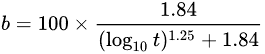 , where b is the proportion of material remaining in memory (in %), and t is the elapsed time (in minutes).
It is worth emphasizing that the results of this work were later confirmed. In 2015 scientists Ebbinghaus experiment and achieved approximately the same performance.
Ebbinghaus' discovery made it possible to draw several conclusions about mechanical memory at once. First, the scientist found that the brain tries to find something familiar even in deliberately meaningless material. Secondly, information slips out of memory unevenly - in the first hour more than half of the material “leaves”, after ten hours a person can remember only a third, and what is not forgotten in a week, most likely he will be able to remember in a month.
Finally, the most important conclusion is that you can work on memorization by periodically returning to what you have learned before. This method is called spaced repetitions. It was first formulated in 1932 by the British psychologist Cecil Alec Mays in one of his books.
Repeat wisely
Although researchers proved the effectiveness of the repetition technique back in the 30s, it did not gain wide popularity until 40 years later, when the German scientist Sebastian Leitner applied it to teaching foreign languages. His book How to Learn to Learn (So lernt man lernen, 1972) has become one of the most popular practical guides to the psychology of learning.
The main condition proposed by Leitner is that each subsequent interval before the next repetition of the material should be greater than the previous one. The size of pauses and the dynamics of their increase can be different. Intervals "20 minutes - eight hours - 24 hours" provide effective short-term memorization. If you need to remember something on an ongoing basis, you need to return to such information regularly: after 5 seconds, then after 25 seconds, 2 minutes, 10 minutes, 1 hour, 5 hours, 1 day, 5 days, 25 days, 4 months, 2 years.
Photo: /Pixabay.com
In the 70s, Leitner suggested using flashcards to write down the meanings of foreign words. As the material was memorized, the cards were moved from the group with the most frequent repetitions to the rarer ones. With the advent of computers and specialized software, the essence of the process has not changed.
In 1985, Polish researcher Piotr Woźniak released the SuperMemo program. It has become one of the most advanced memorization programs. The solution exists to this day, and its algorithms have been used in many alternative applications.
Wozniak's software allows you to work with virtually any information, since it is possible to add data. Next, the program will track the “forgetting curve” for individual cards and form a queue from them according to the principle of spaced repetitions.
In subsequent years, all sorts of analogues of SuperMemo and author's versions of systems for developing memorization skills came out. Many such programs have proven their effectiveness in practice - we talked about this in an earlier habrapost. But, alas, criticism followed.
Fly in the Ointment
However useful Leitner's for learning foreign languages, memorizing mathematical formulas or remembering historical dates, scientists find no evidence that training memory on any particular topic improves overall memory ability.
You also need to understand that to deal with deterioration in cognitive abilities, whether due to injury, any disease or age-related changes, such programs also do not help.
Photo: /Pixabay.com
In recent years, this topic has often brought experts together. And how can one read in the open , under which dozens of eminent scientists signed in 2014, most of these systems, including various intellectual games, are effective only within the framework of those tasks that they themselves solve, but cannot contribute to an overall improvement in the “quality” of memory. On the other hand, these "accusations" opponents and the dispute continues.
But be that as it may, as a result of the ensuing litigation, at least one developer of "brain simulators" was forced to adjust the wording.
In 2016, the US Federal Trade Commission Luminosity to pay $2 million for incorrect advertising. The regulator concluded that the company played on the public's fear of age-related changes and instilled false hopes in users. Now the project is promoting its services as tools for "unleashing the potential of the human brain."
Further research on the topic is increasingly leaning towards the fact that there is still some effect from daily exercise, but most likely solving puzzles on a smartphone will not increase your perseverance, no matter how convincing some mobile simulators are.
And memorizing foreign words with the help of such software will help you at least somehow speak a new language, at best, in a year or two. Therefore, anyone who wants to improve their memory should pay extra attention not only to the “tools” for memorization, but also focus on the area of competence you need and not lose sight of the factors that , ability to concentrate and to educational workloads.
Additional reading:
And more:
Source: habr.com
