

The popularity of freelancing is growing every year. After all, this way of organizing the workflow includes a whole lot of advantages: free schedule, lack of attachment to a specific workplace, opportunities for international cooperation, greater freedom in choosing projects.
All these advantages together form a good basis for moving a freelancer to another country, because he does not have to change his job and work style.
But the process of relocating a freelancer in different countries is slightly different from moving a full-time specialist. Let's consider it on the examples of different countries of Europe, Asia and North America.
What is a freelancer
Freelancers are individual entrepreneurs who work in the fields of IT technologies, design, media, journalism, translation, and also engage in various consulting or expert activities.
Also, freelancers are often referred to as hired freelance remote employees who are hired for the period of work on a specific project.
Freelancing in different countries
Before you pack your bags, you need to decide where exactly you want to move.
There are three categories of countries by availability for relocation:
- Affordable: They have fairly simple immigration laws, entry and residency processes, or even the ability to work without one. For example, Thailand, Ecuador, India, Indonesia.
- Medium availability. There are some difficulties for an immigrant, but the chances of a positive one are extremely high. For example, Bulgaria, Cyprus, Portugal, China.
- Practically inaccessible. Countries with very strict immigration laws, where entry to freelancers is practically closed. For example, USA, Canada.
Let's take Canada. For a freelancer, relocation under the “Self-employed person” program, that is, “Self-Employed”, is ideal. But there are many nuances. Firstly, only representatives of the arts and sports fall under this category. That is, a copywriter and a web designer will still pass, but the SMM manager will no longer. In addition, there is a very strict system for evaluating the value of a specialist, which depends on education, work experience, knowledge of languages (English and French).
In Canada, there are over 70 different programs for the immigration of specialists, but specifically with freelancers, questions may arise, because legal work requires a contract with a Canadian company, and opening your own company is quite expensive and dreary.
And, for example, in Thailand, the visa issue is resolved quite simply. This is if you go the official and legal way. You need to apply for an annual Non-Immigrant Visa-B business visa without obtaining a work permit. The only thing is that every 3 months you will have to renew your visa when leaving the country.
Thailand's immigration law was seriously tightened in 2015, but it's still simpler than Canada's or America's.
I highly recommend not to participate in any fraud with visas. In Thailand, you can even buy a residence permit for $3000, and if this is discovered, then the case will not be limited to deportation - you can get a real term of 3-5 years. There is nothing to say about more developed countries, where the punishments are much tougher.
However, if you intend to live in the country for six months or a year, and not longer, then you should not bother too much with visas. In many countries, including European ones, there are options based on tourist visas, with which you can stay in the country for quite a long time if you renew them on time.
To find out about the peculiarities of obtaining and extending a visa, you can contact the consulate of the selected country or a special visa center.
Cost of living in countries
Before moving, be sure to evaluate the cost of living in the country and calculate what minimum income is required to comfortably stay in this country.
The main rule is one: "work in a country with a high income, and live in a country with a low cost of living."
That is, if you work as a freelancer with customers from Germany or the USA, then you will be comfortable living in almost any country.
But with Russian income, you need to choose a country where the cost of living is not higher than in Russia. Otherwise, you will have to save a lot, and the very meaning of moving to another country for more comfortable work will be lost.
What you need to pay special attention to:
The cost of housing and utilities. As well as features of renting housing. In Italy, for example, the removal process itself takes up to one and a half months. You will also have to conclude an agreement with the public utilities for connecting the light, for which you will need to make an Italian identification number. In general, the bureaucracy is on top.
The Internet. Pay special attention to the cost and characteristics of the Internet. In European countries, the Internet is quite expensive - a normal package with a speed of 10 Mbps or more will cost at least $ 40. In Asian countries, the Internet is often unstable, so you often have to buy two modems from different operators and also pay for mobile Internet.
The cost of food and clothing. It is best to estimate the cost of a basic set of products: milk, bread, cheese, chicken breast, cereals, local vegetables and fruits. In different countries, the basic set may vary. For example, in island countries (Cyprus, Sri Lanka), seafood is cheaper than meat.
Transport. Be sure to find out the most convenient way to travel. This can be either public transport, or renting a car, or buying a moped. For example, public transport is well developed in Poland, and in Montenegro it is advised to buy a moped for travel.
If you have children of kindergarten or school age, be sure (!) Take a look prices for kindergartens and schools. They can be just obscenely huge.
All statistical information can be found on the website. .
For you, we have collected some of the most common freelance relocation locations and compared the cost of living in them:
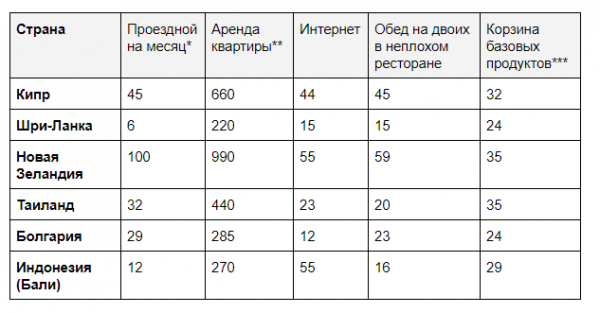
All local prices are converted to US dollars for ease of comparison.
* Travel card for ground transport.
** Rent a one-room apartment in the center of a medium or large city.
*** The basket includes: milk, cereals or pasta, meat (beef), eggs, cheese, bread, local vegetables and fruits.
Features of work and withdrawal of money
When moving to another country, you need to decide whether you are going to stay in it for a long time or for a year or two.
The second option is much simpler in bureaucratic terms, because it does not oblige you to register as a taxpayer in the country. In fact, you remain under the jurisdiction of Russia and pay taxes in Russia too. Formally, you are registered in the territory of another state as a tourist, which, in fact, imposes its own restrictions.
- It will be problematic to conclude formal contracts with residents.
- In most cases, you will not be able to open a bank account. Or, to open an account, you will need a tidy sum of several tens of thousands of dollars.
- You will be able to receive transfers only to international bank cards or services. Therefore, you need to make a physical map of the service. For example, a Payoneer or Paypal debit card. But in this case, you may face double or even triple conversion on the card if the currency of the card does not correspond to the currency of the country in which you are staying.
In general, all the difficulties that arise in this case can be dealt with in a few weeks. Especially if you prepare while still in Russia.
In most countries, the time of continuous stay in the country is limited if you come on a tourist visa. Therefore, you need to study this moment in advance. For example, a multivisa in Thailand is valid for 180 days, but you can only spend 60 days continuously in the country. That is, in order to legally stay in Thailand, you will need to come to the border or to another country 2 times in six months.
If you are planning to move for a long time - several years or even in the long term with obtaining a residence permit, then it is much more difficult here. And purely my opinion - a freelancer does not really need a residence permit, because I have freelance clients for whom I applied for a business visa with a reserve for long-term residence several years ago, and recently they again turned to me to move to another country, because she's already tired.
If possible, I recommend trying about a month of “test” residence in the country. It often happens that expectations from life and work in the country are very different from reality.
Let's take Bali for example. Many freelancers go there. But besides the "paradise picture" there are many nuances. You won’t be able to work under a palm tree - in the high season, the temperature outside reaches 35 degrees. At the same time, the ocean is quite cold due to undercurrents. They are strong and cunning even close to the shore, so sailing far is simply dangerous. In the cities of Indonesia, severe unsanitary conditions - rats can safely run along the roads. Plus, the strong influence of Islam on society.
Such negative nuances are revealed only directly during the stay. And they can spoil the impression very much, up to complete disappointment.
So it’s worth staying in the country a little longer than a regular vacation takes. Three to four weeks will be enough.
If you have not previously been involved in relocation planning, then for the first time I highly recommend turning to professionals. After all, there are a large number of nuances that you cannot take into account due to ignorance, and this will result in big expenses and all kinds of problems in a new place.
Agree, it would be a shame to plan a move up to ordering tickets, and then find out that you were denied a visa. Or, even worse, already in the country to find that you, as a foreigner, have been swindled three times in size.
But if you still decide, then go ahead! For a freelancer, this is a great experience and an opportunity to get acquainted with the life of different countries and cultures.
Source: habr.com

