

Even people far from physics know that the maximum possible data transfer rate of any signal is equal to the speed of light in a vacuum. It is denoted by the letter "c", and it is almost 300 thousand kilometers per second. The speed of light in vacuum is one of the fundamental physical constants. The impossibility of achieving speeds exceeding the speed of light in three-dimensional space is a conclusion from Einstein's Special Theory of Relativity (SRT).
Usually, when it is claimed that SRT prohibits the transmission of information above the speed of light, an implicit assumption is made that there is no other way but to “attach information” to a photon and transmit it. However, there is another way. A well-known physical hypothesis - the holographic principle (a modern and widely used tool in theoretical physics today) points to an interesting phenomenon: "Phenomena occurring in three-dimensional space can be projected onto a remote" screen "without loss of information" - Leonard Susskind "The World as a Hologram"[p. 3].
“Without loss of information” means that a speculative projection operation is not required if we understand that our informational Universe really exists only on the 2D surface of the holographic horizon (screen) with a single time coordinate, and the fundamental laws of physics are a natural way to encode information with losses . Then the conclusion suggests itself, if you know the extremely simple holographic code of the Universe - the natural mechanism for encoding and moving information on the screen, then one of the new possibilities may appear - we can discover the mechanism for transmitting and receiving information without limitation by the distance and speed of light. As for the generation of the holographic code of the Universe, the idea of its search is to use the main property of holograms: each minimal section of the hologram contains information about the entire object. Based on this fact, we postulate an extremely simple formula for coherent oscillations of any point in three-dimensional space and load it into a conventional computer dynamics simulator (even such a program as 3D MAX is suitable), and on the screen of a conventional computer, in isometry, on two halves of one emerging spherical surface one can observe the dynamics of projections and numerous properties of elementary particles of the Standard Model. One parametric formula generates the dynamics of projections of three generations - the entire zoo of elementary particles: 48 fermions and 12 bosons. The scientific data visualization method allows you to see the invisible on a conventional computer - one cycle of coherent oscillations of one point, which is identified with its radius vector:
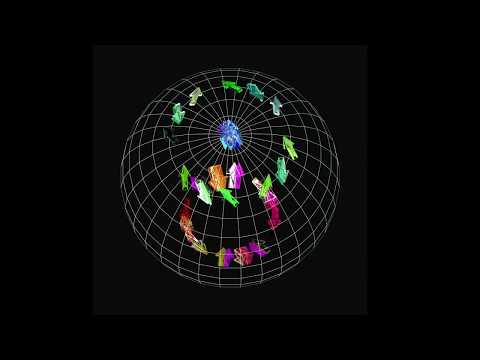
Against this fundamental promising “holographic background”, the emergence of an electromechatronic device, a fundamentally new type of astatic gyroscope with rigid parameters, looks natural, since it uses the same basic properties of holograms: coherence, interference, and the same formula for coherent oscillations of rotor points. If the hypothesis of the holographic Universe is ever transformed into a working theory, then only if its predictions are repeatedly confirmed in experiments, or better, in its practical applications. With the advent of the experimental base - the top of the physical pyramid, the hypothesis, which is actually part of the theory, is temporarily removed from criticism until the moment of practical implementation of the experiment and measurements.
The design of an unusual gyroscope looks like this: a spherical rotor with magnets levitates inside an evacuated spherical cavity of the stator with electromagnets. The rotor can be forced to rotate in any of 64 directions under the control of a computer system around one fixed point of the center of mass and simultaneously around three axes per cycle.
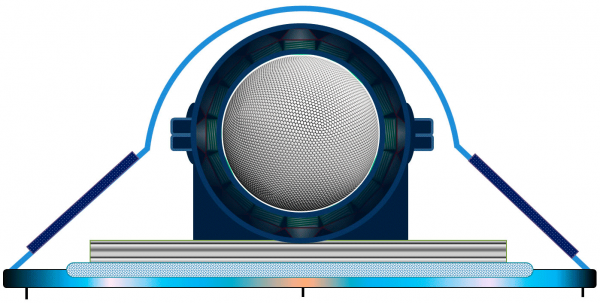
If in a conventional astatic gyroscope the rotor makes one revolution around one axis in one cycle, then in an unusual gyroscope the rotor makes a complete revolution in the same time around three fixed axes of Cartesian coordinates associated with an accelerated observer. The elements of the mass of the rotor (with such a rotation algorithm) produce coherent oscillations, and accelerations are related to the direction of the semiaxes. Antinodes and nodes of accelerations form a fixed interference pattern of six identical and diametrically directed groups.
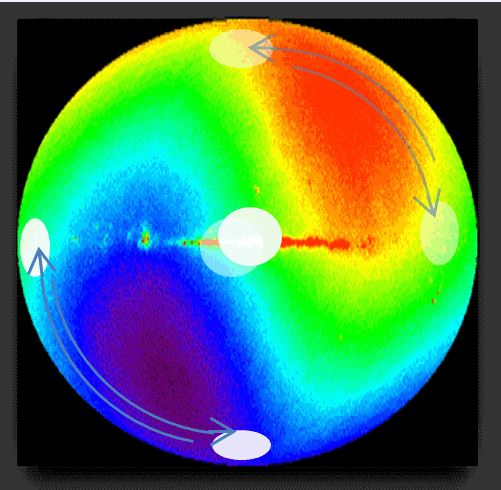
We have six groups of rotational accelerations, which, according to the holographic principle, can be projected on six opposite sides of a spherical 2D screen without loss of information, being invisible to the observer, we conditionally show them in the photo with six white circles. With the help of a computerized rotor motion control system, we can change directions and move the projections in pairs (any four out of six), but now they are represented by the information itself, which moves around the screen with a single time coordinate and without the limitation of distance and the speed of light.
The holographic principle relates bits of information to entropy and temperature on a spherical screen. Hence, it becomes possible to simultaneously transmit information and receive it, for this it is enough to measure the entropy force that will be applied to the center of mass of the rotor relative to the stationary stator. The entropy force arises as a result of the interaction of stationary temperature gradients of a spherical holographic screen and entropy gradients caused by a directed jerk (the first derivative of the acceleration of matter).
Fentr = ΔTΔS;
where Fentr - entropy force ∆T — temperature gradient on the screen, ∆S is the entropy gradient associated with the controlled jerk of the mass elements.
If the expected uncompensated entropy force manifests itself in a closed system on a holographic screen, then the holographic theory is valid, and all observers, receivers and transmitters of information are on the same surface with a single time coordinate, and holographic information exchange can technically be implemented between them, and this means that we need to think about the immediate practical implementation of an unusual gyroscope. An unusual gyroscope as an experimental setup will be able to answer the question: “Is the holographic principle correct, according to which the physics of our “3D + 1”-dimensional space-time is equivalent to physics on a hypersurface with a dimension of “2D + 1”?, in other words, the problem is solved “ demarcation" of the holographic hypothesis.
And in conclusion, we can assume that the solution to the Fermi paradox lies in the fact that if there are intelligent civilizations in our holographic Universe, they will use the holographic screen as a communication channel, and this, as we assume, allows them to exchange information without restrictions on distance and speed. Sveta.
Source: habr.com
