

The number of manufacturers trying their hand at producing solid-state drives has long ceased to be recounted. The threshold for entering this market is very low - independent controller developers are ready to take on the entire burden of SSD production if necessary, offering their customers only to distribute the resulting product. As a result, store shelves are littered with numerous SSD models with little-known names. Russian buyers are observing the manifestation of this trend especially clearly: with the cessation of official deliveries of products from a number of international brands, Chinese companies have rushed to the domestic market, seeing opportunities to increase sales here.
Most often, such Chinese SSDs do not deserve special attention. They compete for the attention of consumers with low prices and hardly need detailed technical reviews. However, not all Chinese SSDs are the same: among them, you can find quite interesting solutions. For example, Dahua C970 Plus, which will be discussed in this review.
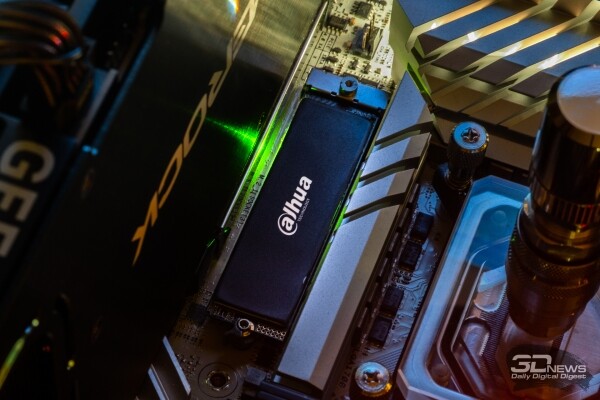
This drive is interesting at least because Dahua is not some little-known manufacturer, but one of the leaders in the video surveillance systems market, which, together with another Chinese manufacturer, Hikvision, produces up to 40% of the video surveillance cameras used in the world. This means that this company has sufficient engineering resources and production capacity to make high-quality related products, such as SSDs.
In addition, it is impossible not to note the fact that in recent years China has made quite serious progress in creating its own element base for quite decent SSDs. The country has its own flash memory manufacturer YMTC, which has not only caught up with South Korean and American competitors, but also surpassed them in some technological aspects, for example, in increasing the number of 3D NAND layers. In addition, China also has its own controller developers, for example the well-known company Maxio Technology, whose chips have managed to gain a good reputation.
Thus, Chinese SSDs have a good chance of becoming popular not only in the lower market segments, but also as mid-range solutions. It is in this league that Dahua C970 Plus is going to perform. This is a bufferless but high-speed drive with a PCIe 4.0 x4 interface, which is guaranteed to be equipped with TLC memory and is produced by a manufacturer with a world-famous name. And in this review, we will see how such an SSD looks against the background of solutions of the Kingston KC3000 and Samsung 990 Evo Plus class.
Appearance and internal arrangement
The fact that the developers of Dahua C970 Plus did not aim to make the resulting product as cheap as possible is already evident from the packaging. The drive comes in a cardboard box, is supplied with paper instructions and is even equipped with a mounting screw for the M.2 slot. Concern for the user can also be seen in the design of the SSD itself. Despite the fact that we are talking about a bufferless drive with far from record-breaking performance, it is equipped with an aluminum heat-dissipating plate that contacts all the chips and helps to remove heat from them.
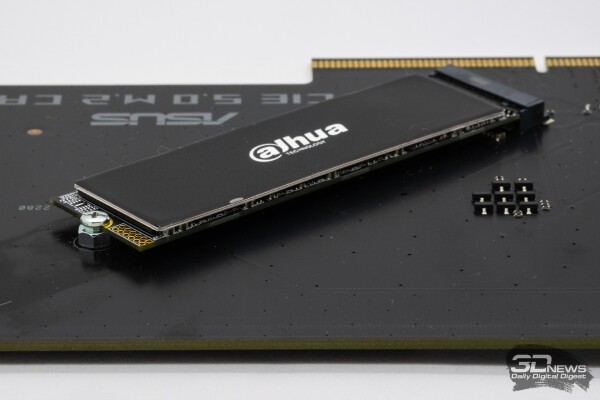
This is a basic but quite convenient cooling system that hardly makes the drive any thicker. With it, it will fit both in the PlayStation 5 and in any laptop. Moreover, it can be left in place even if the SSD is supposed to be used in an M.2 slot on the motherboard, equipped with its own radiator.
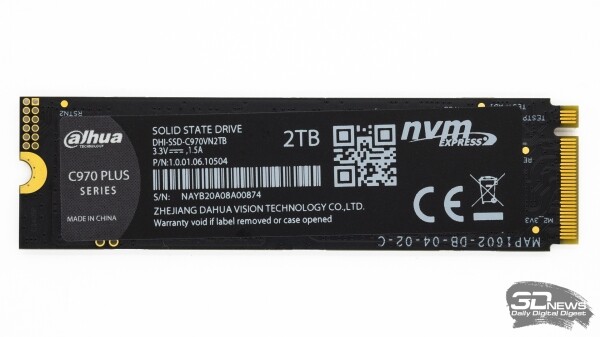
The technical information sticker for the Dahua C970 Plus is located on the back side, where there are no chips and where it does not interfere at all. It lists only the most basic things - the name of the SSD, the article number and the serial number - so it does not deserve much attention. Let us just note that, as you can see from the photo, this review is about the 970 TB version of the C2 Plus.
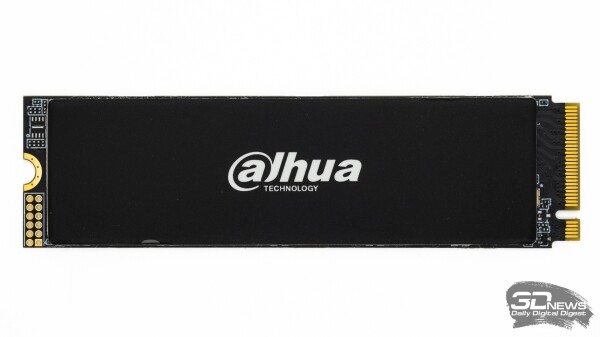
There are three chips under the heat-dissipating plate. The first is the Maxio MAP1602 controller, which we are already quite familiar with. Today, it is one of the most common controllers for high-speed PCIe 4.0 SSDs without a DRAM buffer, with four channels for forming a flash memory array and supporting NAND chips with a 2400 MHz interface.
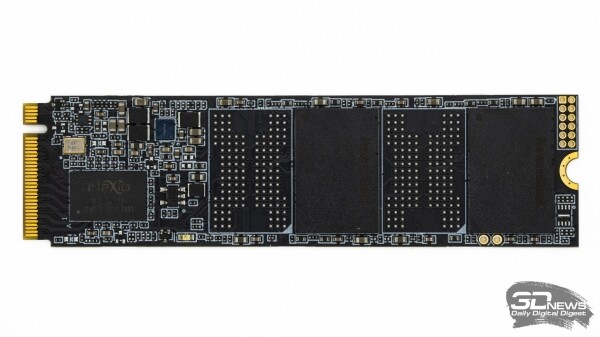
The other two chips are flash memory. As expected, the Chinese Dahua drive uses Chinese TLC 3D NAND from YMTC, and its most modern and fastest version is with 232 layers. This means that the C970 Plus is built on a solid and time-tested element base. The YMTC memory with 3.0 layers, which belongs to the Xtacking 232 generation, in combination with the MAP1602 controller is capable of fully utilizing the entire bandwidth of four PCIe 4.0 lanes, which is a great achievement for a bufferless SSD.
Interestingly enough, the memory chips on the C970 Plus are labeled MasonSemi, which refers to Mason Technology, one of the Chinese semiconductor firms that in this case was the contractor for cutting and packaging the flash memory chips produced by YMTC. YMTC and Mason were previously thought to be closely related, but since the sanctions that affected YMTC, any relationship between the two has been vehemently denied by both companies.
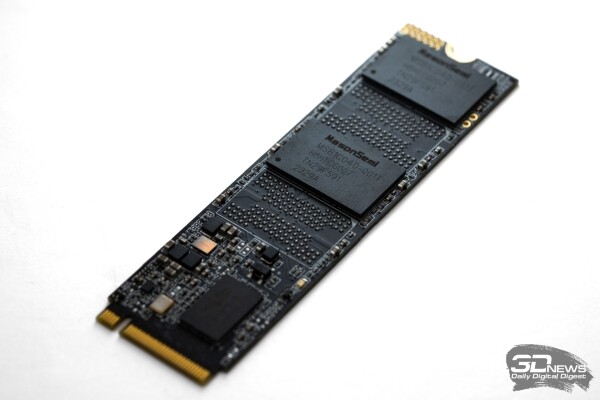
Apart from three chips, there is nothing interesting on the Dahua C970 Plus board. There is no DRAM chip in this drive, it is replaced by Host Memory Buffer (HMB) technology, which allows the SSD to get a small part of the system RAM for its own needs. In the C970 Plus, its volume is limited to 40 MB.
It can be added to the above that the design of the printed circuit board on which the drive in question is assembled is a reference. Dahua simply took the existing developments from Maxio for its product and did not change anything. That is, from the point of view of the hardware component, the C970 Plus is completely similar to many other SSDs built on a combination of the MAP1602 controller and 232-layer TLC memory YMTC.
A good illustration of the lack of any design changes is the hidden LED on the front surface of the C970 Plus, which shows the activity of the drive. In this case, its existence makes no sense, since the heat spreader installed on the drive completely hides it from the user's view. But Dahua left even this.
Technical specifications
An important advantage of the C970 Plus over similar drives from many other manufacturers is its detailed specifications. In them, Dahua specifies specific speed indicators, without using revolutions like “up to…”, which means that the filling of its SSD cannot suddenly change for the worse and the C970 Plus will not one day move to QLC memory. This fact has to be specifically stated, because such a migration is a fairly common practice, and even manufacturers like Adata do not disdain it. For example, the same Legend 900, which was originally based on the same element base as the Dahua C970 Plus, has recently begun to be supplied with QLC memory. Fortunately, such a metamorphosis does not threaten the Dahua drive in question, which is precisely what is enshrined in its clear passport characteristics.
| Manufacturer | Dahua | ||
|---|---|---|---|
| Серия | C970Plus | ||
| Model number | DHI-SSD-C970VN512G | DHI-SSD-C970VN1TB | DHI-SSD-C970VN2TB |
| Form Factor | M.2 2280 | ||
| Interface | PCI Express 4.0 x4 - NVMe 2.0 | ||
| Capacity, GB | 512 | 1024 | 2048 |
| Configuration | |||
| Flash memory: type, manufacturing process, manufacturer | YMTC 232-layer 1-Tbit TLC 3D NAND | ||
| Controller | Maxio MAP1602 | ||
| Buffer: type, volume | No | ||
| Performance | |||
| Max. sustained sequential read speed, MB/s | 7000 | 6290 | 7200 |
| Max. sustained sequential write speed, MB/s | 4300 | 5680 | 6400 |
| Max. random read speed (4 KB blocks), thousand IOPS | 915 | 985 | 1026 |
| Max. random write speed (4 KB blocks), thousand IOPS | 763 | 749 | 766 |
| physical characteristics | |||
| Max. power consumption, W | 3,6 | 3,5 | 4,3 |
| MTBF (mean time between failures), mln h | 1,5 | ||
| Recording resource, TB | 300 | 600 | 1200 |
| Warranty period, years | 3 | ||
| Overall dimensions: L × H × D, mm | 80 × × 22 2,25 | ||
However, there are some oddities in the specifications table. In particular, Dahua provides only a three-year warranty for its drive, while the standard for TLC 3D NAND-based SSDs has long been a five-year warranty. But this three-year warranty really works in our conditions due to the fact that the company has its own service center in Russia. Few drives can boast a full-fledged brand warranty in today's reality, and the Dahua product in question is one of them.
As for the speed indicators, in reality the C970 Plus turns out to be even a little faster than the manufacturer promises. At least judging by the 2 TB model that we received for testing.
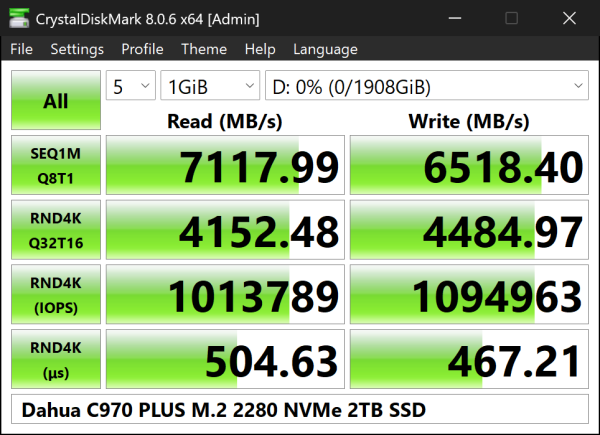
Linear read and write speeds are 7,1 and 6,5 GB/s, respectively, peak speeds of small-block operations reach 1,0 and 1,1 million IOPS. Based on these numbers, Dahua C970 Plus is slightly ahead of the new Samsung 990 Evo Plus, which gives it the right to claim a place among the best unbuffered SSDs with PCIe 4.0 interface. But we cannot help but mention the interface here: unbuffered drives with a faster PCIe 5.0 interface on the Phison E31T controller have already appeared on the market, and they are, naturally, noticeably faster.
However, Dahua does not pretend that the C970 Plus is a high-end solution. For example, the model range does not yet include a 4 TB modification of this drive, which is typical primarily for mass-market models. But in the future, the manufacturer may well release such a version - the MAP1602 controller allows for this.
Along with fairly high speed characteristics, the C970 Plus has a not too high price. In fairness, we should note that this SSD is currently sold at a slightly higher price than similar products from smaller companies. But the small markup on the Dahua drive can be forgiven. Although Dahua is a Chinese brand, it is not some no-name, but a well-known name on a global scale.
Software
The manufacturer does not offer any service software for Dahua C970 Plus. However, this is a completely typical picture for drives on Maxio controllers.
Description of the test system and testing methodology
For comparison with Dahua C970 Plus, we selected several modern drives with PCIe 4.0 and PCIe 5.0 interfaces. Its main competitors will be the Netac NV7000-t with similar hardware, the new unbuffered PCIe 4.0 drive Samsung 990 Evo Plus, and the Kingston KC3000, which represents an army of drives on the Phison E18 controller, many of which are still available for sale.
Details about all test participants are summarized in the table.
| Drive | SKU | Interface | Controller | DRAM buffer | Flash memory | Firmware |
|---|---|---|---|---|---|---|
| Adata Legend 900 2048GB | SLEG-900-2TCS | PCIe 4.0 x4 | Maxio MAP1602 | No | YMTC 232L QLC NAND | SN14436 |
| Dahua C970 Plus 2048GB | DHI-SSD-C970VN2TB | PCIe 4.0 x4 | Maxio MAP1602 | No | YMTC 232L TLC NAND | H231255a |
| Digma Meta P31 2048GB | DGSM5002TP31T | PCIe 5.0 x4 | Phison PS5031-E31T | No | Kioxia 218L TLC NAND | EVFM00.0 |
| Kingston KC3000 2000GB | SKC3000D/2048G | PCIe 4.0 x4 | Phison PS5018-E18 | 2 GB | Micron 176L TLC NAND | EIFK31.6 |
| MSI Spatium M570 Pro Frozr 2000 GB | SM570PN2TBF | PCIe 5.0 x4 | Phison PS5026-E26 | 4 GB | Micron 232L TLC NAND | EQFM22.2 |
| Netac NV7000-t 2000GB | NT01NV7000t-2T0-E4X | PCIe 4.0 x4 | Maxio MAP1602 | No | YMTC 232L TLC NAND | H230827a |
| Samsung 990 Evo Plus 2000GB | MZ-V9S2T0BW | PCIe 4.0 x4 | Samsung Piccolo | No | Samsung 236L TLC NAND | 2B2QKXG7 |
| Samsung 990 Pro 2000 GB | MZ-V9P2T0BW | PCIe 4.0 x4 | Samsung Pascal | 2 GB | Samsung 236L TLC NAND | 4B2QJXD7 |
The test system configuration was as follows:
- Processor: Intel Core i9-14900K (Raptor Lake Refresh, 8P+16E cores, 3,2-6,0/2,4-4,4 GHz, 36 MB L3).
- CPU cooler: Noctua NH-D15.
- Motherboard: ASUS ROG Maximus Z790 Apex (LGA1700, Intel Z790).
- Memory: 2×16GB DDR5-6400 SDRAM (G.Skill Ripjaws S5 F5-6400J3239G16GX2-RS5K).
- Video card: GIGABYTE GeForce RTX 4090 Gaming OC (AD102 2235/2535 MHz, 24 GB GDDR6X 21 Gbps).
During testing, test drives are installed on the motherboard in the second PCIe 5.0 x16 slot (via the Asus PCIe 5.0 M.2 Card adapter), to which PCI Express lines are connected directly from the processor.
Testing was performed on the Microsoft operating system Windows 11 Pro (24H2) Build 26100.2605. The system used the Microsoft Standard NVMe Express Controller driver 10.0.26100.2454.
SLC Caching: Writing, Reading and Deleting Files
SLC caching is the most important algorithm that is responsible for accelerating write operations in modern drives. Its essence is that information on an SSD with TLC or QLC memory is first written in a fast single-bit mode, and its compaction occurs later, when the drive is idle. This means that modern drives can demonstrate high speeds only on limited amounts of data, the size of which depends on the specific implementation of the SLC caching algorithm.
To determine how this works in practice and the speeds of the flash memory array of specific drives when operating in various modes, we conduct a test of continuously writing files to an SSD until its capacity is completely exhausted, while simultaneously measuring performance. This test uses standard OS parameters. Windows single-threaded file copy operations to the tested SSD (from a RAM disk), and the test is performed in three passes: for a completely clean SSD; for an SSD half-filled with data; and for an SSD that is initially three-quarters full.
SLC caching works dynamically in Dahua C970 Plus, which means that the size of the SLC cache depends on the amount of free space on the drive. On a clean and half-filled 2 TB SSD, it is possible to write about 320 GB of data at high speed, but if three-quarters of the volume is occupied by data, the size of the SLC cache is halved - to 160 GB.
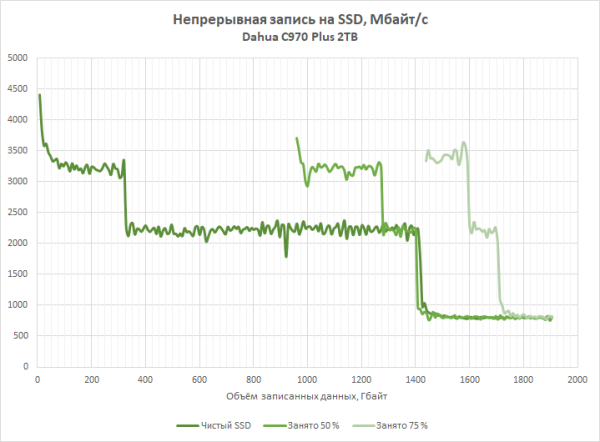
The SSD data filling speed has three gradations, which is typical for drives on TLC memory. SLC mode provides recording at a speed of 3,1-4,4 GB/s, in the usual TLC mode the speed drops to 2,0-2,2 GB/s. And in the worst case, when internal data compression occurs along with recording with switching of SLC cache cells to TLC mode, recording occurs at a speed of about 800 MB/s.
At the same time, if we talk about the average speed across the entire volume of the drive, then Dahua C970 Plus shows itself quite well - among the options with a four-channel flash memory array, it can be considered one of the fastest solutions. It takes about 2-20 minutes to completely fill all 22 TB of the capacity of this SSD with files. Only eight-channel drives show better results, and even then, not all of them.
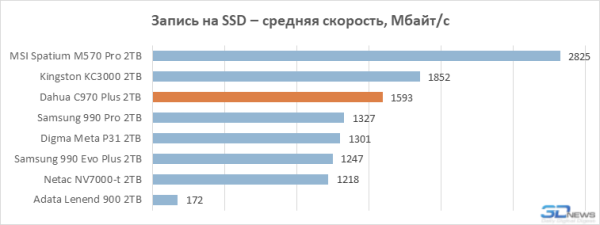
It is worth noting that in terms of average fill rate, the Dahua C970 Plus is quite noticeably better than the Netac NV7000-t, a similar drive with the same hardware components. But they differ in firmware logic, and the SLC cache of these SSDs works completely differently. In the C970 Plus, its volume is almost half as much, due to which the drive writes data beyond its limits much more briskly.
If you look at maximum speed recording by means Windows, which can be achieved on different SSDs, all drives with a PCIe 4.0 x4 interface will be similar. Only models using a PCIe 5.0 x4 bus deliver the best results.
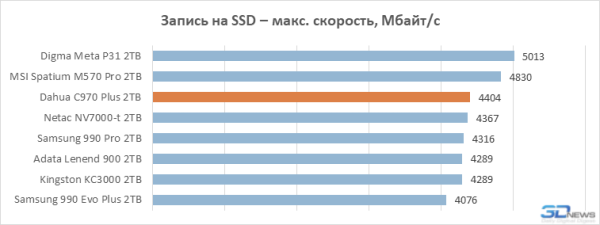
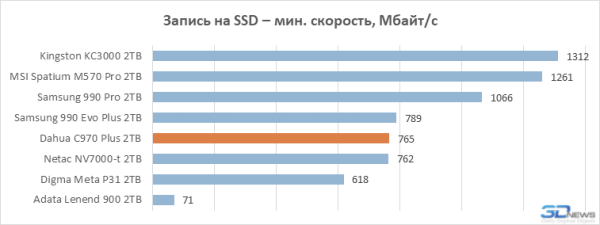
In terms of minimum speed, the Dahua C970 Plus falls into the subgroup of drives with four-channel controllers and TLC memory: they all deliver approximately the same minimum level of recording performance.
The drive in question does not demonstrate any significant differences from solutions of a similar class when evaluating the average file reading speed using WindowsMoreover, this SSD's four-channel memory array appears to be just as fast as the eight-channel array in the Samsung 990 Pro, which clearly demonstrates the success of the 232-layer TLC 3D NAND from Chinese manufacturer YMTC.
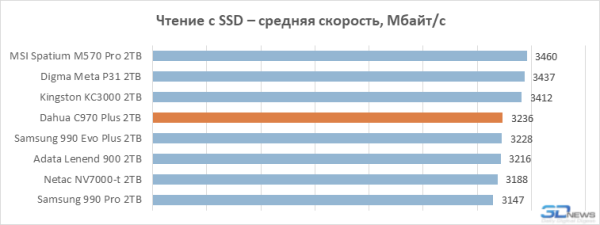
Thus, the Dahua C970 Plus copes quite confidently with simple operations of copying files from and to the drive. The Maxio MAP1602 platform with 232-layer TLC YMTC memory is considered one of the best options for bufferless drives with the PCIe 4.0 interface, and the drive under review so far confidently confirms this.
There are no complaints about its performance when studying how it handles file deletion operations. After deleting large amounts of information from the Dahua C970 Plus, its performance drops for only a few seconds, and for a consumer SSD, this behavior is quite acceptable. Moreover, although the drive temporarily loses speed, it remains responsive enough for the user not to suspect something is wrong. This is clearly illustrated by the graph below. It shows what happens to the performance of the C970 Plus after erasing 16 files of 8 GB each.
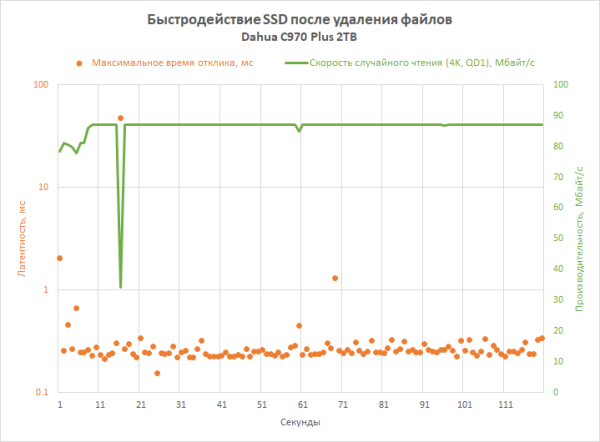
The consequences of deleting files become apparent to one degree or another within 15 seconds after the operation, but noticeable negative effects in the form of a more than twofold drop in speed occur only for a second and not immediately.
Performance of complex file operations
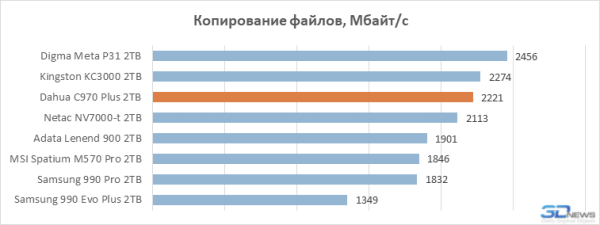
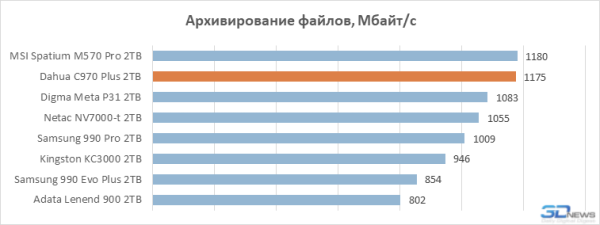
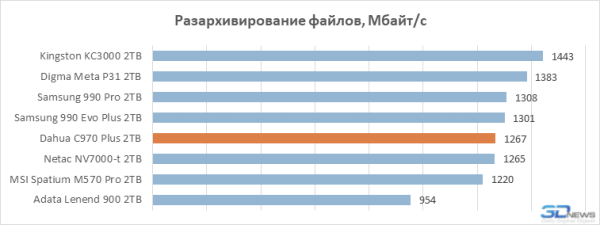
Another option for working with files in WindowsOne of the tasks we test when evaluating new SSDs is copying, archiving, and unarchiving files within the drive's space. These scenarios are more complex than copying to or from the drive, as the drive must handle two data streams in different directions simultaneously, and in this case, the controller's performance and algorithms play a more significant role.
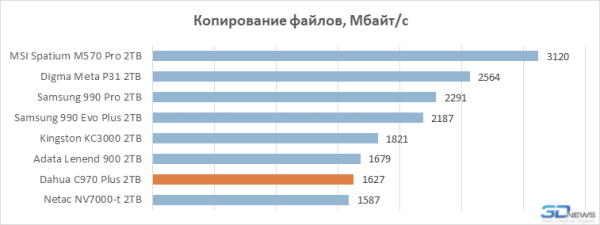
However, Dahua C970 Plus copes with such a load very well. In terms of the totality of results, it can be compared with Kingston KC3000 - a drive with a DRAM buffer and an eight-channel flash memory array. In other words, the SSD in question is quite suitable for use as a file storage: its results are at the top of the charts both for regular copying of folders and for working with archives.
Productivity in applications
To study the performance of storage devices in applications of various nature, we use two tests that reproduce the disk activity that occurs on a PC when solving various practical problems. The first test, PCMark 10, is aimed at assessing performance in common scenarios typical for home and office use. The second is SPECworstation 4.0. As the name suggests, it has a professional character and simulates a much more intensive load that is typical for workstations used for engineering or scientific work.
The Dahua C970 Plus's PCMark 10 result is quite expected. This SSD demonstrates exactly the same performance as its relatives on the Maxio MAP1602 controller with TLC or even QLC memory. This means that, on the one hand, the C970 Plus outperforms the Kingston KC3000 on the Phison E18 platform, but, on the other hand, it loses to the unbuffered Samsung 990 Evo Plus.
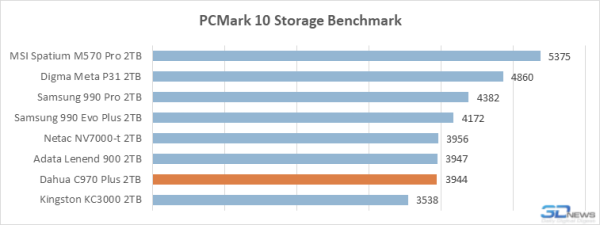
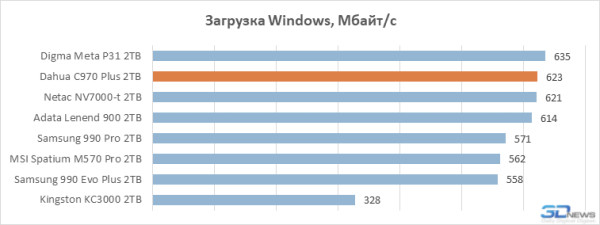
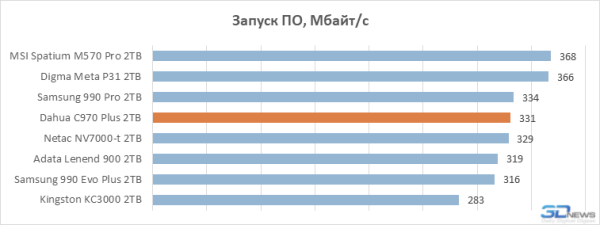
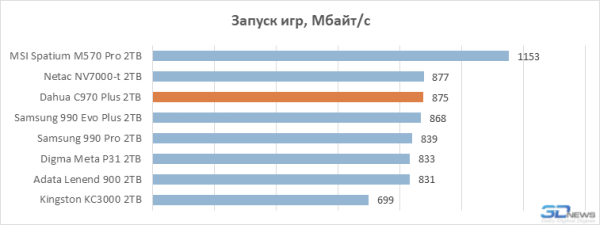
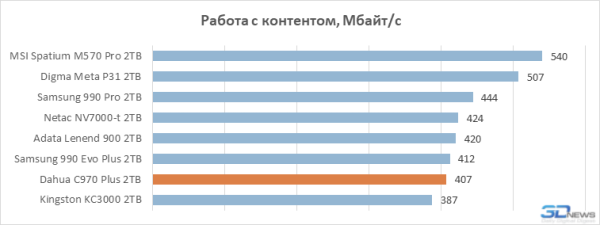
If we pay attention to how the SSD in question passes various routes included in PCMark 10, we can conclude that launching an operating system, programs and games are more suitable scenarios for its use than using it as a working storage device when creating and processing digital content.
Source: 3dnews.ru

