

Eric Migicovsky, founder of Pebble Technology, announced the release of the missing Pebble Watch software source code—all applications required for the Pebble smartwatch can now be built from source code. It is noted that approximately 95% of the software components were previously open source. The final step, filling the remaining 5%, was the publication of the mobile app code for Android and iOS, as well as the libpebble3 library it uses, which provides functionality for interacting with Pebble wearable devices. The mobile app code is written in Kotlin and distributed under the GPL 3.0 license.
The code for the PebbleOS operating system used on smartwatches was open-sourced by Google in January 2025 following its acquisition of Fitbit. Since then, over a thousand changes and improvements have been made to the PebbleOS codebase with community input. The developer tools (SDK) and the implementation of a catalog for distributing apps and screen themes installed on smartwatches are also open-sourced.
To eliminate the ecosystem's ties to a single app catalog, preparations have been announced to introduce support for subscriptions to alternative catalogs and to allow anyone to create their own app catalogs. As an example, the company has launched its own catalog, the Pebble Appstore, and a developer interface, the Developer Dashboard. A process has been established to maintain an independent, publicly accessible backup of the entire catalog's contents, maintained by the Archive.org project.
The developers of the original Rebble catalog, whose contents were used to create the new Pebble Appstore, expressed dissatisfaction with this move and accused Eric Migicovsky of plagiarizing someone else's work. Eric explained his actions by citing the opportunity to choose, disagreements over collaborating, and a desire to keep the catalog separate from a third-party organization to prevent a repeat of the project's demise. Regarding the accusations of code plagiarism, Eric pointed out that forking open-source projects does not violate the code license and is not theft, even if the development of that open-source code was funded. Following Eric's clarification, Rebble representatives announced that they had overreacted in accusing him of theft and expressed their willingness to resume work on an agreement with Eric's company that would benefit all parties involved and the community.
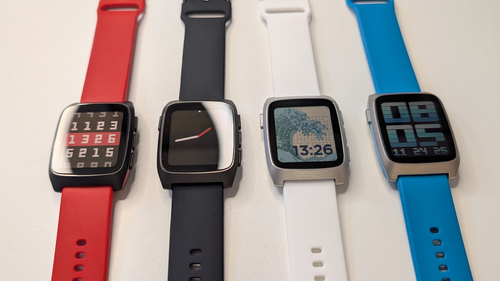
At the same time, the Pebble Time 2 smartwatch has announced a delay in shipping from January to March. The Pebble Time 2 features a 64-color 1.5-inch e-paper display. The touchscreen is covered by a flat glass lens, which, unlike the curved lens on previous Pebble Time models, reduces distortion and glare. Features include sleep tracking, a pedometer, a heart rate monitor, and a compass. It features two microphones (one for noise cancellation) and a speakerphone. It is IPX8 water-resistant. Battery life is stated at 30 days. Pre-order price is $225.
Schematics and design files (KiCad) for the simplified Pebble 2 Duo model released in August are available on GitHub (similar files for the Pebble Time 2 will be published after the prototype is completed). The firmware used on the devices and in the mobile app builds retain some proprietary components and blobs, such as the Memfault library and components for the heart rate monitor, as well as code for accessing external proprietary APIs, such as the Wispr-flow speech recognition service. These features are optional, and enthusiasts can build a firmware version without them if desired.
The principles implemented in the Pebble smartwatch:
- Use of an e-paper screen that is easy to read in sunlight and does not attract attention from others with its glow.
- Long battery life on one charge.
- A simple user interface offering a basic set of the most frequently used features (time display, notifications, music playback controls, alarm clock, weather forecast, calendar, pedometer and sleep tracking).
- The presence of buttons that allow you to perform actions without looking at the screen (for example, stopping music playback or moving to the next song).
- Availability for modification (hackable), expansion of functionality, creation of your own add-ons and change of design.
The PebbleOS platform supports all the core features of older Pebble watches, such as notifications and messages from your smartphone (notifications of incoming calls and calendar events, information about new SMS, emails, and messages from popular instant messengers), action lists, screen theme changes, alarm clocks, timers, calendars, music playback controls, fitness tracker functions, and expanded functionality through app installations.
Source: opennet.ru

