

As is well known, NASA's Perseverance rover is exploring the delta of an ancient river that once flowed into a lake at the site of Jezero Crater. One of the rover's instruments is ground-penetrating radar, which peers 35 meters beneath the Red Planet's surface. When scientists pieced together the ground-penetrating radar data, pieces of which Perseverance had been collecting for months, they were surprised—it's so deep down there. there was a delta of another river, against which the traces on the surface are a trifle.
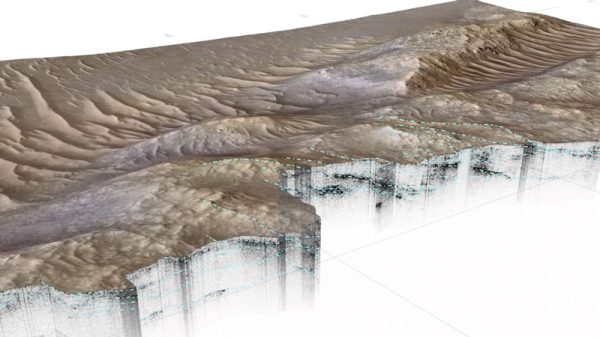
In its study of sedimentary rocks, the rover relied on the RIMFAX (Radar Imager for Mars' Subsurface Experiment) instrument. Using it, Perseverance collected data at depths of up to 35 meters during 78 passes across the terrain, covering a total of 6,1 kilometers. The work lasted from September 2023 to February 2024, but only after its completion did scientists understand what they had encountered.
This turned out to be an older river delta, located deep beneath the surface of Mars. Taking into account the elevation changes during the rover's progress, the estimated thickness of the sedimentary rocks of the ancient delta reaches 90 meters. The radar map clearly reveals structures characteristic of those formed by flowing water—from sediments to inclusions of boulders carried by a powerful current.
What Perseverance discovered from orbit and set out to study on Mars turned out to be traces of more recent water flows. New, deeper structures indicate a long history of river delta existence in this part of the planet, which means a higher chance of the emergence of microbial life on Mars—water was present there longer and in greater quantities than scientists previously thought. Moreover, the deep layers are well protected from radiation and could preserve the ancient biological history of the Red Planet, if it existed there.
Source:
Source: 3dnews.ru
