

In Russia, an initiative to educate students on the design of small satellites, even accessible in schools, is expanding. The only danger inherent in the components of such platforms is their propulsion system, which typically uses high-pressure gases. To ensure that schoolchildren and students can easily design satellites at their institutions, scientists from the National Research Nuclear University MEPhI (Moscow Engineering Physics Institute) have created a safe rocket engine powered by "solid water" - a popular fire extinguishing substance.
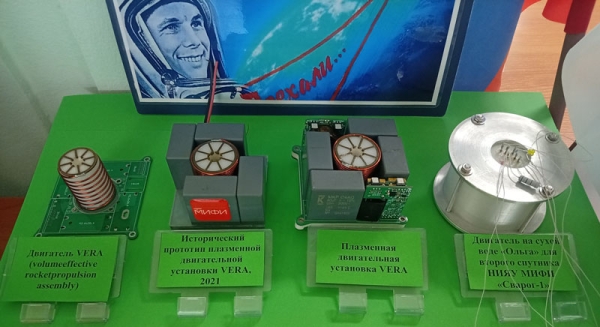
Several years ago, this same team of developers created the VERA electric plasma thrusters for CubeSats, which have already been launched into space on CubeSats. The safe thrusters are called OLGA. They have now been tested in a vacuum chamber and are entering the final refinement stage.
The OLGA engine uses fluoroketone, or "dry water" as it's commonly called, as its working fluid. It's a popular fire extinguishing agent in server rooms and libraries, according to a MEPhI press release.
"The OLGA engine, which has already demonstrated its fundamental functionality, has demonstrated thrust in a vacuum chamber," noted Evgeny Stepin, Director of the Center for Space Research and Technology at National Research Nuclear University MEPhI. "Certain technical issues related to preventing leakage of the working fluid are currently being addressed."
In turn, Igor Egorov, head of the Plasma Rocket Engine Laboratory, emphasized that the development is aimed at creating inexpensive and completely safe propulsion systems for educational satellites, the cost of which is significantly lower than existing analogues, such as the VERA engine.
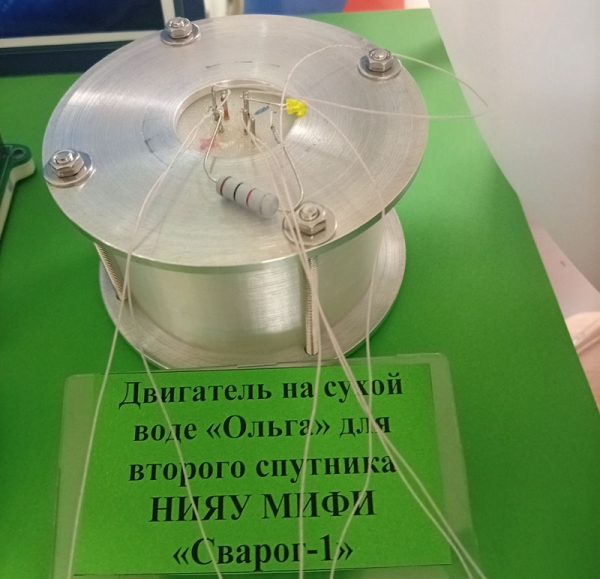
OLGA's key feature is the use of fluoroketone, which at room temperature has a vapor pressure of approximately half an atmosphere and does not create excess pressure on Earth, making the system safe for transportation.
Unlike traditional cold gas engines, which use substances under pressure of tens or hundreds of atmospheres, the new substance is non-toxic, non-flammable, and poses no danger to either people or equipment. In space, in a vacuum, the liquid vapor enters the nozzle through a valve, providing sufficient thrust for maneuvering small vehicles weighing just a few kilograms.
The first satellite equipped with the new propulsion system will be the Svarog-1 satellite, developed at MEPhI (Moscow Engineering Physics Institute) for gamma radiation monitoring for scientific purposes. According to the developers, safety and low cost are the project's key advantages, opening up prospects for the widespread use of such engines in educational and small space missions. This will significantly reduce the risks and costs of launching inexpensive nanosatellites.
Source:
Source: 3dnews.ru

