

The Blender Foundation has released Blender 4.2, a free 3D modeling package suitable for a variety of tasks related to 3D modeling, 3D graphics, computer game development, simulation, rendering, compositing, motion tracking, sculpting, animation, and video editing. The code is distributed under the GPL license. Ready-to-use builds are available for Linux, Windows и macOSThis release has been designated an Extended Service (LTS) release and will be supported until July 2026. Blender 3.3 and 3.6 LTS branches will also continue to be supported, with updates being generated until September 2024 and June 2025.
Improvements added include:
- The add-on and theme systems have been modernized and unified, transforming them into a unified extension concept. Extensions can be easily installed from disk, a local repository, or extensions.blender.org using drag-and-drop mode and updated directly from the Blender interface (a check for updates in the repositories is performed each time Blender launches).
- A new, completely rewritten implementation of the EEVEE rendering engine is included, supporting physically based real-time rendering and utilizing the GPU for rendering. The new engine variant is being developed within the EEVEE Next project and is notable for its support for realistic rendering using global illumination (rendering taking into account indirect illumination, reflection, and refraction of light), displacements (deformation according to a texture map), improved SSS (Subsurface Scattering, simulating light scattering within translucent materials), stable dithered volumetric effects during scene navigation, an unlimited number of BSDFs (Bidirectional Scattering Distribution Function) and light sources in the scene, and the application of the motion blur effect in the viewport (simulating blurring due to fast object movement). EEVEE now allows for the automatic extraction of intense ambient light sources and their processing as sun rays, providing more realistic shadows.
- The Cycles rendering system has been updated to improve rendering quality and speed. A new Ray Portal BSDF node has been added for transferring rays to a new location in the scene, which can be used, for example, to render portals. The Principled BSDF node now supports physically accurate thin-film interference effects, such as for realistic bubble rendering. Noise reduction has been improved, and the ability to accelerate noise reduction operations using AMD GPUs has been added on systems with Linux и Windows.


- Expanded capabilities for automating the deployment and maintenance of Blender builds in animation studios, as well as in isolated environments that do not provide access to the global network (the scripts and add-ons used can be designed as separate sets, and the "—offline-mode" flag is provided for running in offline mode).
- Support for the PBR Neutral Tone Mapper specification published by the Khronos consortium has been built in, enabling photorealistic color rendering when rendering assets.
- A new mode has been added for quickly creating polygonal shapes. In this mode, each left-click adds a new point to the polygon, and if the click coincides with the starting point, the shape is closed. In sculpting mode, the line gesture can now be used for trimming, creating face sets, and hiding, while the lasso gesture can be used to hide areas.
- A new socket type has been added that uses matrices and significantly simplifies transformations. Standard nodes for working with matrices have also been added.
- Interactivity with the Node Tools toolkit has been improved. It can be used to extend Blender's core capabilities and modify existing tools using geometry nodes instead of Python scripts. The node system now supports viewport and mouse position information, and a feature has been added that allows the selected operator to be applied only after a mouse click. Geometry nodes have been optimized for multithreading. Node execution speeds for scaling elements have been increased by 4-10x, and for UV surface sampling by 10-20x.
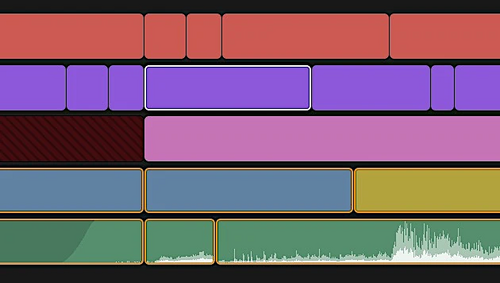
- The non-linear video editor (Video Sequencer) interface has been improved. For more visible separation, element corners have been rounded, margins on the timeline have been increased, and the outlines of active and selected tracks have been thickened. To adjust an element's position, simply move the cursor to the edge of a track or the area between tracks and drag the mouse while holding down the left mouse button. Elements associated with non-existent files are now highlighted in red and have a special icon. Additional text shadow settings have been added to text tracks.

- Compliance with the CY2024 specification, which defines the VFX reference platform utilities and libraries, has been achieved. Python 3.11, OpenEXR 3.2, OpenColorIO 2.3, and OpenSubdiv 3.6 have been updated.
- Added support for assigning a custom export handler to each collection, eliminating the need to select a format each time you re-export assets. For example, you can assign glTF to assets for games or USD to assets for studio work. Export settings are saved in .blend files and are not reset between sessions. Added the ability to import and export hair models and point clouds in USD format. Mesh validation during import is now 3-2 times faster. Mesh validation is enabled when importing files in USD, OBJ, PLY, and STL formats. Added the ability to import multiple Alembic files at once.
- We've added tools for creating portable installations that automatically pick up settings to recreate the user's environment. These settings are stored in the portable directory, from which Blender attempts to transfer the configuration during startup.
- The post-processing system (Compositor) now supports GPU acceleration.
- The performance of the graphics editor has been significantly improved.
- The built-in text editor provides syntax highlighting for the GLSL shader language.
- The design of various dialogs has been optimized and interface scaling has been improved.

- Undo performance has been accelerated by 5 times.
- In user environments based on the Wayland protocol, the ability to copy and paste images from the clipboard has been implemented.
- On the platform Linux Provided support for registering and removing file associations that allow the Blender application to be invoked when attempting to open different file types.



Source: opennet.ru

