

Does anyone remember Erwise? Viola? Cello? Let's reminisce.
When Tim Berners-Lee arrived at CERN in 1980, the famous European particle physics laboratory, he was hired to update the control systems of several particle accelerators. But the inventor of the modern web page quickly noticed a problem: thousands of people, many of whom were there temporarily, were constantly coming and going at the research institute.
"For contract programmers, it was quite difficult to try to understand both the human and computational systems that controlled this fantastic playground," Berners-Lee later wrote. "Most of the critically important information existed only in people's heads."
So, in his spare time, he wrote some software to address this shortcoming: a small program he called Enquire. It allowed users to create "nodes"—pages similar to index cards filled with information and linked to other pages. Unfortunately, this application, written in Pascal, ran on CERN's proprietary OS. "A small number of people who saw this program thought it was a good idea, but no one used it. Ultimately, the disk was lost, taking the original Enquire with it."
A few years later, Berners-Lee returned to CERN. This time he relaunched his 'World Wide Web' project to increase its chances of success. On August 6, 1991, he published an explanation of the WWW in the Usenet group alt.hypertext. He also released the code for the libWWW library, which he developed with his assistant Jean-François Groff. The library enabled participants to create their own web browsers.
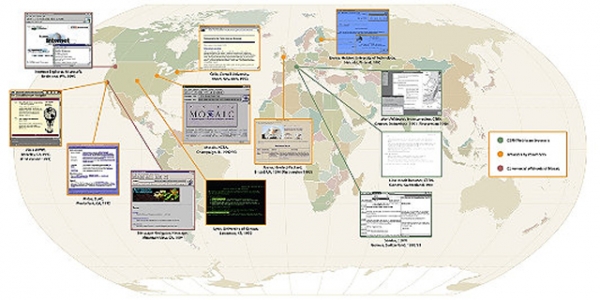
"Their work—more than five different browsers in 18 months—saved the web project, which was struggling with funding, and launched the community of web developers," was noted during the celebration of this anniversary at the Computer History Museum in Mountain View, California. The most famous of the early browsers was Mosaic, written by Marc Andreessen and Eric Bina of the National Center for Supercomputing Applications (NCSA).
Mosaic soon turned into Netscape, but it wasn't the first browser. The map created by the museum gives an insight into the global scale of the early project. What's remarkable about these early applications is that they already contained many features of later browsers. Here’s a tour of web browsing applications as they existed before they became famous.
Browsers from CERN
The first browser by Tim Berners-Lee, called WorldWideWeb, from 1990 served as both a browser and an editor. He hoped that future browser projects would follow this direction. CERN gathered a reproduction of its contents. The screenshot shows that by 1993, many characteristics of modern browsers were already present.
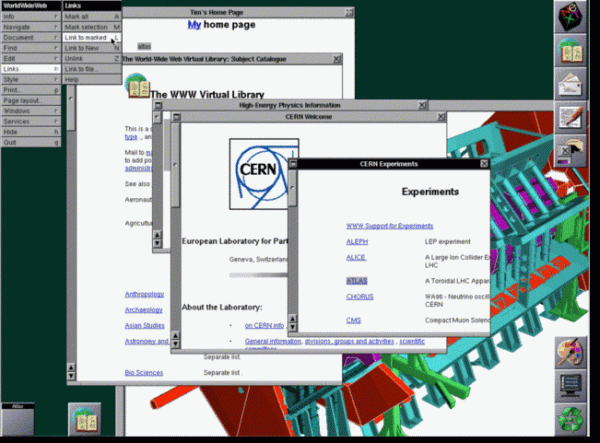
The main limitation of the software was that it ran on NeXTStep OS. However, soon after WorldWideWeb, a mathematics intern at CERN, Nicolas Pellow, wrote a browser capable of running elsewhere, including networks on UNIX and MS-DOS. 'Thus, anyone could go online,' explains internet historian Bill Stewart, 'which at the time mostly consisted of CERN's phone book.'
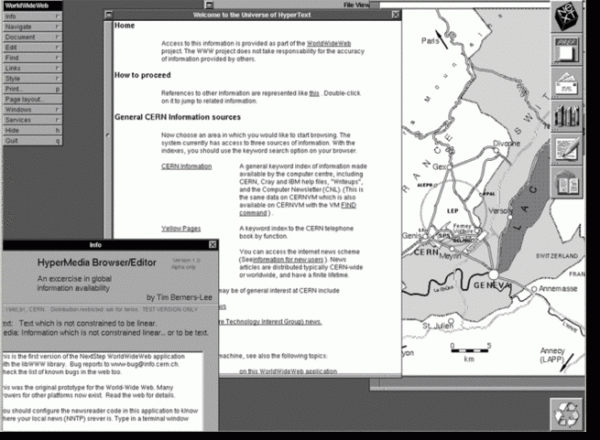
Early web browser from CERN, c. 1990
Erwise
Then came Erwise. It was written by four Finnish college students in 1991 and released in 1992. Erwise is considered the first browser with a graphical interface. It also had the ability to search for words on the page.
Berners-Lee reviewed Erwise in 1992. He noted its ability to work with different fonts, highlight links, allow navigation to other pages with a double click on a link, and support multiple windows.
'Erwise looks quite smart,' he announced, although there is some mystery—a strange frame around a single word in the document that resembles a button or a radio button. Although it was neither—it might be something for future versions.'
So why didn’t the application take off? In a later interview, one of the creators of Erwise noted that at the time, Finland was undergoing a deep recession. There were no angel investors in the country.
"At that time, we couldn't create a business based on Erwise," he explained. "The only way to make money was to continue development with the hope that Netscape would eventually buy us. However, we could have reached the level of the first Mosaic if we had worked a little longer. We needed to finish Erwise and release it on several platforms."
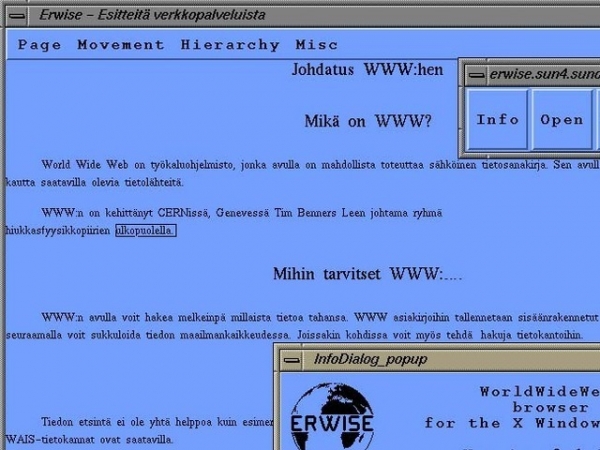
Erwise Browser
ViolaWWW
was released in April 1992. Developer Pei-Yuan Wei wrote it at the University of California, Berkeley, using the Viola scripting language that ran on UNIX. Wei didn't play the cello; "it just happened because of a memorable abbreviation" Visually Interactive Object-oriented Language and Application, as James Gillies and Robert Cailliau noted in their history of the WWW.
Wei apparently drew inspiration from an early Mac program called , which allowed users to create matrices of formatted documents with hyperlinks. "Back then, HyperCard was a very interesting project, graphically, and those hyperlinks," he later recalled. However, the program "wasn't global and only worked on Mac. I didn't even have my own Mac."
Instead, he had access to UNIX X-terminals at the Berkeley Experimental Computing Center. "I had the manual for HyperCard, I studied it and just used the concepts to implement them in X-windows." What's quite impressive is that he implemented them using the Viola language.
One of the most important and innovative features of ViolaWWW was that a developer could include scripts and "applets" in the page. This foreshadowed the huge wave of Java applets that appeared on websites in the late '90s.
In Wei also noted various shortcomings of the browser, the main one being the lack of a PC version.
- Not ported to the PC platform.
- HTML printing is not supported.
- HTTP is non-interrupted, non-multithreaded.
- Proxy is not supported.
- The language interpreter is not multithreaded.
"The author is working on these issues and others," Wei wrote at the time. And yet, "a very neat browser, suitable for use by anyone, very intuitive and straightforward," concluded Berners-Lee in his . 'Most users will not utilize 90% of the additional features, but these are functions that experienced users need.'
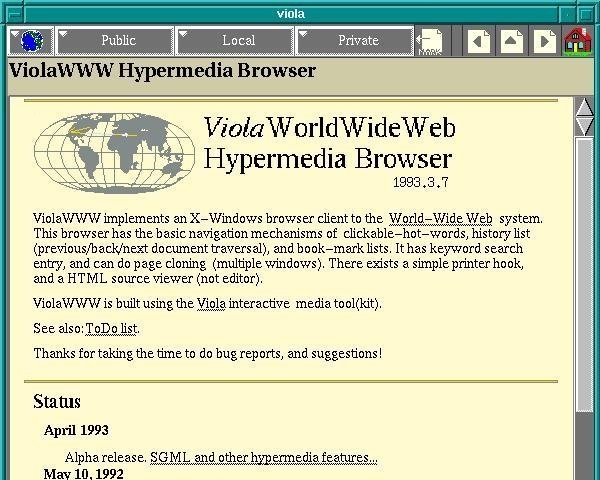
ViolaWWW Hypermedia Browser
Midas and Samba
In September 1991, physicist Paul Kunts visited CERN from the Stanford Linear Accelerator (SLAC). He returned with the code necessary to launch the first North American web server at SLAC. 'I just came back from CERN,' Kunts told chief librarian Louis Eddis, 'and discovered this wonderful thing being developed by a colleague, Tim Berners-Lee. It's exactly what you need for your database.'
Eddis agreed. The chief librarian made the key research database available on the web. Physicists from Fermilab did the same shortly after.
Then in the summer of 1992, a physicist from SLAC wrote Midas, a graphical browser for Stanford physicists. A huge of Midas was that it could display documents in PostScript format, which physicists favored for its ability to accurately reproduce scientific formulas.
'With these key advantages, the web began to be actively used in the physics community,' concluded of the progress of SLAC to the U.S. Department of Energy in 2001.
Meanwhile, at CERN, Pellown and Robert Cailliau released the first web browser for Macintosh computers. Gillies and Cailliau describe the development of Samba.
For Pellown, progress on the Samba project was slow, as the browser crashed every few links, and no one could figure out why. 'The Mac browser was full of bugs,' Tim Berners-Lee sadly stated in a newsletter from '92. 'I will give a T-shirt with W3 on it to whoever can fix it!' he announced. The T-shirt went to John Streets from Fermilab, who tracked down the bug, allowing Nicola Pellown to continue developing a working version of Samba.
Samba 'was an attempt to port the design of the first browser I wrote on a NeXT machine to the Mac platform,' Berners-Lee, 'but it had not been completed by the time NCSA released a version of Mosaic for Mac, which overshadowed it.'
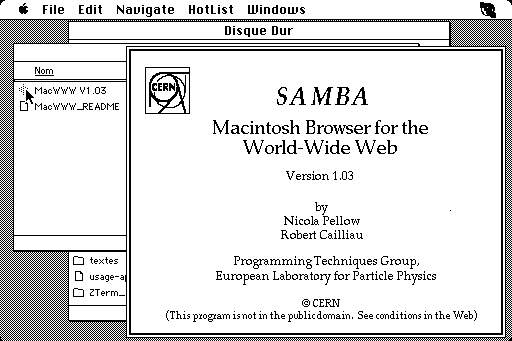
Samba
Mosaic
Mosaic was "the spark that ignited the explosive growth of the web in 1993," explained historians Gillies and Cailliau. But it could not have been developed without its predecessors and without the NCSA offices at the University of Illinois, equipped with the best UNIX machines. NCSA also had Dr. Ping Fu, a computer graphics expert and wizard who worked on morphing effects for the movie 'Terminator 2.' He had recently hired an assistant named Marc Andreessen.
"What do you think about writing a graphical interface for a browser?" – Fu proposed to his new assistant. "What's a browser?" – Andreessen asked. But a few days later, one of the NCSA employees, Dave Thompson, made a presentation of Nikola Pellow's early browser and the ViolaWWW browser by Pei Wei. Just before the presentation, Tony Johnson released the first version of Midas.
The latest program amazed Andreessen. "Incredible! Fantastic! Unbelievable! Impressive, damn it!" – he wrote to Johnson. Then Andreessen brought in a UNIX expert from NCSA, Eric Bina, to help write his own browser for X.
Mosaic incorporated many new features for the web, such as support for videos, audio, forms, bookmarks, and history. "And remarkably, unlike all previous X browsers, everything was contained in a single file," Gillies and Cailliau explain:
The installation process was simple – you just had to download it and run it. Later, Mosaic became famous for introducing the
tag, which allowed images to be embedded directly in the text, rather than appearing in a separate window like in Tim's first browser for NeXT. This allowed people to make web pages look more like the familiar printed materials; this idea wasn't appealing to all innovators, but it definitely made Mosaic famous.
"What Marc succeeded in doing quite well, – later wrote Tim Berners-Lee, – was making the installation very simple, and providing support with bug fixes via email, any time of day or night. You could send him a bug report, and within a couple of hours he would send you a fix."
The most significant breakthrough of Mosaic, from today's perspective, was its cross-platform compatibility. "By the authority that no one has bestowed upon me, I declare X-Mosaic to be released," proudly wrote Andreessen in the www-talk group on January 23, 1993. Alex Totic released his version for Mac a few months later. The PC version was developed by Chris Wilson and John Mittelhauser.
The Mosaic browser was based on Viola and Midas, as noted in the exhibition at the Computer Museum. It used a library from CERN. "But, unlike others, it was reliable, could be installed even by non-professionals, and soon added support for color graphics on pages instead of in separate windows."
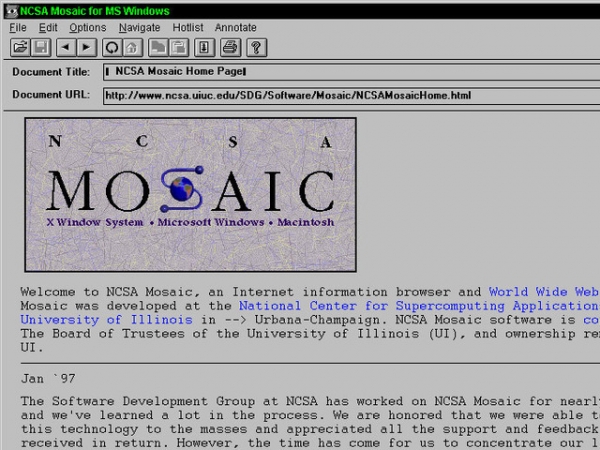
The Mosaic browser was available for X Windows, Mac, and Microsoft Windows.
The guy from Japan
But Mosaic was not the only innovative product to emerge at that time. A student from the University of Kansas adapted his campus's hypertext information browser for the internet and the web. It launched in March 1993. "Lynx quickly became a favorite browser for text-only terminals without graphics, and it is still used to this day," explains historian Stewart.
At Cornell Law School, Tom Bruce was writing a web application for PCs, "since those were the computers typically used by lawyers," note Gillies and Kiyau. Bruce published his Cello browser on June 8, 1993, "and soon it was being downloaded 500 times a day."
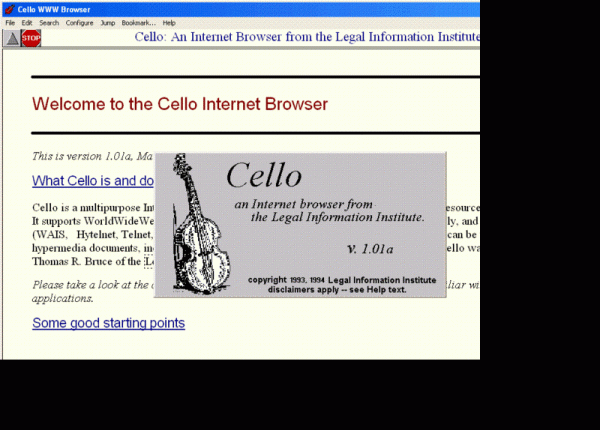
Cello
Six months later, Andreessen was in Mountain View, California. His team planned to release Mosaic Netscape on October 13, 1994. He, Totic, and Mittelhauser eagerly uploaded the application to the FTP server. The last developer recalls that moment: "Five minutes passed, and we all sat there. Nothing happened. And then the first download occurred. It was a guy from Japan. We promised to send him a T-shirt!"
This complex story reminds us that no innovation is created by a single person. The web browser entered our lives thanks to visionaries from all over the world, people who often did not quite understand what they were doing, but were motivated by curiosity, practical considerations, or even a desire to play. Their individual sparks of genius fueled the entire process. Just like Tim Berners-Lee's insistence that the project must remain collaborative, and most importantly, open.
"The early days of the web were very resource-constrained," he said. "So much needed to be done, such a weak flame to keep alive."
Source: habr.com
