

Hi!
Recently, together with Geekbrains, we held a hackathon dedicated to the industrial IIoT Internet of Things and now we are starting to post a series of interviews with our experts. The first of them was a conversation with Nikolai Chevalier, chief architect of the Industrial Internet of Things project office at Rostelecom.
Nikolai will tell you what the Industrial Internet of Things is and how it differs from the usual IoT, as well as about the solutions that Rostelecom already has.
Under the cut - about the role of IIoT in the automation of housing and communal services, agriculture, smart offices and much more.
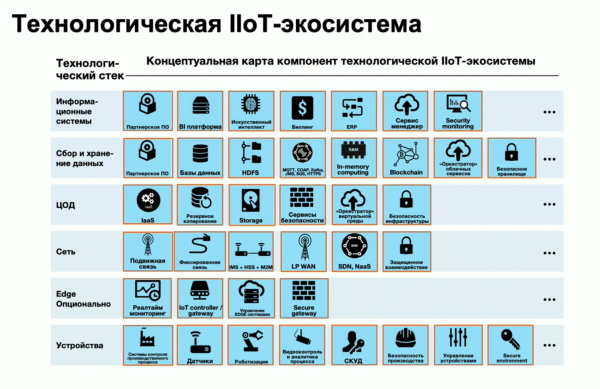
Nicholas Chevalier: this slide is a reflection of all the technological aspects that can be present in one way or another in industrial Internet projects. As you can see from the picture, there are many aspects, so I will briefly talk about each of them.
Industrial Internet
In a general sense, the industrial Internet is a new round of automation that allows you to achieve a higher quality level in various industries. Here we are talking about agriculture, and nuclear energy, and metallurgy. In fact, this is a subsection of the Internet of things, but it is focused specifically on industrial solutions. The structure of the picture should be considered from the bottom up - from sensors to information systems.
Sensors and devices collect information from both physical and cyber-physical systems, and this allows us to work with such data. Here we have all kinds of sensors, robots, video analytics, security systems (both the usual security and labor safety).
One level up - Edge, these are systems that are in production next to devices. Directly at the factories in the circuits of technical processes. APCS (automatic process control system), fire alarm and similar systems that require a minimum delay from the onset of an event to a reaction to it.
Higher - Data network, the task of which is to transfer these data to computer centers for further processing. Radio networks, overlay networks, fixed networks. By the way, what is the difference here: fixed networks are optical lines that carry the backbone of the entire communication system in general. There won't be them, there won't be radio communications, because radio communications won't work without optics. This last-mile radio allows you to quickly and efficiently connect devices without running a cable. But until that last mile, a cable is needed. Overlay networks are routing and traffic management systems that can be used to organize dedicated private networks over any structure with the necessary level of protection.
After networks - infrastructure Data centers (here, storage systems, servers, IDS, firewalls) and software for working with information (virtualization).
At the same level, the classic set is the data centers themselves, data storage, backup services, IaaS and the like ...
Separately, I note the software that allows you to organize work with dataas well as their processing and storage. There is still a very active trend in terms of computing in memory, blockchain (in one of the utopian options for the development of technologies, different IIoT solutions will be able to interact with each other within the framework of smart contacts).
The next global level is smarter systems. Artificial intelligence, various billings, production management systems, security monitoring that collects data from all security levels using AI and analytics systems.
In general, this is a brief description of the IIoT organization scheme. The important thing is that special information security systems are used at every level. And a solution can be considered secure only when all its levels are protected and all organizational processes of employees who interact with such a solution are taken into account.
More details
Networks
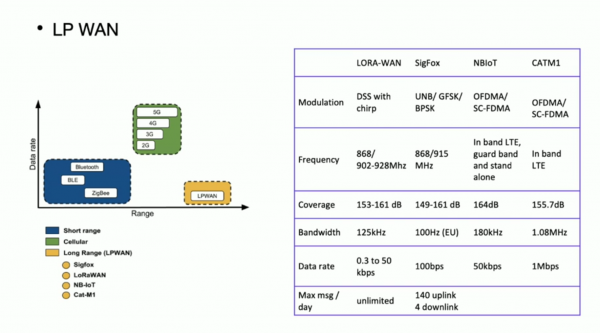
Here on this slide we are talking about LP WAN. These are energy efficient long-range networks. The most famous and established standards are LORA-WAN, SigFox, LTE-Cat NB(NB-ioT), LTE-CAT M1. To understand the level of action of such networks, it is easier to compare them with household ones. Here we all have Bluetooth - this is stable operation and communication with devices within a radius of a couple of meters to a couple of tens of meters. Then come cellular networks - 2G, 3G, 4G. And already behind them - LP WAN, the networks of the longest range, they have the largest coverage radius and they allow you to achieve a certain level of energy efficiency. For example, there is a gas meter that transmits readings once at a given time, and you can not change the battery on it for 10 years.
Data center protection
Here's a slide from our cybersecurity colleagues that shows common threats.
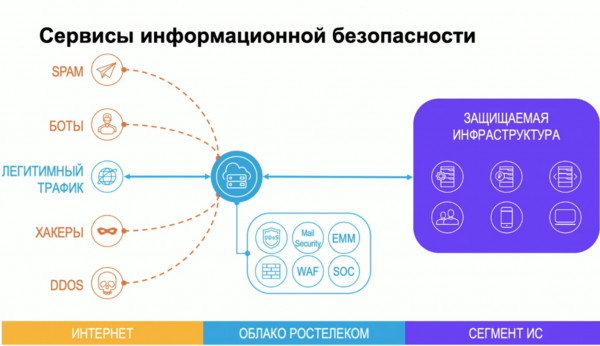
Of course, if the service works only for a couple of IPs, you can simply close the circuit, and this will already provide yourself with the desired level of protection. But if this is an open service that involves users interacting with it, then the usual network threats can already be superimposed here. Spam bots, hacker attacks, DDoS and other good things. To protect against this, a large number of technical means of protection are used, which, in case of emergency situations, notify the security operation centers - specially trained security guards sit there and react to specified events.
Housing and utilities
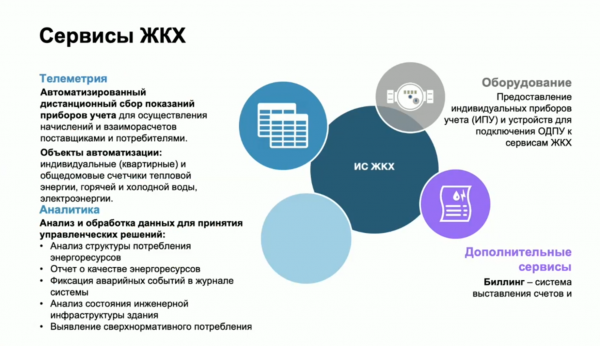
For housing and communal services there is a special service developed in Rostelecom, which allows you to automate the receipt of data from metering devices that are in the apartment of almost everyone: water and electricity meters, both individual and common house. If earlier these values had to be entered manually, which leads to a waste of time and to the transmission of not entirely correct readings, now in the Russian Federation there are already a number of complexes where human participation in this process is completely excluded. All these things are successfully automated and they themselves collect readings from all sensors and transmit them to management and resource supply companies.
Energetics
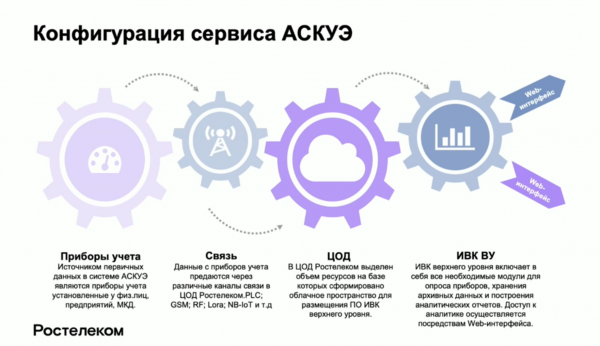
In addition to housing and communal services in general, we have developed a comprehensive special solution for electricity metering. The terrible abbreviation ASKUE on the slide is just the Automated System for Commercial Electricity Metering. What she does is clear from the name. These are meters that are installed at the substations themselves, at user connection points, at generation stations - all this allows power engineers to understand how efficiently the services work. The operation scheme is simple: metering device - communication channel link - data centers - an application that visualizes and processes data.
smart office
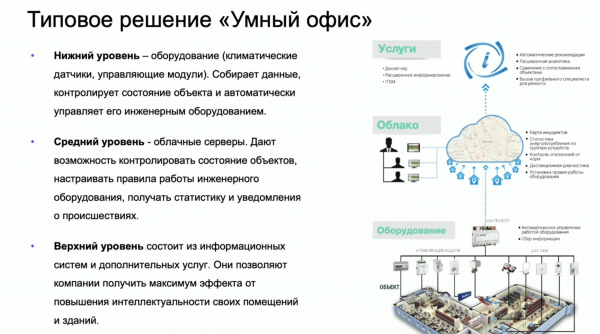
The solution for a smart office helps to record a number of indicators that are important for the comfortable work of a person in an office space. First of all, these are the levels of CO2 and light, which are often underestimated, as well as the overall consumption of electricity. There are two “hares in sight” here at once: both employees work more comfortably, and it helps operating personnel save money through a more rational use of resources.
Production personnel monitoring
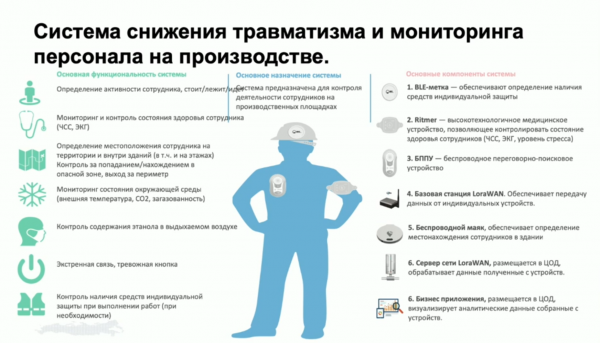
In addition to offices, there are more dangerous industries where it is necessary to reduce possible injuries and monitor personnel. The main idea here is to know that the employee is doing well with his well-being, and that he is where he should be, and not where he should not be. For factories with a large number of moving mechanisms, this is critical. There are many different sensors, from gas analyzers to bracelets that monitor both the pulse and condition of the employee, and his location. This helps to notify the system in time that an employee has suddenly found himself where it is dangerous for him right now (for example, a crane is moving or a gas release is planned). In this case, the system will suspend work, automatically notify the person in charge and wait until the person leaves the danger zone. And there are also smart helmets that detect the presence of an impact or acid on their surface, and immediately notify the personnel responsible for industrial safety.
Agriculture
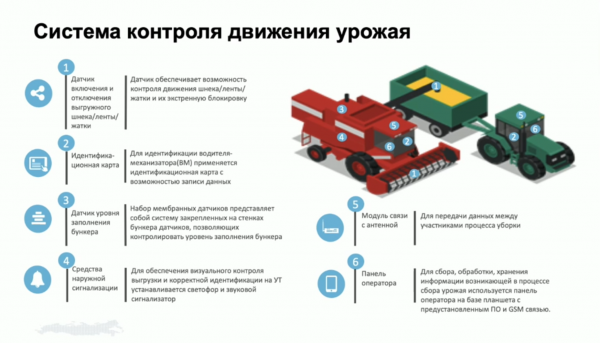
Agriculture was faced with the task of managing the control of crop movement. This means that it was necessary to be able to understand when the combine is being unloaded, when the transport module is being loaded. It is important to note here in advance that the modern harvester is very different from the one that the wolf rode in “Well, wait a minute” - today it is a serious machine equipped with an on-board computer that reports its status and telemetry to the main system. This is already a reality, there are such combines in the Russian Federation, including unmanned models.
Of course, what we are doing now is aimed specifically at the current fleet of vehicles - they are not unmanned, but still quite “smart”, we automate the process of selecting the devices themselves and create a control system for working with devices.
Cattle monitoring
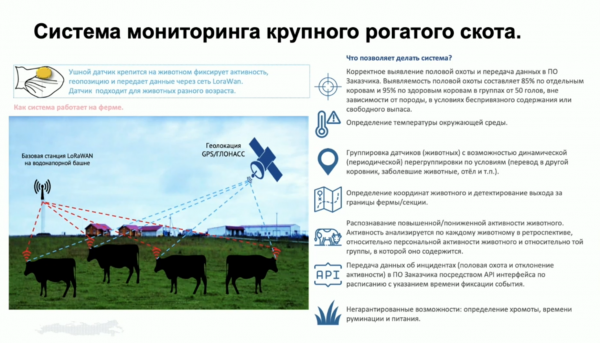
In Rostelecom, together with other companies, we implemented monitoring of cattle. The task of agriculture here was this - there is a need to understand when cows are ready to breed, whether they get sick or not, where exactly they graze. All this is important in order to determine the best moments - to understand whether the cow is ready to mate, or her head hurts, whether it is time to release the bulls or wait, respond in time to the animal's illness, and so on. Such solutions help to control the condition of animals, improve product quality, and monitor profitability.
Why is artificial intelligence here
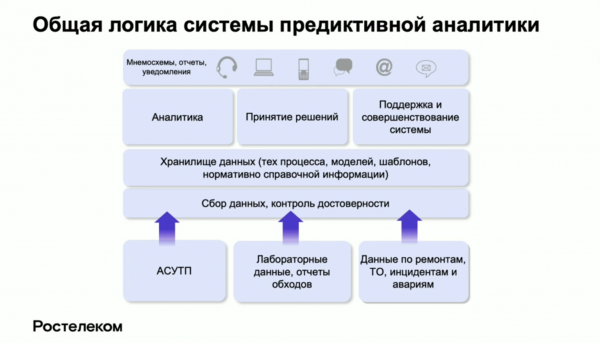
It is not enough just to collect and store data - you need to work with it. This helps predictive analytics scenarios. For example, we have collected data, while we know where and when this data was collected, we add to this volume the calculations of design research institutes, information about production events, including emergency ones, we add basic information about the processes of the industry, it does not matter whether it is energy or agriculture . We normalize this data using mathematics and models. And then we add analytics and a predictive component.
The predictive analytics module looks like this:
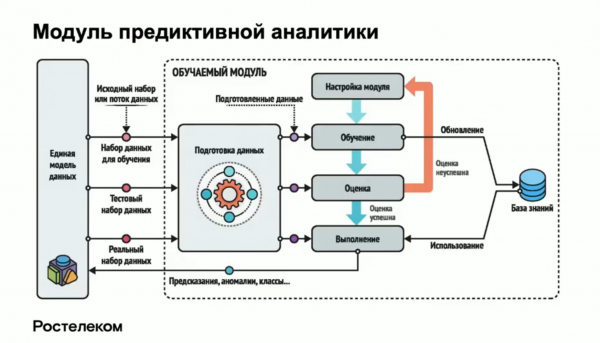
This is the construction of predictive models. There is a loop in which data is modeled and systems in which it is captured. In addition, there are test datasets, training datasets, and, of course, real data. This is an ongoing process, the model needs to be retrained. Now a good indicator for the model is 90% accuracy. The average value so far for most models is 85-87.
During the preparation for the hackathon, participants received questions on the topic.
Do you want to replace existing SCADA with IIoT?
Good question. In fact, the existing SCADA are very different. If we consider the IIoT concept itself, SCADA is suitable for it, like MES systems, they can also be part of the IIoT. This does not mean that they need to be changed, there are several options.
The IIoT platform connects to a ready-made MES or SCADA system.
When there is a high-quality replacement of equipment that does not need SCADA, because it can do all these things quickly at its level.
There is an Edge level where SCADA is designed in a kind of fog version.
That is, SCADA will be replaced by SCADA in the deployed fog, it will be a new Edge-level of the platform, managed centrally, but located at a local point. And in this infrastructure, the solution will be deployed in essence the same SCADA, but in a different control loop.
Therefore, as a SCADA class, it will not go anywhere, it will simply be transformed.
What are the main challenges facing Rostelecom's IIoT now?
Now these are 4 sectors - agriculture, manufacturing, fuel and energy complex and energy. Digitalization of each of the industries is seen as very promising.
The systems for monitoring people at enterprises are interesting - do they work, how well, do they violate regulations. Such cases are very often solved by video analytics or control of machines for which people work, just like the factory from which we took the dataset for tasks. With a similar approach, the plant doubled productivity, simply because they began to look: the machine is idle = it is not being used. And here the point is not that the employees worked so-so, it was just that the processes themselves were arranged in such a way that sometimes there were downtime.
Now kaizen production systems or lean production are relevant; within the framework of the system, the manager needs data to make decisions. We need to collect data from metering devices, we need their visualization. It is not by chance that I talk about visualization so often, it is important because it helps to look at the same data set from different angles.
About the hackathon
In response to the call to get together and write an IIoT solution for real business, we received 434 applications, and as a result, 184 people participated - 35 teams. These are novice developers who have tried their hand in a new area for themselves.
Of these, 33 teams, 174 participants, reached the finish line and presented their projects. We look at the best of them for positions in Rostelecom. everything was.
Video version of the interview .
Source: habr.com
