

The author of the article is Alexey Malanov, an expert in the antivirus technologies department at Kaspersky Lab.
I've heard the opinion that blockchain is really cool, it's a breakthrough, and that it has a future. I hasten to disillusion you if you happen to believe this.
Clarification: in this post, we will discuss the implementation of the blockchain technology used in the Bitcoin cryptocurrency. There are other applications and implementations of blockchain, some of which have addressed certain shortcomings of the 'classical blockchain', but they are typically based on the same principles.
About Bitcoin in general
I consider the Bitcoin technology itself to be revolutionary. Unfortunately, Bitcoin is often used for criminal purposes, which is quite concerning for me as a security specialist. However, when it comes to technology, there is undoubtedly a breakthrough.
All the components of the Bitcoin protocol and the ideas embedded in it were generally known before 2009, but it was the creators of Bitcoin who managed to put everything together and make it work in that year. In nearly 9 years of implementation, only one critical vulnerability was found: an attacker managed to obtain 92 billion bitcoins from one account, and fixing it required rolling back the entire financial history by a day. Nonetheless, having only one vulnerability over such a long period is quite an achievement; I take my hat off to that.
The creators of Bitcoin faced the challenge of making it work under the condition that there is no center and that no one trusts anyone. The authors met this challenge, and electronic money functions. However, the solutions they adopted are horrendously inefficient.
Let me clarify that the aim of this post is certainly not to discredit blockchain. It is a valuable technology that has already found and will undoubtedly find many remarkable applications. Despite its shortcomings, it also has unique advantages. However, in the pursuit of sensationalism and revolution, many focus on the benefits of the technology and often forget to soberly assess the reality, ignoring the drawbacks. Therefore, I think it is useful to consider the disadvantages for a change.

An example of a book where the author places great hopes on blockchain. The following text will contain quotes from this book.
Myth 1: Blockchain is a giant distributed computer.
Quote #1: "Blockchain can become 'Occam's Razor', the most efficient, direct, and natural means of coordinating all human and machine activities, corresponding to the natural desire for balance."
If you haven't delved into , but have only heard feedback about this technology, you might get the impression that blockchain is some sort of distributed computer performing, respectively, distributed computations. That nodes around the world collect together something bigger in bits and pieces.
This perception is fundamentally erroneous. In reality, all nodes serving the blockchain perform exactly the same task. Millions of computers:
- Verify the same transactions according to the same rules. They do identical work.
- Record in the blockchain (if lucky and given the chance to record) the same thing.
- Store the entire history for all time, identical, one for all.
No parallelization, no synergy, no mutual assistance. Just duplication, and that, million-fold. We'll discuss why this is necessary below, but as you can see, there's no efficiency. Quite the opposite.
Myth 2: Blockchain is eternal. Everything recorded in it will last forever.
Quote #2: "In the context of the proliferation of decentralized applications, organizations, corporations, and societies, many new types of unpredictable and complex behaviors resembling artificial intelligence (AI) may emerge."
Yes, indeed, as we have established, every full client of the network stores the entire history of all transactions, and it has already accumulated over 100 gigabytes of data. This is the total capacity of a cheap laptop or the most modern smartphone. And the more transactions are made in the Bitcoin network, the faster the volume grows. A significant portion has appeared in the last couple of years.

Growth of the blockchain volume.
Bitcoin has been fortunate — its competitor, the Ethereum network, accumulated 200 gigabytes in just two years after launch and only six months of active use on the blockchain. So, in today's reality, the lifespan of a blockchain is limited to a few decades — the growth of hard drive capacity is definitely not keeping up with the increase in blockchain volume.
But in addition to needing storage, it also has to be downloaded. Anyone who has tried to use a full local wallet for any cryptocurrency has been surprised to find that they can't make or receive payments until the entire specified volume has been downloaded and verified. You’ll be lucky if this process takes just a couple of days.
You may ask, can we not store all this, since it's the same on every network node? You can, but then, firstly, it won’t be a peer-to-peer blockchain anymore, but a traditional client-server architecture. Secondly, clients will then be forced to trust the servers. In other words, the idea of 'trusting no one', which is part of the reason blockchain was created, disappears in this case.
Bitcoin users have long been divided into enthusiasts who 'struggle' and download everything, and ordinary people who use online wallets, trust the server, and generally aren't concerned about how it works.
Myth 3: Blockchain is efficient and scalable; traditional money will become obsolete.
Quote #3: 'The combination of "blockchain technology + personal of the organism' will enable encoding and making all human thoughts accessible in a standardized, compressed format. Data can be captured through scanning the cerebral cortex, EEG, brain-computer interfaces, cognitive nanobots, etc. Thinking can be represented as chains of blocks, recording almost all of a person’s subjective experience and perhaps even their consciousness. After being recorded on the blockchain, various components of memories can be managed and transferred – for example, for memory restoration in cases of diseases associated with amnesia.
If every node in the network does the same thing, then it is obvious that the bandwidth of the entire network is equal to the bandwidth of one network node. And do you know what it is equal to? Bitcoin can process a maximum of 7 transactions per second—combined.
Additionally, transactions are recorded in the Bitcoin blockchain only once every 10 minutes. After a record is created, it's standard practice to wait another 50 minutes for reliability, because records can often revert spontaneously. Now imagine that you need to buy gum with bitcoins. You’ll just spend an hour at the store, thinking about it.
In the context of the entire world, this is already laughable, considering that Bitcoin is used by barely one in a thousand people on Earth. At this transaction speed, it’s impossible to significantly increase the number of active users. For comparison: Visa processes thousands of transactions per second, and can easily scale its capabilities, as classic banking technologies are indeed scalable.
Even if regular money were to vanish, it would certainly not be because blockchain solutions displaced them.
Myth 4: Miners ensure the security of the network
Quote No. 4: "Autonomous enterprises in the cloud, operating on blockchain and based on smart contracts, could enter into electronic agreements with relevant organizations, such as governments, to independently register under any jurisdiction they wish to operate in."
You’ve probably heard about miners, about giant mining farms that are built near power plants. What do they do? They waste electricity for 10 minutes, ‘shaking’ blocks until they become ‘nice’ and can be included in the blockchain (we explained what 'nice' blocks are and why they need to be 'shaken' in the previous post The amount of electricity consumed is equivalent to what a city of 100,000 residents uses. But add to this the expensive equipment that is suitable solely for mining. The principle of mining (the so-called proof-of-work) is equivalent to the notion of ‘burning humanity’s resources.’
The amount of electricity consumed is equivalent to what a city of 100,000 residents uses. But add to that the expensive equipment specifically designed for mining. The principle of mining (known as proof-of-work) is synonymous with the concept of 'burning humanity's resources.'
Blockchain optimists love to say that miners are not just doing pointless work, but ensuring the stability and security of the Bitcoin network. This is true, but the problem is that miners protect Bitcoin from other miners..
If there were a thousand times fewer miners and a thousand times less electricity was used, Bitcoin would function just as well—still generating one block every 10 minutes, the same number of transactions, and the same speed.
In the context of blockchain solutions, there's a risk of a “.” The essence of the attack is that if someone controls more than half of the total mining power, they can secretly write an alternative financial history in which they never transferred their money to anyone. Then they can present their version to everyone, and that becomes reality. Thus, they have the opportunity to spend their money multiple times. Traditional payment systems are not susceptible to such attacks.
It turns out that Bitcoin has become a hostage to its own ideology. 'Extra' miners cannot stop mining because then the likelihood increases that one person will control more than half of the remaining power. As long as mining is profitable, the network is stable, but if the situation changes (for example, because electricity becomes more expensive), the network may face mass 'double spending'.
Myth 5: Blockchain is decentralized and therefore unbreakable.
Quote #5: 'To become a full-fledged organization, a decentralized application must contain more complex functionality, such as a constitution.'
You might think that since the blockchain is stored on every node in the network, authorities won't be able to shut down Bitcoin if they want to, because there isn't a central server or anything like that—there's no one to come and shut it down. But this is an illusion.
In reality, all 'independent' miners are united in pools (essentially cartels). They have to band together because it's better to have a stable but small income than a huge one that comes once every thousand years.
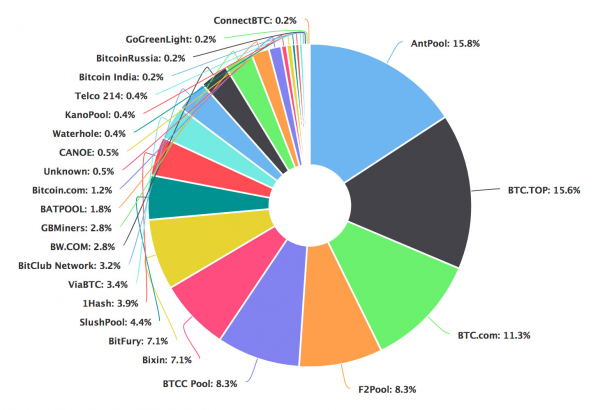
Distribution of Bitcoin power across pools.
As you can see from the diagram, there are about 20 large pools, and only 4 of them control more than 50% of the total power. It is enough to knock on four doors and gain access to four controlling computers to allow you to spend the same bitcoins more than once in the Bitcoin network. As you understand, such a possibility somewhat devalues bitcoin. And this task is quite achievable.
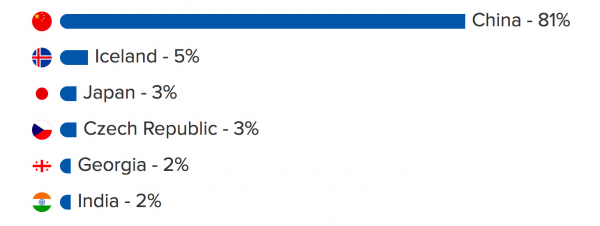
Distribution of mining by countries.
But the threat is even more real. Most pools, along with their computational power, are located in the same country, which makes it easier to potentially seize control over Bitcoin.
Myth 6: Anonymity and transparency of the blockchain are good.
Quote #6: “In the age of blockchain, the traditional 'government 1.0' is becoming an outdated model, creating opportunities to transition from inherited structures to more personalized forms of governance.”
The blockchain is open, everyone can see everything. So, there is no anonymity in Bitcoin; it has 'pseudonymity'. For example, if a criminal demands a ransom to a wallet, everyone understands that the wallet belongs to a bad actor. And since anyone can monitor transactions from that wallet, it will not be so easy for the criminal to use the received bitcoins, because as soon as their identity is revealed, they will be immediately arrested. Almost all exchanges require identification to convert to regular currency.
Therefore, criminals use something called a 'mixer'. The mixer mixes dirty money with a large amount of clean money, effectively 'washing' it. The criminal pays a high fee for this and takes significant risks since the mixer is either anonymous (and could run off with the money) or already under the control of some powerful entity (and could turn the authorities against them).
But let's leave the criminals' problems aside; why is pseudonymity bad for honest users? Here’s a simple example: I transfer a little bitcoin to my mom. After that, she knows:
- How much money I have in total at any moment.
- How much, and importantly, what exactly I spent it on over time. What I bought, which roulette I played, which politician I 'anonymously' supported.
Or if I repaid a friend for a lemonade, then he now knows all about my finances. Do you think this is nonsense? But how about revealing the financial history of your credit card to everyone? Not just the past, but all the future as well.
If this is somewhat acceptable for individuals (after all, some might want to be 'transparent'), for companies it’s lethal: all their counterparties, purchases, sales, clients, invoice amounts, and everything—absolutely everything—becomes public. Financial openness is arguably one of the biggest drawbacks of Bitcoin.
Conclusion
Quote #7: “It’s possible that blockchain technologies will become the overarching economic layer of an organically connected world of diverse computing devices, including wearable computing devices and sensors of the 'Internet of Things.'”
I’ve listed six key criticisms of Bitcoin and the blockchain version it uses. You might ask, why did you hear about this from me and not from someone else earlier? Is it possible that no one sees the problems?
Some are blinded, some simply do not understand, , while some see and realize everything but just find it inconvenient to write about it. Think about it: many of those who bought bitcoins start advertising and promoting them. It’s a kind of . Why write that technologies have drawbacks if you're counting on price growth?
Yes, Bitcoin has competitors who have tried to solve various problems. And although some ideas are very good, the core remains blockchain. Yes, there are also other non-monetary applications of blockchain technology, but the key drawbacks of blockchain persist there as well.
Now, if someone tells you that the invention of blockchain is as significant as the invention of the Internet, take that with a good dose of skepticism.
Source: habr.com
