

After 6 months of development, the postmarketOS 23.12 project, which develops the distribution, has been released Linux for smartphones, based on the Alpine package base Linux, the standard C library Musl and the BusyBox utility suite. The goal of the project is to provide Linux- a smartphone distribution that's independent of the official firmware support lifecycle and isn't tied to the standard solutions of major industry players that set the direction of development. Builds are available for the PINE64 PinePhone, Purism Librem 5, and 29 community-supported devices, including the Samsung Galaxy A3/A5/S4, Xiaomi Mi Note 2/Redmi 2, OnePlus 6, Lenovo A6000, ASUS MeMo Pad 7, and even the Nokia N900. Limited experimental support is provided for over 300 devices.
The postmarketOS environment is as unified as possible and places all device-specific components in a separate package; all other packages are identical for all devices and are based on Alpine packages. Linux. The builds use the vanilla kernel whenever possible. Linux, and if that's not possible, then kernels from firmware prepared by device manufacturers. KDE Plasma Mobile, Phosh, GNOME Mobile, and Sxmo are offered as the primary user interfaces, but other environments, including MATE and Xfce, can also be installed.
In the new release:
- The number of devices officially supported by the community has been increased from 31 to 54. Compared to version 23.06, support has been added for Chromebook laptops, ODROID XU4 board and Xiaomi devices based on the Qualcomm Snapdragon 625 MSM8953 chipset. Due to the lack of a maintainer, support for the ODROID HC2 board has been excluded from the stable release, which remains available in the experimental postmarketOS edge branch.
Added devices:
- Xiaomi Mi A1
- Xiaomi Mi A2 Lite
- Xiaomi Redmi 4 Prime
- Xiaomi Redmi 5 Plus
- Xiaomi Note 4 Redmire
- Xiaomi Redmi S2/Y2
- Google Chromebook with CPU x64
- Google Chromebook
- Google Kukui Chromebook
- Google Oak Chromebook
- Google Trogdor Chromebook
- Google Veyron Chromebook
- Samsung Chromebook
- Samsung Chromebook 2 11.6″
- ODROID XU4
- The package database is synchronized with Alpine Linux 3.19. Core Linux Updated to release 6.6. The iptables-nft package is now used as the default backend for iptables.
- The GNOME Mobile user environment has been updated, which uses an edition of the GNOME Shell, adapted for use on smartphones and tablets with a touch screen. GNOME Mobile components have been migrated to the GNOME Shell 45 branch from Git.
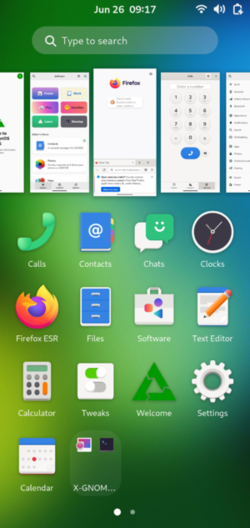
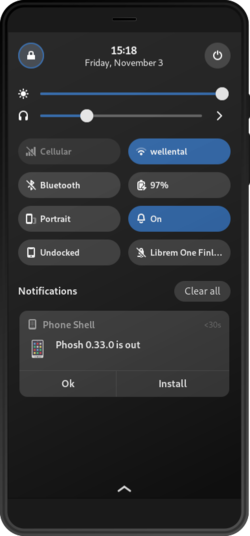
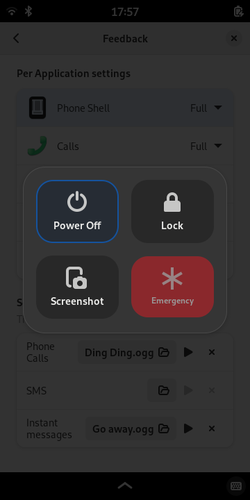
- The Phosh environment, based on GNOME technologies and developed by Purism for the Librem 5 smartphone, has been updated to version 0.33 (previously released 0.26). Compared to the previous release of postmarketOS, Phosh has added an option to show passwords in input fields, included a plugin for controlling screen lock mode, added settings for xdg-desktop-portal, implemented a switch to switch to tablet mode, improved active call notifications, added advanced sound settings, added the effect of gradually hiding system modal dialogs, provided the ability to reboot, end the session and go to sleep mode from the menu, allowed the screen to turn on when notifications arrive, improved work on devices with very small screens, added support for emergency calls, built-in ability to create full-screen screenshots, the screen area used for the front camera has been excluded, a menu has been implemented that is displayed on top of the content when you hold down the power button.
- The KDE Plasma Mobile shell has been updated to version 5.27.10 (previously shipped version 5.27.8), a detailed review of which was published earlier.
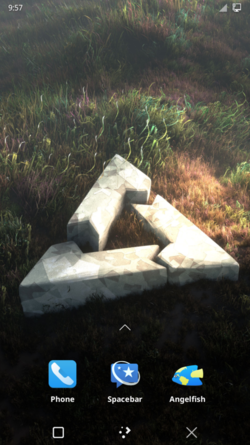
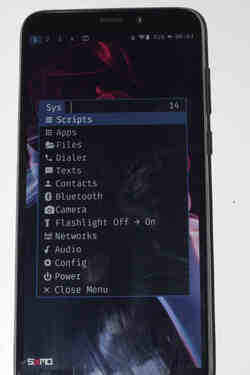
- The graphical shell Sxmo (Simple X Mobile), based on the Sway composite manager and adhering to the Unix philosophy, has been updated to version 1.15, which has been refactored and added support for devices with electronic paper-based screens.
- To unlock settings for encrypted partitions, an interface with a built-in on-screen keyboard unl0kr is used, which replaced osk-sdl and uses output through a framebuffer.
- The default module for organizing network access via USB has been replaced from RNDIS (Remote Network Driver Interface Specification) to NCM (Network Control Model).
- In Phosh and GNOME based environments, the default image viewer is Loupe, instead of the previously supplied Eye of GNOME (EoG).
- Improved reliability of the update process to a new release. Added additional checks for the size of the boot partition and the presence of packages installed via mrtest on the system. Fixed issues with mirrors that do not have the "alpine/" directory in their URL.
- Installation images compiled for PinePhone (Pro), Librem 5 and Pinebook Pro for installation from a microSD card to internal media have been removed (the installer used in these images is not yet ready and it is recommended to use your own pmbootstrap-based assemblies instead).
- It is possible to enable swap partition compression using zRAM technology using the “rc-update add zram-init default” command. In the future, zRAM is planned to be activated automatically.
Source: opennet.ru

