

In the coming hours, four astronauts will reach the closest point to the Moon on the Artemis II mission's trajectory. At 7:41 AM Moscow time this Monday, the Orion spacecraft, carrying them for their lunar flyby, entered the lunar sphere of influence, where the moon's gravity exerts a stronger influence on surrounding celestial bodies than Earth's.
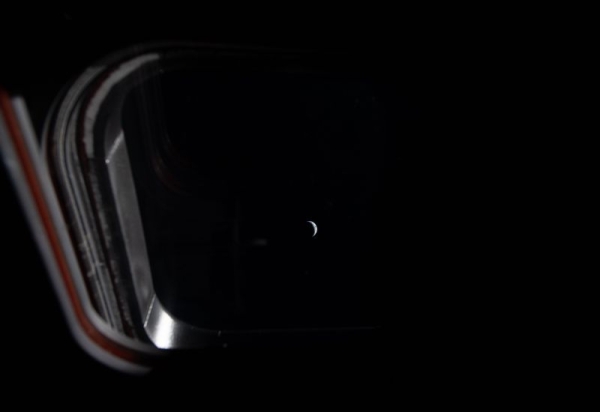
The said boundary, as explained NBC News, is conditional and is not physically felt by the expedition members. Importantly, this barrier was first crossed by humans since 1972, when the Apollo 17 mission was sent to the Moon. A photo of our planet taken by Artemis II astronauts on Sunday from the Orion porthole shows that it is quite far from Earth. By Monday evening, the astronauts will have traveled 406,778 km from their home planet during their current mission—the greatest distance in the history of space exploration, since the crew of Apollo 13 last century managed to travel 400,171 km from Earth.
Moving on to the lunar flyby aboard the Orion spacecraft, astronauts will spend seven hours capturing detailed images of the moon, including areas of the moon's surface never before observed by humans. NASA will broadcast this phase of the mission live. Orion will approach the lunar surface to within almost 6449 km. Two Nikon D5 and Nikon Z9 cameras will be used to photograph the lunar surface.
One of the study sites will be the so-called Orientale Mare, a large crater 966 km in diameter and estimated to be 3,8 billion years old. The slightly smaller Hertzsprung crater will also be visually examined by astronauts during the Artemis II mission. Comparing images of the two craters should help scientists better understand how the Moon's topography has changed over time. A specially developed program will guide the astronauts in the optimal algorithm for collecting photographic data. However, NASA representatives maintain that the expedition members reserve the right to deviate from the intensive research program if they discover anything extraordinary.
By the end of the lunar flyby, the astronauts will be able to observe a solar eclipse for an hour, which will also be used to observe the solar corona and objects impacting the lunar surface on their way from space. The eclipse will also allow the astronauts to take photographs of Mercury, Mars, Venus, and Saturn. Orion's trajectory was calculated so precisely that two scheduled thruster adjustments were not required, and only on Sunday did they burn for 14 seconds to correct the spacecraft's trajectory. Apollo 16 mission member Charlie Duke sent the Orion crew a greeting message, mentioning that in 1972, he and John Young landed on the lunar surface in a spacecraft with the same name, Orion, and the coincidence of the names holds a certain symbolism.
Source:
Source: 3dnews.ru

