

Magic Constants
H - Purity (see Marshak),
B - Balance (see Nash),
MLPP - Materials, people, and process in space (see Mayakovsky, Corbusier).
A fresh graph convolutional neural network will fit in the kitchen. Getting started in molecular cooking has never been easier. It is enough to describe the dish as:
$inline$H = sigma [ hat D ^{-½} hat A hat D^{-½} Dropout {sigma[hat D ^{-½} hat A hat D ^{-½} XW ]}] , $inline $
Where:
 - regularization by zeroing randomly selected parameters - the same 'forgetting' patented by Google,
 is the non-linear activation function
  ,
,
 is the diagonal matrix of degrees of vertices (the number of connections),
 is a diagonal matrix of units,
 is the connectivity matrix,
 is the matrix of vertex properties,
 - weights of the neural network, which we can:
- learn in the learning mode with a teacher;
- fill with randomly selected values;
- throw away (the function will become a little more linear from this).
The author himself considered the mechanics of the work in detail . In addition, step by step and with examples, the method is also considered .
The fact - the introduction to graph theory and the corresponding notation can be refreshed - already wrote.
Now - about the really important. About the preparation of data markers.
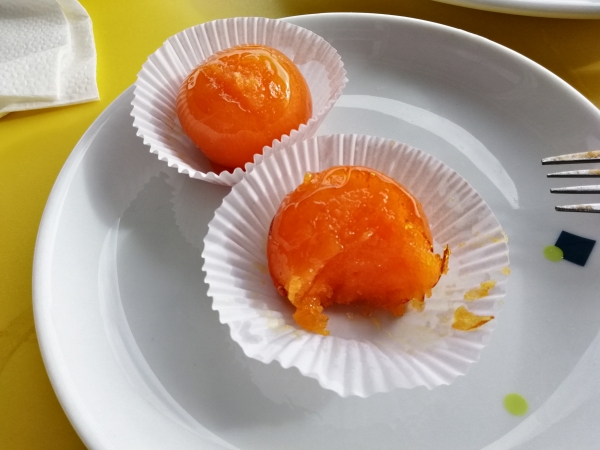
For five years at Nestle, I studied how specially trained people and robots made chocolates from raw materials and packaging. The first acquaintance with the heart of the business came in early spring, when I was implementing SAP-based product data life cycle processes - from idea to exit from the market. Now I am watching the process of preparing Bachelors of Culinary Arts in Lisbon. In the picture above - one of the limits in the cakes - candy with egg cream. Like a Christmas tree toy made of sugar, only stuffed. Chefs are trained here for four years.
I am delighted with what I saw. And since I am posting educational materials here, I will tell you why cooking in Portugal is better to learn than mathematics.
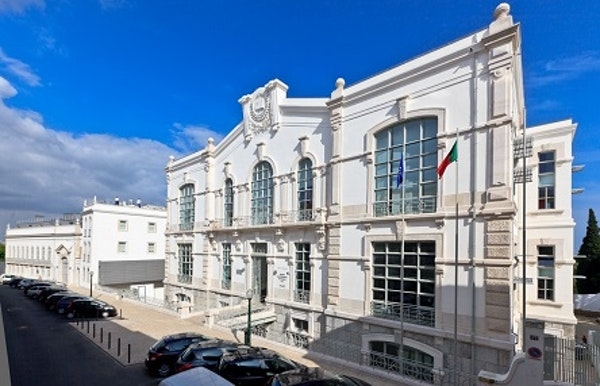
Hogwarts meets with a bas-relief with the inscription 'Work and order'.
This is exactly what the students are looking for. By chance, he was educated in quality and safety and environmental protection of food production - he was responsible in one of the projects for certification of the market (legal entity - a regional unit from two countries - a couple of factories, an office, and even a couple of warehouses) according to all relevant ISO standards and building an internal audit in the world market leader is an interesting experience. Providing a basis for value judgments.
Located in the most fashionable district of Lisbon, the school of tourism and hospitality is a bastion of the right attitude.

What is the point of paying attention to zucchini salad on Habré - ask?
The fact that there are eternal values, like cakes and witty solutions, and the code is fleeting. For example, in a couple of days, the second python will fix the state of development. Increasingly, there is talk of ethics in relation to the application of mathematics, and I believe that confectionery is an excellent field for experimentation in molecular cooking.
One of the discoveries was chocolate mousse with strawberry marmalade. Black caviar with white chocolate is already getting beaten up, but still an impressive combination. In general, fun, sometimes tasty, ethical and AI.
Is it possible to combine math with cooking in Lisbon?
Rather, yes. In self-training mode.
What else is more interesting to drive into your food processor?
There are two tips here - the recently introduced and new , which will only be presented at ICLR 2020.
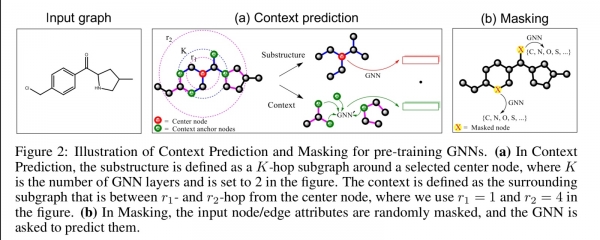
The first one pleases with the fact that it allows you to learn the small details of the relationships of ingredients on publicly available data and learn more about local specifics - these data will have to be collected, studied, prepared, etc. - how a restaurant menu or a technological map for individual dishes is prepared. We considered this work at the recent NeurIPS Lisbon Meetup - the organizers of PyData-Lisbon held it in the format of two days in a row from 14 to 20 - thanks to them for the regular deliveries of stories, cakes, and a pizza dropout.
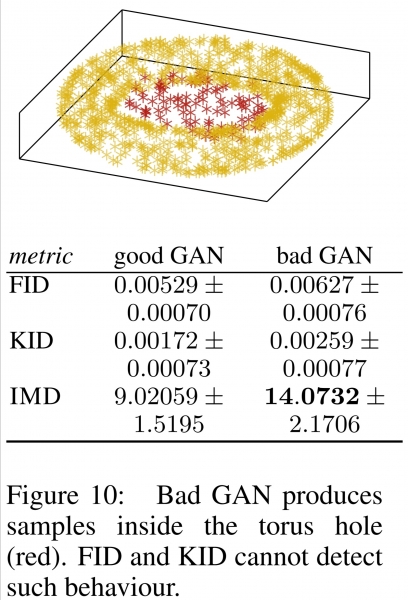
The realm of beauty. It is still unclear how much this measure of distance will accelerate progress in building recipes and technological maps from photography, but the potential is there.
Briefly, a graph can approximate a manifold. Its shape can be learned very accurately by simulating the distribution of heat in the structure.
Mathematics inside - in some places scares, and in general graph theory is rapidly acquiring tools and the choice of algebras is expanding - more and more people are talking about hypergeometry and other spaces. More importantly - the features of the application - not only the oven can be considered as a black box.
The result is that we can better evaluate the recipes that the neural network has generated.
It is known that training neural networks is a tricky engineering discipline. Consumes a lot of data, electricity, and machine hours. So if you haven't yet digitized your grandmother's cookbook to train polished architectures under the screech of throttles, and are still skeptical about algorithmic cooking, then there is an alternative. People in white caps.
If you are not yet ready to give work in the kitchen to robots, and you are already opening a restaurant, then I strongly recommend that you take a closer look at the graduates of this institution. They are cooked right there.
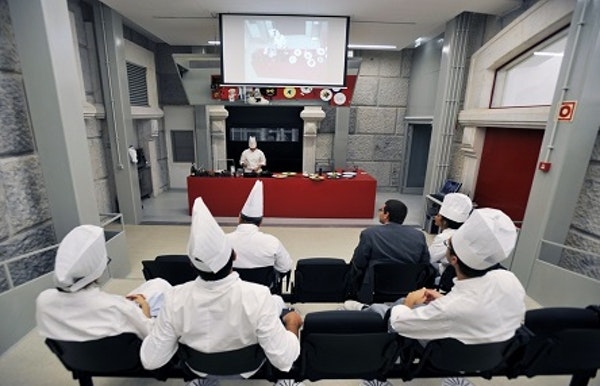
Uniforms are part of the educational experience.
A personal chef (and support staff) has begun to be offered as part of the compensation package, a healthy practice that is thought to keep the employee creative.
Does your employer already do this?
Only registered users can participate in the survey. , you are welcome.
What level of attention does your employer pay to gastronomy?
62,5%Soviet engineer? Walk to the bakery! (no canteen)5
0,0%Personal chef, directors only0
0,0%Personal chef - available even for leading specialists0
0,0%Personal chef - and even for department heads0
0,0%This is the first time I've heard of this practice.
37,5%There is a canteen - stationary3
0,0%There is a canteen - catering (they bring food)0
8 users voted. 3 users abstained.
Source: habr.com
