

Cozystack, a free PaaS platform built on Kubernetes, is now available in version 0.37. The project aims to provide a ready-to-use platform for hosting providers and a framework for building private and public clouds. The platform installs directly on servers and covers all aspects of infrastructure preparation for delivering managed services. Cozystack allows you to launch and provision Kubernetes clusters, databases, and virtual machines. The platform code is available on GitHub and is distributed under the Apache 2.0 license.
Talos is used as the underlying technology stack. Linux and Flux CD. Images with the system, kernel, and necessary modules are pre-built and updated atomically, eliminating the need for components like dkms and a package manager, and ensuring stable operation. A simple installation method is provided in an empty data center using PXE and debian-like talos-bootstrap installer. Within the platform, you can deploy Kafka, FerretDB, PostgreSQL, Cilium, Grafana, Victoria Metrics, and other services with a single click.
The platform includes a free implementation network infrastructure (fabric) based on Kube-OVN, and uses Cilium for service mesh organization and MetalLB for service advertising. Storage is implemented on LINSTOR, which uses ZFS as the underlying storage layer and DRBD for replication. A pre-configured monitoring stack based on VictoriaMetrics and Grafana is included. To launch virtual machines KubeVirt technology is used, which allows you to run classic virtual machines directly in Kubernetes containers and already has all the necessary integrations with the Cluster API for launching managed Kubernetes clusters inside a hardware Kubernetes cluster.
Over the past month and a half, the project team has released new versions 0.36 and 0.37. Changes in these releases include:
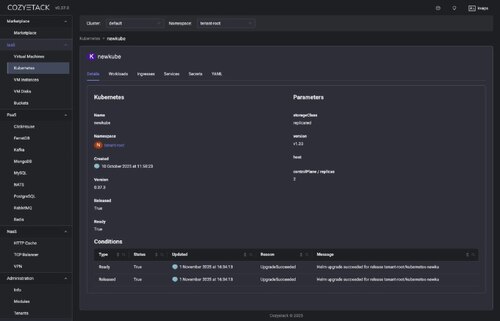
- The user interface has been rewritten from scratch, using the openapi-ui project as a basis.

- A cluster selector has been added to the interface. Currently, the dashboard operates in single-cluster mode (one dashboard per cluster). In the future, this same interface will be used for multi-cluster mode.
- The cluster screen now displays all available namespaces at a glance. The list is generated through the Kubernetes aggregation layer (tenant namespace), so only those namespaces that are accessible are shown.
- Resource creation is now done through forms automatically generated from Kubernetes OpenAPI. YAML comments are no longer required: fields and validation are taken directly from the specifications.
- The specification of new applications is generated from Helm charts using the cozy-values generator, and the fields entered in the form are synchronously reflected in the resulting YAML.
- Tenant management modules have been moved to the administration section: here you can create subtenants and install specific modules/applications for them (access depends on the user's role and rights).
- A VNC console tab for virtual machines is planned for release. Specific tabs/fields will be added for some resource types (e.g., for KubeVirt VMs).
- The resource management mechanism for Cozystack tenants has been stabilized. Platform administrators can now set explicit CPU, memory, and storage limits for each tenant namespace in the tenant specification. This prevents any single tenant from hogging all resources, leaving other tenants without resources.
- The Kube-OVN Plunger component has been added for continuous monitoring of the Kube-OVN network's central management cluster. An external agent collects OVN cluster status and consensus information, displays Prometheus metrics, and streams events via SSE (Server-Sent Events).
- The CoreDNS add-on is now deployed via the Helm chart and configured in the cluster specification (autoscaling, number of replicas, service IP, etc.). CoreDNS can be configured both in the dashboard and via the Cozystack API.
- SeaweedFS-based S3 storage has become more flexible at the component level. The Helm chart allows for independent configuration of each component and its resources: master nodes, volume servers (with multi-zone support), database, and S3 gateway. Administrators can set the number of replicas, CPU/memory limits, and storage capacity for each component.
- SeaweedFS 3.97 has been integrated with support for server-side encryption of S3 buckets (SSE-C, SSE-KMS, SSE-S3). When Cozystack is updated, the SeaweedFS version will be updated, and the service specification will be automatically converted to the new format.
- The NGINX controller is now configurable at the per-replica level: you can set CPU and memory requests/limits directly or choose one of the ready-made presets.
- If a virtual machine has an external IP assigned, it is always used for egress traffic, regardless of the method used to assign that IP.
Source: opennet.ru
