

Servo 0.0.2, the browser engine, and the accompanying demo browser, ServoShell, both written in Rust, have been released. This release is functionally identical to the November 14 nightly build, which has undergone additional manual testing. The final builds are available for download. Linux, Android, macOS и Windows.
The engine was initially developed by Mozilla, but then came under the auspices of the organization Linux Foundation. Servo features support for multi-threaded web page rendering, parallelization of DOM (Document Object Model) operations, and the use of safe programming mechanisms provided by the Rust language. Servo was built from the ground up to support splitting DOM and rendering code into smaller subtasks that can be executed in parallel and more efficiently utilize multi-core CPU resources. Firefox already integrates some parts of Servo, such as the multi-threaded CSS engine and the WebRender rendering system.
Major changes:
- XPath (XML Path Language), AbortController, and AbortSignal support is enabled by default.
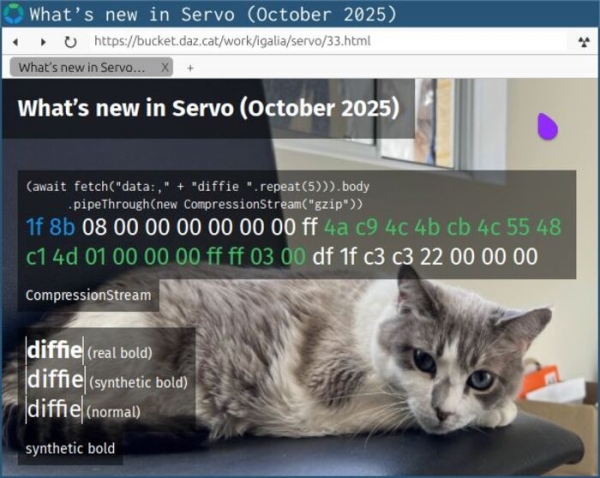
- Added CompressionStream and DecompressionStream APIs for compressing and decompressing data streams.
- Added support for the element inside the blocks And .
- The fetchLater() and Document.parseHTMLUnsafe() methods have been implemented.
- The UIEvent event implements the "which" and "relatedTarget" properties.
- The HTMLMapElement API implements the "name" and "bareas" properties.
- The rendering engine implements synthetic bold, which makes characters thicker programmatically without using a separate font.
- Added vsync support to synchronize the start of rendering with the frame blanking pulse.
- The formation of native arm64 builds of the ServoShell browser has begun macOS.
- In the ServoShell browser prototype for Android An experimental mode has been implemented, enabling experimental features that are not yet fully stabilized and are still in development and are disabled by default. Touch events are now delivered to the touchscreen, and the on-screen keyboard is displayed when input forms are activated by touchscreen events. Pinch-to-zoom support has been added. Scrolling of the on-screen keyboard is now allowed when zooming.
Source: opennet.ru
