

After three months of development, Niri 26.04, a compositing server, has been released. It implements a tiling layout method similar to the GNOME extension PaperWM, grouping windows into an infinitely scrolling ribbon. Opening a new window expands the ribbon, while previously added windows remain unchanged. The project relies on the Wayland protocol but allows running X11 applications using the Xwayland DDX server. The project's code is written in Rust and is licensed under the GPLv3 license. Packages are available for Fedora, NixOS, and Arch. Linux and FreeBSD.
The fundamental difference between Niri and PaperWM is that each monitor is assigned its own window strip, which does not intersect with the strips on other monitors (in PaperWM, separate work with monitors cannot be implemented due to the binding to global window coordinates in GNOME Shell). Niri supports HiDPI and can work on systems with several GPUs (for example, hybrid systems with a discrete video card and an integrated GPU). There is a built-in interface for creating screenshots and recording screencasts, a feature of which is the ability to exclude individual windows with confidential information from recording.
Virtual desktops in Niri are dynamically created and, similar to GNOME, are arranged vertically (the window ribbon rotates horizontally, while the desktop ribbon rotates vertically). Each monitor can display an independent set of virtual desktopsYou can use touchpad gestures to switch between desktops and windows. When you disconnect a monitor, the virtual desktop layout is remembered and transferred to the remaining monitor, and when you return the monitor, it is restored to its original state. Configuration is performed via a configuration file, allowing you to change parameters such as frame width, indents, output modes, and window sizes. Changes made to the configuration file are applied automatically without restarting the composite screen. Server.
In the new version:
- The ability to blur the background of translucent windows has been added. Applications and user environment components can control transparency using the ext-background-effect Wayland protocol, and for programs that don't support this protocol, transparency can be configured via a binding in the configuration file. Built-in background blur support is implemented in the Dank Material Shell and Noctalia shells, the Vicinae launcher, the foot, kitty, and Ghostty terminal emulators, and the Quickshell and winit toolkits. Two background blur modes are available: "xray" (the blur is calculated once and then a predefined static image is inserted) and "normal" (the blur is performed on the fly).
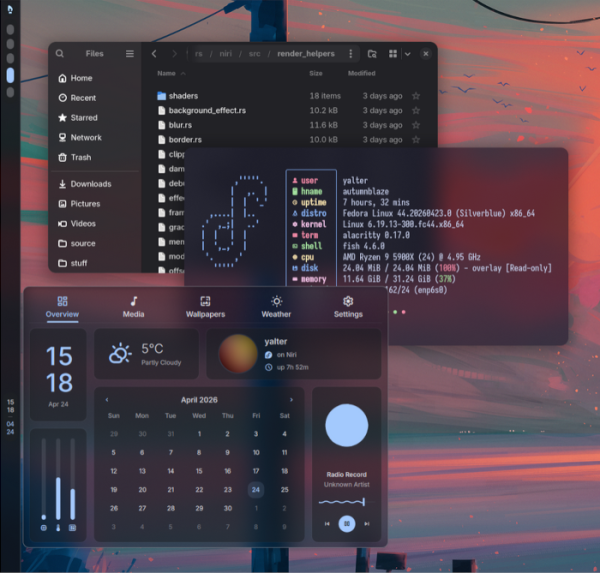
- The "optional=true" option has been added to the "include" configuration file directive, which is used to substitute the contents of other files. This option allows you to specify optional configuration components. If the included file is missing, a warning will be displayed instead of an error if the "optional=true" option is present. Within the configuration, the ability to use the "~/" path associated with the home directory has been added.
- To simplify navigation across multiple windows, similar to Blender, the cursor now automatically jumps from one side of the screen to the other when scrolling horizontally with the mouse across the workspace.
- When recording screencasts, cursor metadata is now sent to PipeWire separately from the video stream, allowing, for example, OBS to draw the cursor independently. Commands have been added to the IPC for monitoring screencast recording, stopping the screencast, and receiving recording start/stop events (to display an indicator in the panel).
- Improved animation of scrolling and opening/collapsing windows.
- Added the ability to cancel a drag&drop operation by pressing the Escape key.
- Improved support for tablets and trackballs.
- GPU profiling capabilities have been expanded using the Tracy package. The ability to track rendering and blur performance has been added. Support for hybrid graphics systems (integrated GPU + discrete graphics card) has been implemented.
- Rendering optimizations have been implemented. Building the list of objects rendered on the screen has been accelerated by 2-3 times on modern systems and up to 8 times on older systems.
Source: opennet.ru

