

Proxmox Virtual Environment 9.0, a specialized Linux-distribution based on Debian GNU/Linux, aimed at deploying and maintaining virtual servers using LXC and KVM, and capable of replacing products such as VMware vSphere, Microsoft Hyper-V, and Citrix Hypervisor. The installation ISO image size is 1.6 GB.
Proxmox VE provides the tools for deploying a fully-fledged, industrial-grade virtual server system managed via a web interface, designed to manage hundreds or even thousands of virtual machines. The distribution has built-in tools for organizing backups of virtual environments and out-of-the-box clustering support, including the ability to migrate virtual environments from one node to another without interrupting operation. Features of the web interface include: support for a secure VNC console; role-based access control to all available objects (VMs, storage, nodes, etc.); support for various authentication mechanisms (MS ADS, LDAP, Linux PAM, Proxmox VE authentication).
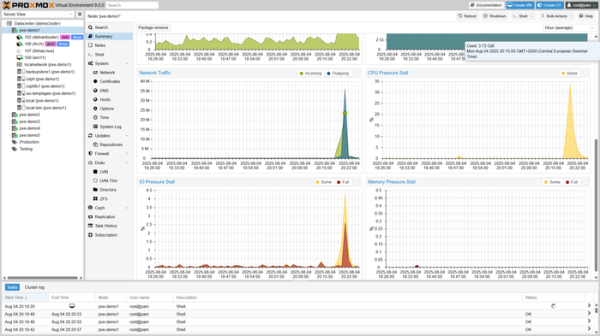
In the new release:
- The transition to the distribution package base has been completed Debian 13, which is expected to be released on August 9. The kernel is enabled by default Linux 6.14. QEMU 10.0.2, LXC 6.0.4, OpenZFS 2.3.3 and Ceph Squid 19.2.3 have been updated.
- A new web interface for mobile devices has been introduced, written in Rust using the Yew web framework. The interface is automatically used when accessed from mobile devices, replacing the standard Proxmox VE GUI, and allows for a quick assessment of the status of guest systems, tasks, storage, and other resources. The mobile web interface can also be used to change basic settings and perform common operations, such as starting and stopping. virtual machines.
- Added support for a new mechanism for creating virtual machine snapshots that can be used with any storage systems that support block storage, including iSCSI and Fibre Channel-based SANs. The functionality is implemented through snapshots as volume chains, in which a volume based on a snapshot stores only the differences compared to the parent volume. Support for volume chain-based snapshots is also available for Directory, NFS, and CIFS storage.
- A new mechanism, "HA affinity rules", is proposed, which allows managing the distribution of virtual machines in a cluster and the placement of resources in fault-tolerant configurations. The mechanism makes it possible to define rules for binding a resource to a specific node or fixing resources between themselves. For example, resources that depend on each other, such as an application server and its associated database, can be placed together on a single physical node to minimize delays in data exchange. On the other hand, for services that require maximum redundancy, it is possible to configure the distribution of processors across different nodes. For example, to ensure fault tolerance, it is possible to configure the launch of virtual machines running the same critical application always on different nodes.
- The Software-Defined Networking (SDN) stack has introduced the SDN Fabric feature, simplifying the setup and management of complex routed networks of interconnected nodes. To improve reliability, SDN Fabric can route inter-node traffic along different routes and automatically handle network card failures. SDN Fabric simplifies the management of dynamically routed networks, which can be used to create a Ceph cluster or as a foundation for building VPN-networks. OpenFabric and OSPF are supported as routing protocols.
- Provided the ability to transparently upgrade from Proxmox VE 8.x branch to release 9.0.
- OpenZFS implements the ability to add new disks to an existing RAIDZ array on the fly, which allows you to increase the storage size without stopping work and without having to create a new group of drives. Redistribution of redundant data taking into account the new disks is carried out automatically.
Source: opennet.ru

