

Google announced ahead of the GDC (Game Developers Conference) that it would be making the Vulkan graphics API official on the platform. AndroidGoogle is working on using Vulkan as the primary GPU abstraction layer (HAL, Hardware Abstraction Layer), recommended for use in GPU-based games and applications. Internal APIs and components such as HWUI, Skia, and WebGPU will also run on top of Vulkan.
Translation work is currently underway Android to a new unified rendering stack based on Vulkan. In the context of game development, Google believes that migrating development to Vulkan will allow for more efficient use of GPU capabilities and performance, allowing for games to create advanced visual effects and utilize features like ray tracing.
Vulkan is supported in Android since 2016 (Android 7.0), but active promotion of this graphics API only began recently, as previously only a small percentage of devices were compatible with Vulkan. This has now changed, and according to Google, the percentage of devices in use that support Vulkan has reached 85%.
OpenGL ES support will be provided in future releases via the ANGLE layer running on top of Vulkan. This year, the ANGLE-based OpenGL ES implementation will be enabled by default, and next year, it will remain the only supported implementation. Android 16, scheduled for Q2 2025, will migrate some new devices to use ANGLE for games and apps that have been verified and whitelisted.
В Android All new devices and most apps will be migrated to ANGLE (instead of a whitelist, a blacklist of apps with issues will be used). The migration requirements to ANGLE will only apply to new devices originally released based on Android 16 or Android 17 (the requirements do not apply to devices that have updated their firmware to new branches).
To achieve seamless Vulkan support across devices, Google introduced the Vulkan Profiles (VPA) system. Android), which define the minimum required Vulkan capabilities that a device must support to be certified by Google and enable new releases. AndroidFor example, VPA for Android 16 mandates support for the basic capabilities of Vulkan 1.3, and VPA for Android 17 will require Vulkan 1.4 support. If the device doesn't meet the profile requirements, it won't be able to use the new branches. Android.

Additionally, it is worth noting the publication of the third beta version of the open mobile platform Android 16. A preliminary testing program has been offered to evaluate the new platform features. Firmware builds have been prepared for the Pixel 6/6a/6 Pro, Pixel 7/7a/7 Pro, Pixel 8/8a/8 Pro, Pixel 9/9 Pro/9 Pro XL/9 Pro Fold, Pixel Fold, and Pixel Tablet devices.
Among the changes in Android 16 Beta 3:
- Pixel 9 devices include support for Bluetooth audio broadcasting (Auracast), which allows one source to be sent to multiple recipients, or one recipient to receive audio from multiple sources (useful for listening to external audio streams, such as airport announcements, on headphones and hearing aids without interrupting other broadcasts).
- A text contrast enhancement mode has been added, which removes the transparency under the text (light text is displayed on a black background, and dark text on a white background). This mode may be useful for people with poor vision.
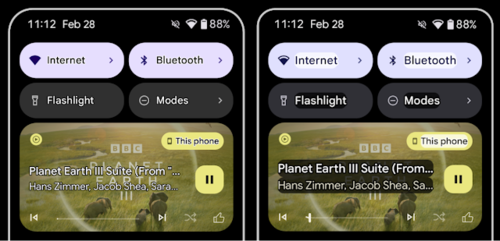
- Testing of the LNP (Local Network Protection) mode has begun, which allows restricting application access to internal intranet subnets (192.168.xx, 10.xxx, etc.) to block attacks on resources in the local network. In the new mode, in addition to having "INTERNET" permissions, the application will have to obtain separate access confirmation from the user.
Source: opennet.ru

